Cost Per Lead
Measure the cost-effectiveness of your lead generation campaigns.
Cost Per Lead
Cost per lead (CPL) measures how much you spend to acquire a single lead from a marketing campaign. It tells you which channels are generating interest efficiently and which are draining budget without results.
Tracking CPL gives you a clear read on where your marketing dollars are working. When you know the cost of each lead by channel, you can shift budget toward what performs and stop funding what doesn't. That clarity is the difference between guessing and deciding with confidence.
What is Cost Per Lead?
Cost Per Lead (CPL) is a marketing metric that calculates the average spend required to generate one lead. A lead is a person who has expressed interest in your product or service by completing an action: filling out a form, subscribing to a newsletter, or downloading a resource.
Cost Per Lead examples
CPL applies across every major marketing channel. Here are six common scenarios:
Social media advertising: A fitness brand runs a Facebook campaign offering a free workout guide. The campaign costs $1,000 and generates 200 downloads, resulting in a CPL of $5 ($1,000 / 200 leads).
Pay-per-click (PPC) campaigns: A real estate agency invests $3,000 in Google Ads targeting homebuyers. The campaign brings in 150 inquiries, making the CPL $20 ($3,000 / 150 leads).
Email marketing: A SaaS company spends $500 on an email campaign offering a free product trial. Twenty-five users sign up, making the CPL $20 ($500 / 25 leads).
Event marketing: A business spends $2,500 hosting a webinar. One hundred attendees register in advance, making the CPL $25 ($2,500 / 100 leads).
Influencer marketing: A skincare brand pays $2,000 for an influencer to promote a free consultation. The campaign generates 400 sign-ups, resulting in a CPL of $5 ($2,000 / 400 leads).
Content marketing: A B2B company spends $800 producing a whitepaper and promotes it via LinkedIn ads. Forty professionals download it, making the CPL $20 ($800 / 40 leads).
CPL vs. CPA (Cost Per Action)
While CPL measures the cost of acquiring a lead, CPA (Cost Per Action) measures the cost of a specific completed action, such as a purchase, subscription, or app download.
CPL evaluates the early stages of the customer journey. CPA reflects the final stages, closer to conversion.
For example: if you spend $2,000 to generate 100 leads, your CPL is $20. If only 10 of those leads make a purchase, your CPA is $200 ($2,000 / 10 actions).
CPL is best for campaigns focused on building a pipeline. CPA is better for evaluating completed transactions. Tracking both gives you a complete picture of funnel performance and return on investment.
Cost Per Lead formula
The CPL formula is:
CPL = Total Campaign Cost / Number of Leads Generated
Two inputs drive this calculation:
Total campaign cost: Every dollar spent on the campaign, including ad spend, creative production, software subscriptions, and agency fees. If you spent $1,500 on ads and $500 on design assets, your total campaign cost is $2,000.
Number of leads generated: The total count of people who completed the desired action. Track this accurately using a CRM, ad platform reports, or an analytics tool.
The result is the average cost of acquiring one lead. Monitor both inputs consistently across campaigns to make meaningful comparisons.
What is a good CPL?
A good CPL depends on your industry, audience, and campaign objectives. There is no universal benchmark, but context matters:
SaaS: $20 to $50 per lead is often reasonable, given longer sales cycles and higher contract values.
E-commerce: $5 to $15 is a more typical target, where margins are tighter.
Finance and real estate: Higher CPLs can be justified because customer lifetime value is significantly larger.
The real test is whether your CPL fits within your customer acquisition cost (CAC) goals while still leaving room for a healthy return on marketing investment. A low CPL means nothing if the leads don't convert.
Common causes of high CPL and how to lower it
High CPL drains your budget without delivering proportional results. Most causes are fixable once you know where to look.
Targeting the wrong audience
Broad or poorly defined targeting produces clicks from people unlikely to convert. Campaigns aimed at audiences that are too large or too diverse dilute relevance and waste spend.
What you can do:
Analyze your customer data to identify the traits of your highest-value leads, then build campaigns around those profiles.
Use tools like GA4 or Meta Audience Insights to pinpoint the demographics, interests, and behaviours that drive conversions.
Test narrow audience segments first, then expand once you've confirmed which groups perform best.
Use lookalike audiences modelled on your existing customers to reach similar prospects.
Create custom dashboards for you and your team.
Get started with KlipsIneffective ads
Weak visuals, generic copy, or messaging that doesn't address customer pain points leads to low engagement and wasted impressions.
What you can do:
Lead with a clear value proposition. Tell the audience exactly what they'll get and why it matters to them.
Use high-quality visuals and a strong headline that communicates the offer within the first few seconds.
Include a specific call to action: "Get your free guide" performs better than "Learn more."
Test multiple ad formats (carousel, video, static image) to find what resonates with your audience.
Review click-through rates and conversion rates regularly to identify underperforming creatives.
A poor landing page
Effective ads can't compensate for landing pages that fail to convert. Slow load times, cluttered layouts, or messaging that doesn't match the ad all increase drop-off.
What you can do:
Match the landing page message directly to the ad. If the ad promises a free guide, the landing page should lead with that offer.
Reduce friction in the form: ask only for the information you need.
Use Google PageSpeed Insights to identify and fix performance issues, especially on mobile.
Add social proof: testimonials, case studies, or trust badges build credibility and reduce hesitation.
Run A/B tests on headlines, layouts, and CTAs to find the highest-converting combination. Landing page optimization is one of the most reliable ways to reduce CPL without increasing spend.
Overly broad campaigns
Campaigns targeting all age groups, devices, or locations simultaneously often produce irrelevant clicks and inflated costs.
What you can do:
Narrow targeting to the demographics, interests, and behaviours that align with your ideal customer profile.
Break campaigns into focused ad groups so you can tailor messaging and bids for each segment.
Use dayparting to show ads when your audience is most active.
Review past campaign data to identify the most profitable combinations of location, device, and time.
Not using retargeting
Spending all your budget on cold audiences means paying full price for leads who require more nurturing. Retargeting re-engages people already familiar with your brand, which typically converts at a lower cost.
What you can do:
Set up retargeting campaigns for users who visited your site, viewed specific pages, or engaged with previous ads.
Use dynamic retargeting to show personalized ads featuring the exact products or content users previously viewed.
Offer an incentive: a discount, free trial, or exclusive resource to encourage retargeted users to take the next step.
Exclude users who have already converted to avoid wasting spend on completed actions.
Poor budget allocation
Leaving budget in low-performing campaigns while underfunding high-performers drives up average CPL across the board.
What you can do:
Review campaign performance regularly and shift budget toward the campaigns delivering the best results.
Use automated bidding strategies like Target CPA or Maximize Conversions to let the platform allocate spend more efficiently.
Set daily or lifetime budget caps to prevent overspending on any single campaign.
Lack of A/B testing
Without testing, you're guessing which elements drive results. Small changes to headlines, CTAs, or form fields can have a significant impact on CPL.
What you can do:
Test one variable at a time: ad creative, headline, CTA, or landing page layout. Measure the impact before moving on.
Use statistical significance as your threshold before declaring a winner and scaling the change.
Apply the same testing discipline to audience segments and bidding strategies, not just creative.
Inefficient bidding strategies
The wrong bidding approach can result in overpaying for clicks that don't convert, or underbidding on high-value placements.
What you can do:
Align your bidding strategy to your campaign goal. Use Target CPA for lead generation; use Maximize Conversions for broader awareness campaigns.
Adjust bid modifiers for device, location, and time of day based on where conversions are most likely.
Monitor cost per click and conversion rates together to identify where bid adjustments will have the most impact.
Track CPL and improve your marketing ROI
Cost Per Lead tells you how efficiently your campaigns generate interest. A low CPL means your targeting, creative, and landing pages are working together. A high CPL is a signal to investigate, not a reason to increase the budget.
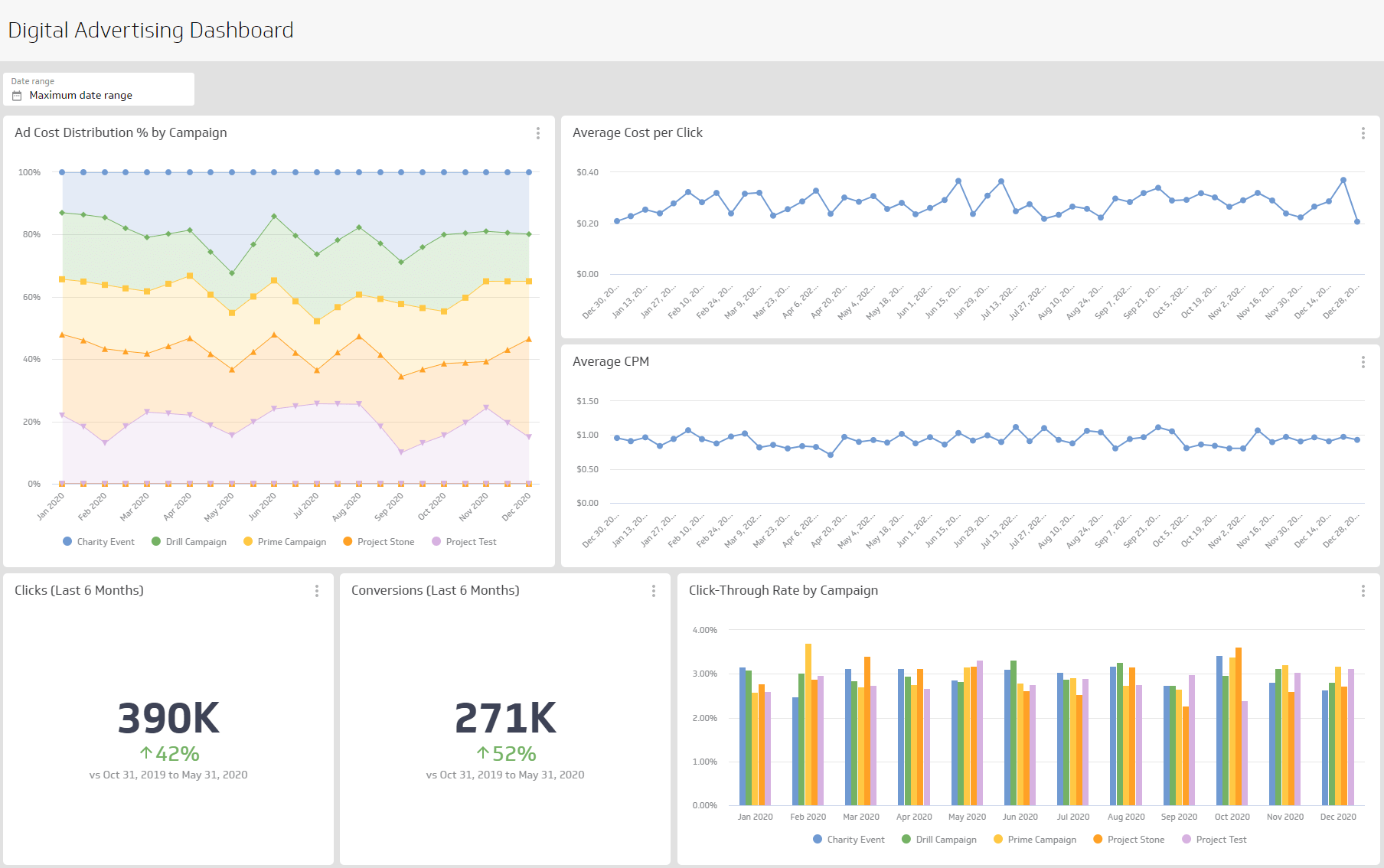
The most effective way to manage CPL is to track it consistently alongside related marketing metrics like CAC and ROI, and to know those numbers without having to chase them down. Pasting figures into a spreadsheet or asking an AI tool to interpret numbers it has never seen before adds friction and introduces error. Klipfolio pulls your marketing data into real-time dashboards that keep CPL visible across every channel, so you always know where you stand without waiting on someone to pull a report.