End Action Rate
Measure how effective marketing campaigns are by monitoring the last action taken by your audience.
End Action Rate by outcome
- Bounced48%
- Browsed multiple pages22%
- Contact form submitted17%
- Social engagement8%
- Converted5%
What is End Action Rate?
End Action Rate is a marketing KPI that measures the last action a campaign visitor takes on your website, capturing both goal completions and secondary outcomes like bounces or social engagements.
Unlike Goal Conversion Rate, which tracks a single desired outcome, End Action Rate gives you a fuller picture of how a campaign lands. A visitor who doesn't convert still tells you something. Whether they bounced immediately, browsed several pages, or submitted a contact request, each of those endings reveals whether your campaign is resonating or falling flat.
For marketing leaders who need to know what's actually working, End Action Rate answers a question that conversion data alone can't: what did people do when they got there?
How End Action Rate works
Every campaign sends people somewhere, usually a landing page. What happens next is the signal. End Action Rate captures the full distribution of those outcomes, not just the wins.
A banner ad campaign might drive traffic to a product page. Some visitors convert. Others request more information. Many leave without taking any action. End Action Rate accounts for all of these, so you can see whether the campaign generated meaningful engagement even when it didn't generate a sale.
This matters because many prospects aren't ready to commit on a first visit. A campaign that produces high bounce rates and little secondary engagement is telling you something different than one where visitors browse, click through, and request contact, even if neither produces a purchase that day.
Key terms
End action: The last interaction a campaign visitor has with your website before leaving.
Lead: A new prospect generated by a marketing campaign.
Win: A new customer generated by a marketing campaign.
How to calculate End Action Rate
The formula depends on which end action you're measuring. For a specific outcome:
End Action Rate = (Number of sessions ending in a specific action / Total campaign sessions) × 100
For example, if a campaign drives 2,000 visits and 340 of those sessions end with a contact form submission:
End Action Rate = (340 / 2,000) × 100 = 17%
Run this calculation separately for each outcome type, conversions, contact requests, bounces, and social engagements, to see the full breakdown of how your campaign is performing.
What a healthy End Action Rate looks like
There's no universal benchmark because End Action Rate is relative to your campaign goals and audience. What matters more than a single number is the pattern across outcomes.
Strong signals include:
- High lead or win rate: Visitors are completing the primary goal.
- Positive secondary engagement: Contact requests, social interactions, or multi-page browsing suggest the campaign is building interest even without an immediate conversion.
- Low bounce rate: Visitors are finding what they came for and staying long enough to engage.
Watch for:
- High bounce rate paired with low secondary engagement: This combination suggests a mismatch between the campaign creative and the landing page experience.
- No secondary engagement at all: If visitors aren't converting and aren't doing anything else either, the campaign isn't resonating.
Why End Action Rate matters for campaign decisions
Conversion data tells you what worked. End Action Rate tells you why something didn't, and what to do about it.
If you're only measuring goal completions, you're missing the context that explains your results. A campaign with a 3% conversion rate looks identical to another 3% campaign on the surface. End Action Rate separates the one where 60% of non-converters bounced immediately from the one where 40% requested more information and another 20% engaged on social. Those two campaigns need very different follow-up actions.
For leaders reviewing campaign performance without pulling raw data themselves, End Action Rate surfaces the story behind the numbers. You can see at a glance whether a campaign is building pipeline, missing the mark on the landing page, or reaching the wrong audience entirely.
Create custom dashboards for you and your team.
Get started with KlipsHow to track End Action Rate
Once you've defined which end actions matter for a given campaign, the next step is making sure you're seeing them consistently, not just when you go looking.
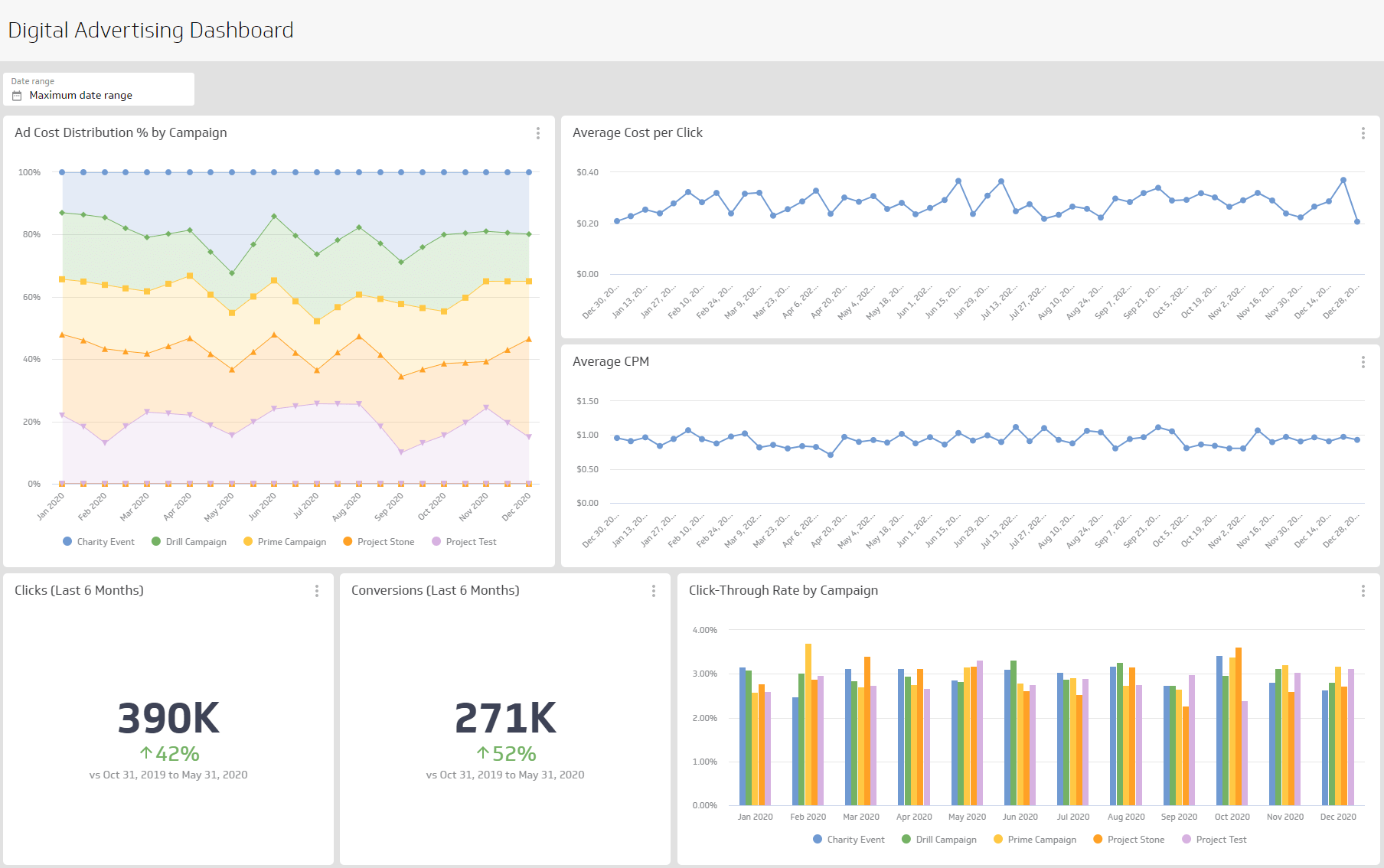
A Digital Marketing Dashboard keeps End Action Rate and related digital marketing KPIs in one view, updated automatically, so your team isn't piecing together results from separate tools or pasting numbers into a spreadsheet after the fact. When the data is always current and always visible, you catch underperforming campaigns early enough to act on them.