Unsubscribe Rate
Unsubscribe Rate is the percentage of email subscribers who opt out after receiving a campaign. Track it to keep your list healthy, protect your sender reputation, and catch content or frequency problems early.
Unsubscribe Rate
Unsubscribe Rate is the percentage of email subscribers who opt out after receiving a campaign. A high rate signals a mismatch between what you promised and what you delivered.
It is one of the most important email marketing metrics to watch because it tells you, quickly and honestly, whether your emails are earning their place in someone's inbox.
What is Unsubscribe Rate?
Unsubscribe Rate is the percentage of recipients who opt out of your email list after a given send. It measures disengagement at its most decisive: the subscriber did not just ignore your email, they actively left.
Tracking this metric keeps your list healthy, protects your sender reputation, and gives you a clear signal when your content or frequency needs to change.
What is a good Unsubscribe Rate?
An Unsubscribe Rate at or below 0.5% is generally considered healthy. Below 0.2% is excellent. Above 0.5% is a signal worth investigating.
A few factors affect what "good" looks like for your list:
- List age: Newer lists tend to have higher rates. Subscribers are still deciding whether your emails are worth keeping.
- Send frequency: Higher-volume senders often see more churn, especially when content is not tightly relevant.
- Industry and audience: B2B lists often behave differently from consumer lists. Benchmark against your own trend, not just a generic average.
- List source: Organically grown lists almost always outperform purchased ones.
The number that matters most is your own trend over time. A stable or declining Unsubscribe Rate means you are building trust. A rising one means something has shifted.
Unsubscribe Rate formula
Unsubscribe Rate = (Number of unsubscribes / Number of emails delivered) × 100
Use emails delivered, not emails sent, to account for bounces. That gives you a cleaner read on how your active audience is responding.
How to calculate Unsubscribe Rate
Example 1: You send a campaign to 10,000 subscribers. 200 people unsubscribe.
(200 / 10,000) × 100 = 2.0%
A 2% Unsubscribe Rate is well above the healthy threshold. That campaign is worth a close look: the content, the audience segment, or the send timing may be off.
Example 2: You send to 15,000 subscribers and 50 unsubscribe.
(50 / 15,000) × 100 = 0.33%
A 0.33% Unsubscribe Rate sits in a healthy range. Most of your audience found the email worth keeping.
The difference between these two campaigns is not just a number. It is the difference between an audience that trusts you and one that is tuning you out.
Why Unsubscribe Rate matters
A rising Unsubscribe Rate costs you more than list size. It erodes the deliverability and domain reputation that determine whether your future emails reach anyone at all. Inbox providers treat high unsubscribe activity as a signal that your emails are unwanted, which can push you into spam folders even for subscribers who do want to hear from you.
More practically: every unsubscribe is a person who decided your emails were not worth their time. That is a decision you can usually prevent.
Waiting until your rate spikes to investigate is the wrong approach. Monitoring it regularly, alongside open and click-through rates, tells you whether your relationship with your list is getting stronger or weaker, before it becomes a deliverability problem.
How to reduce Unsubscribe Rate
Create custom dashboards for you and your team.
Get started with KlipsSegment and personalize your sends
Generic emails feel like noise. When a subscriber receives content that clearly matches their interests or behaviour, they are far more likely to stay. Segment your list by purchase history, engagement level, role, or lifecycle stage, and tailor your messaging accordingly.
Personalization does not require complex tooling. Even simple segmentation, separating active subscribers from dormant ones, or splitting by product interest, produces measurably better retention.
Get the frequency right
Too many emails is the most common reason people unsubscribe, even from brands they like. If a subscriber signed up for a weekly digest, a daily send feels like a breach of trust.
Ask subscribers what they want at sign-up. Give them frequency options. Then honour those preferences. A preference centre is a small investment that pays for itself in list retention.
Collect feedback before people leave
Do not wait for an unsubscribe to find out what went wrong. Periodic surveys, or a simple exit question on the unsubscribe page itself, tell you what is not landing. Ask about content relevance, send frequency, and what would make the emails more useful.
You can run quick polls on social media or use survey platforms to reach your list directly. The goal is to understand the gap between what subscribers expected and what they are getting.
Clean your list regularly
Keeping disengaged subscribers on your list inflates your send volume without adding value. Worse, it drags down your engagement rates and can trigger spam filters.
Remove confirmed unsubscribes promptly. Identify subscribers who have not opened in six to twelve months and either run a re-engagement campaign or let them go. A smaller, engaged list outperforms a large, indifferent one every time.
Never use a purchased email list
People on a purchased list did not choose to hear from you. Many will unsubscribe from your emails immediately, and some will mark you as spam. Both outcomes damage your sender reputation and can affect deliverability for your entire list.
Grow your list organically. Use opt-in forms, gated content, and referral incentives. Subscribers who choose to hear from you are far more likely to stay.
Understand why people leave
Research consistently shows that the most common unsubscribe triggers include:
- Too many emails: Volume fatigue is the leading cause, even among engaged subscribers.
- Irrelevant content: Emails that do not match the subscriber's interests or current situation lose attention fast.
- Unrecognized sender name: Subscribers who do not immediately recognize who the email is from are more likely to unsubscribe or report spam.
- Bait-and-switch sign-up: Subscribers who opted in for a specific offer and then received unrelated content feel misled.
Knowing these patterns helps you design campaigns that avoid the most common exit points before they become a trend in your data.
How to track Unsubscribe Rate
Most email platforms, including Mailchimp, HubSpot, and Klaviyo, report Unsubscribe Rate automatically at the campaign level. That is a useful starting point, but campaign-level data alone does not show you the trend.
To make this metric actionable, track it over time and alongside related signals: open rate, click-through rate, and spam complaint rate. When Unsubscribe Rate rises while open rate holds steady, the problem is likely content or frequency. When both drop together, the issue is often deliverability or list quality.
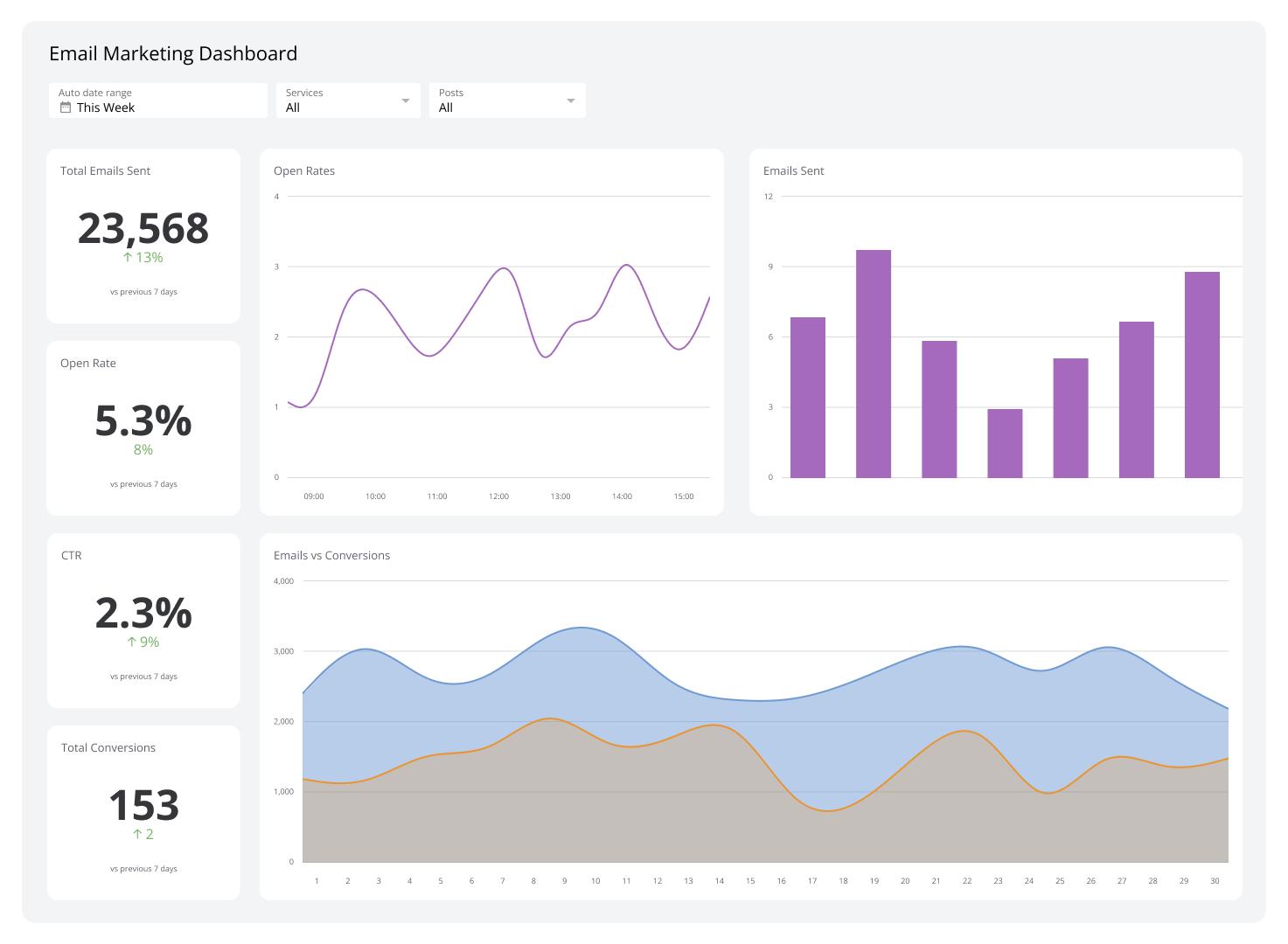
Pulling these metrics into a single dashboard means you see the full picture without chasing numbers across platforms. Klips connects to your email platform and surfaces Unsubscribe Rate alongside the metrics that give it context, so you know what is happening and what to do about it, without waiting for someone to pull a report.