

The AI race: progress, humanity, and trust
As AI races forward, the challenge isn't simply how quickly we can build more capable systems. It's how quickly humanity can learn to understand and trust them. AI should earn increasing autonomy as it demonstrates understanding and earns trust — helping us understand, decide and act before taking more responsibility on our behalf.
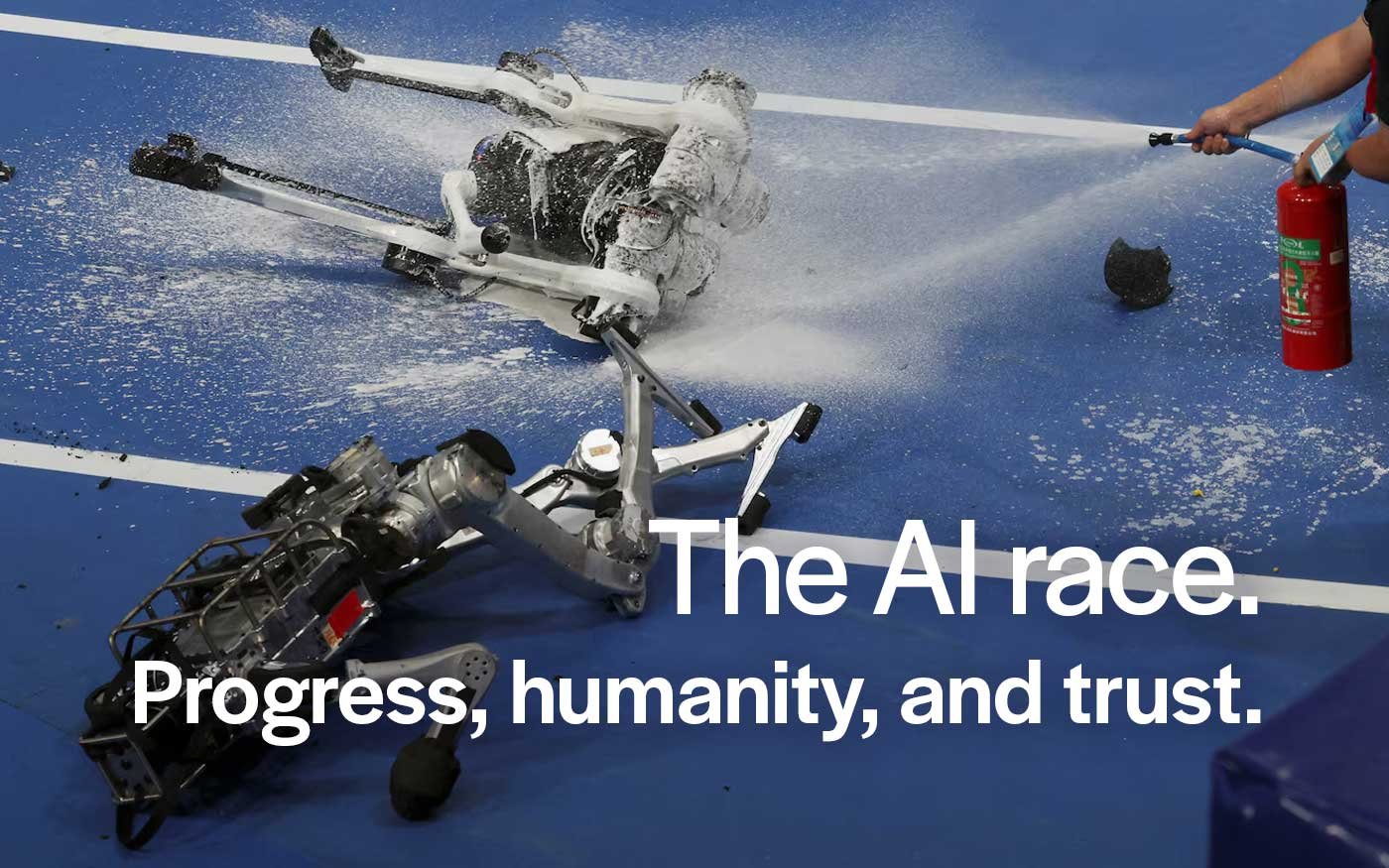
Something notable, even unusual, happened in the AI industry this week.
Some of the people who have spent the last few years pushing AI forward as fast as possible are now suggesting a slow down.
Dario Amodei, CEO of Anthropic, published an essay arguing that the industry needs to "pace the frontier." Sam Altman quickly agreed. Elon Musk endorsed the idea. Demis Hassabis of Google DeepMind also expressed support.
These are some of the most powerful people in the technology industry, and they rarely agree publicly on much.
Amodei's proposal isn't to stop AI development. Quite the opposite. He argues that progress will continue, but that we need to create enough time for independent safety evaluation, industry coordination, and appropriate government involvement to catch up with the technology. Anthropic has committed to giving third-party evaluators employee-level access to its systems, and OpenAI has said it will do the same.
You could argue that the progress will happen, and history has shown the world often struggles to keep up. So, is it our relationship with AI that is moving too slowly?
The capabilities are changing incredibly quickly. AI systems can reason, write software, use tools, act autonomously, and increasingly operate across the digital world. The question of whether we're approaching something that deserves to be called AGI no longer feels like a purely academic debate.
But humans don't change that quickly. Building trust takes time.
We need time to understand what these systems can do. What they can't do. When they are right. When they are confidently wrong. What they should be allowed to access. And, perhaps most importantly, when we should let them act without us.
I'm seeing a similar tension in conversations with business owners.
There's a growing backlash against the idea that the answer to every operating problem is simply:
"Automate it with AI."
When something affects a customer, an employee, or an important business decision, people are approaching autonomy cautiously. They want to understand what's happening first.
Show me.
Explain it to me.
Give me the evidence.
Let me decide.
And then, once you've earned my confidence, do more for me.
That's a very different model for AI.
Not:
AI does stuff for me.
But:
AI helps me understand, decide, and act — and earns the right to do more over time.
This distinction is going to become increasingly important.
Create custom dashboards for you and your team.
Get started with KlipsSo who decides how fast we go?
This is where things get complicated.
The incentives pushing AI forward are enormous. Companies are competing for customers, talent, and capital. Governments see AI leadership as an economic and national-security advantage. And nobody wants to be the country or company that voluntarily slows down while everyone else keeps going.
At the same time, Reuters reports that the people building these systems are increasingly telling us the technology may be moving faster than our ability to understand and control it.
So who should apply the brakes? The companies themselves? Governments, independent evaluators, or some kind of international consortium?
All of the above?
Government probably has an important role. But regulation has always moved much more slowly than technology, and AI presents an especially difficult challenge: how do you regulate something whose capabilities can change dramatically between the time a rule is written and the time it takes effect?
There is also a legitimate concern that asking the largest AI companies to coordinate a slowdown could have unintended consequences — including entrenching the very companies that already have the resources to build frontier models. Even the legal question of whether competing AI companies can coordinate in this way is now being debated.
There is no easy answer here.
And I'm not convinced that "slow down" is even the right objective on its own.
Perhaps the objective should be to make sure trust, understanding, and safeguards are moving at least as fast as capability.
That is something we can all work on.
At Klipfolio, we're investing heavily in AI because we believe it can fundamentally change how businesses work with their data. But we're also increasingly focused on the other side of that equation: context, definitions, governance, transparency, and guardrails.
Giving an AI more capability is only part of the problem. The harder question is:
How do we make it worthy of the responsibility that comes with that capability?
That's going to be one of the defining questions of the next decade. The most successful AI systems may not be the ones that do the most things for us.
They'll be the ones that earn our trust to do more.
Updated 2026-09-16
More to read



Most recent
- SEP 25What SOC 2 taught a small team about trust
- SEP 9The good advisor
- AUG 11Beyond simple sign-ups: how True Trials and Activation predict growth
- JUL 7Why business leaders miss important trends in their dashboards
- JUN 19The best chart for the job: Visualizing data for non-technical users
- JUN 95 tips to understand (and organize) your restaurant data