
It's time to ask better questions about your business
Leaders can now ask a real question about the business and get a useful answer without hiring a data team. This post explains how reporting is shifting from building dashboards to understanding the business, why shared definitions and team knowledge matter more as AI answers questions, and what growing companies should put in place now to trust their numbers and decide with confidence.
The best time to ask better questions about your business is now, because tools can finally combine your numbers with what your team knows.
For two decades, getting answers from your data meant building things: dashboards, reports, data models. The work was expensive and the expertise was scarce, so the best answers went to companies with dedicated data teams.
That is changing. More leaders can now ask a real question about the business and get a useful answer, without hiring a data team first. The leaders who benefit most will do more than look at numbers. They will pair their data with what their company already knows.
From building reports to understanding your business
The tools used to compete on who could build the best dashboard: cleaner charts, faster load times, more chart types. The dashboard was the product.
The next stretch looks different. The goal is to help you understand what the numbers mean, trust them, and decide what to do next. A dashboard is still how the answer reaches your team. It is just no longer the whole point.
That shift is bigger than it sounds. The value no longer sits inside a report. It shows up when you share a number with your team and nobody argues about it, and when a trend finally makes sense.
We're moving from an era of building reports to an era of understanding the business.
Data tells you what happened; knowledge tells you why
Your numbers answer "what happened?" Revenue is up 12%. Churn ticked up in March. Pipeline is thinner than last quarter.
They can't tell you why. The "why" lives in your team's heads, past meeting notes, and decisions made months ago: the big customer who pushed a renewal, the price change in February, the reason you stopped selling to a certain market.
Good decisions need both. Data without knowledge gives you a number with no context. Knowledge without data gives you a strong opinion with nothing to check it against.
What is a company brain?
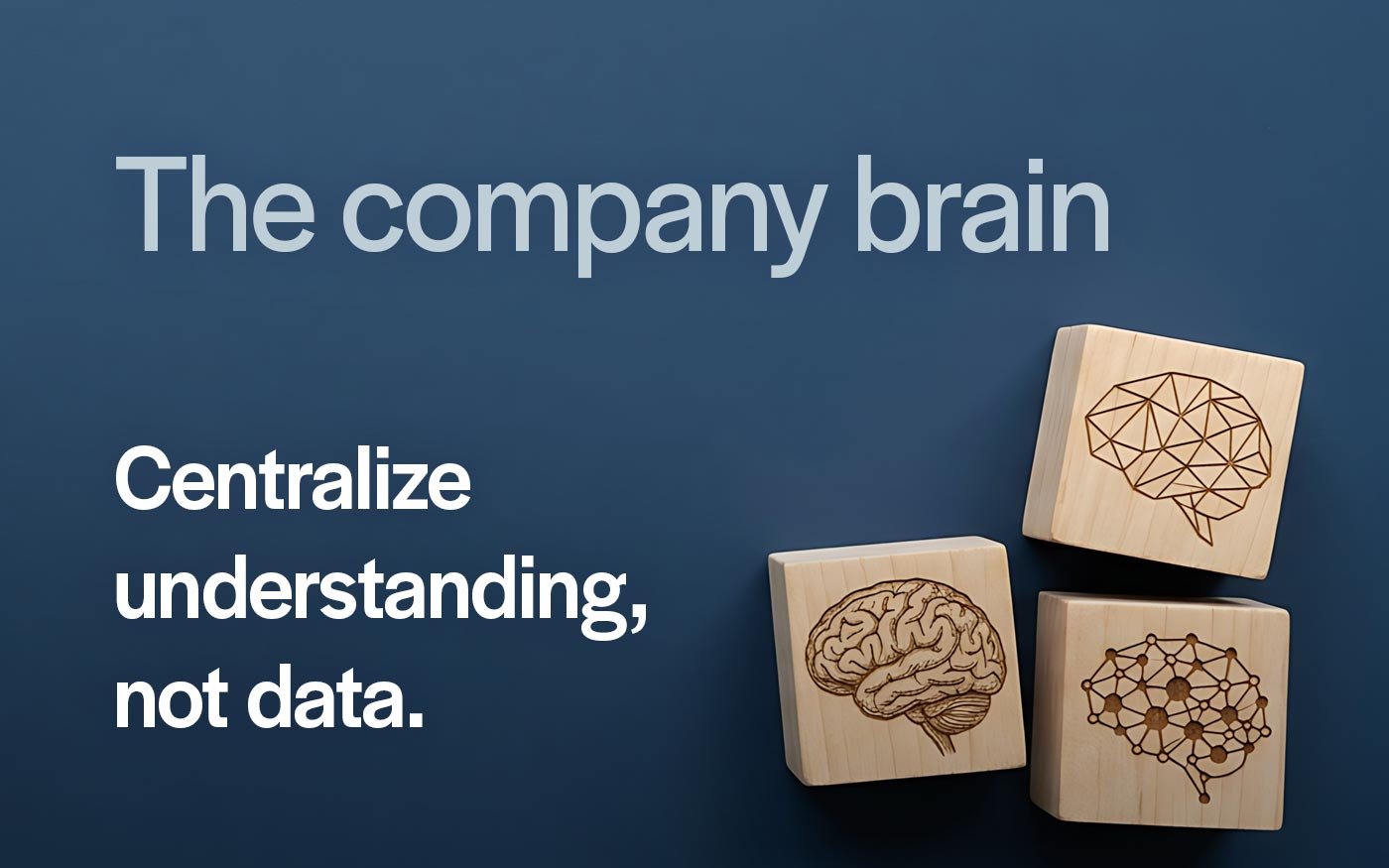
A company brain is a shared record of your numbers, definitions, and team knowledge that people and AI can both use.
You may also hear it called a living and learning knowledge layer. The idea is the same: what your business knows stays in one place, stays current, and gets richer as you learn. New hires don't start from zero, and an answer next week doesn't contradict the one you got today.
You don't need to build one all at once. It starts with two habits: agreeing on what your key numbers mean, and writing down the context behind the big calls.
Every generation of tools solved one problem and exposed another
It helps to zoom out and see how we got here.
- Centralized reporting. Before it, every department kept its own spreadsheets and its own version of the truth. Pulling numbers together was a real breakthrough.
- Beautiful dashboards. Leaders could see their data without writing SQL.
- Self-serve exploration. Anyone could dig into the data, not just specialists.
- AI that answers in plain language. You type a question and get an answer, with no waiting for a report.
Each step is real progress, and each one exposed the next bottleneck. When dashboards got easy to build, teams found they couldn't agree on what their metrics meant. When self-serve arrived, people didn't know which report to trust. Now AI can answer almost anything, and the new problem is that it only knows what you give it.
The question that matters now is whether to trust the answer
The questions have changed over time.
It used to be: Can we get this data into a dashboard?
Then: Can AI answer this question?
Now it is: Should I trust this answer?
Many leaders already know the pain of the alternative. You paste numbers into a chatbot, explain your business from scratch, and get a different answer next week. Someone then has to double-check it.
The cause is usually missing context. Ask three people at your company what "revenue," "customer," or "active user" means, and you may get three answers. Adding AI to that doesn't settle the disagreement. It just surfaces conflicting data definitions faster and with more confidence.
The companies that do well won't be the ones with the fanciest AI. They'll be the ones whose numbers, definitions, and business context are shared, written down, and consistent for both people and AI.
AI raises the value of that foundation. It doesn't replace it.
Why growing companies have an unexpected advantage
For years, larger companies had capabilities that smaller ones couldn't afford: dedicated data teams, expensive software licences, custom data warehouses. The gap felt permanent.
It isn't anymore. Today's tools connect to the software you already use, calculate your key numbers, and answer questions in plain language. Getting started costs far less and takes far less effort.
There is a second advantage that's easy to overlook. Growing companies don't carry decades of legacy reports, overlapping tools, and conflicting definitions that no one fully understands. You can start clean, and start with context, because your team's knowledge is still fresh and within reach.
Sometimes being second is an advantage. You skip the first generation's mistakes.
What you should do: Don't copy what a big company's reporting looks like. You don't need a hundred dashboards. You need a small set of trusted numbers, defined clearly, calculated the same way every time, and in front of the people making decisions. Then add the context behind them: what changed, why, and what you decided.
New approaches are emerging, and they're worth watching
The last twenty years were dominated by dashboard tools. The next decade will likely include more than that. Early signs point to a few shifts:
- Numbers that carry their meaning. Each metric comes with its definition, context, and history, so nobody has to ask what it includes.
- A shared company brain. Data and team knowledge sit together and keep growing as the business learns.
- Plain-language questions. You ask in your own words instead of waiting for a report.
- Answers where you work. Numbers show up in your weekly meeting, inbox, or team screen, so you don't have to remember to go looking.
- Earlier warnings. Tools that flag what is changing before your next review.
Some of today's products will adapt. Others won't. Companies we haven't heard of yet may define the next generation. That's how technology works, and it's a healthy sign the field is still innovating.
What you should do: When you evaluate any tool, ask whether it is built for where things are going, not just where they've been.
- Does it keep your key numbers defined the same way every time?
- Can it use your business context, so answers fit your company and not a generic one?
- Can your team use it without a data specialist standing by?
The goal has never been dashboards
The goal has never really been dashboards. It has always been better decisions.
Dashboards were a good way to get there, and they still are. But the destination is confidence: looking at a number, knowing what it means for your business, and acting on it.
If AI, shared definitions, and a growing base of company knowledge get you closer to that, the disruption is worth it. Growing companies that start building on both data and knowledge now won't just keep up. They may end up running with the clarity of a much bigger team.
The best time to ask better questions about your business is now. The tools are ready, and so is what your team already knows.
Originally published 2026-07-03 · Last updated 2026-11-19