
Centralize understanding, not data
AI agents may end the race to own your data, but small businesses still need somewhere for the meaning of their business to live, and that's the more interesting problem.
The race to be the brain
Last week I came across a LinkedIn post I kept thinking about for days. (Rare, given my love, hate relationship with LinkedIn)
It was a clip from the Humans of Martech podcast, where Arjun Pillai, former Chief Data Officer at ZoomInfo and now co-founder and CEO of Docket, made a provocative argument. GTM vendors are racing to become the "brain" of your revenue stack. He thinks they may be chasing a train that's already left the station.
His point, roughly: AI agents can now pull context from a pile of disconnected systems, sort through duplicate and conflicting records, and act, all without one central platform organizing everything first. So stop debating which system gets to be the brain. Put agents to work across the systems you already have.
I found myself nodding. Then I read the comments... often where the interesting gems hide.
One commenter pointed out that we're conflating two things: centralizing data, and agreeing on what the data means. Another put it more bluntly. Agents can probably reason through messy data, but one day someone has to explain a forecast miss to the CFO, and the answer is "depends which system you ask."
Funny, and also true.
For a lot of small businesses, that answer is a normal Tuesday.
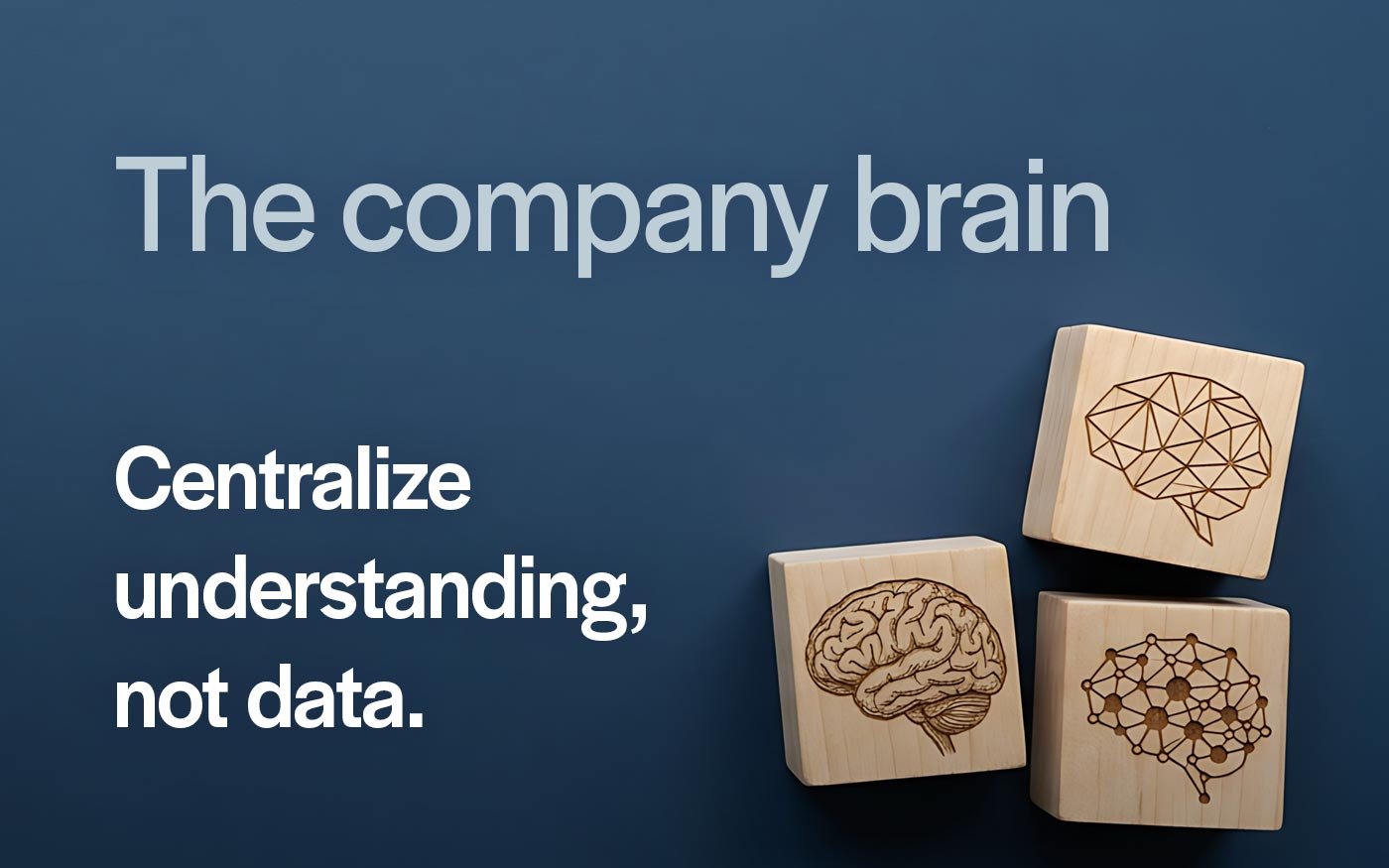
Centralize understanding, not data
I'm going to call the distinction centralizing understanding.
For most of the 25 years I've been in this business, analytics has assumed you had to organize data before you could use it. Pipelines, warehouses, data models, and CRM hygiene projects that never quite end. A lot of that infrastructure exists because people and traditional software needed structure to make sense of anything.
Agents change that equation. They can increasingly go to where the data lives and work with it there. Arjun is probably right about the direction of travel.
But finding the data and understanding the business are two different jobs.
An agent can find revenue in your accounting system, acquisition costs in your ad platforms, and churn in your billing tool. It might even reconcile the conflicting numbers reasonably well. What it doesn't know is which definition of revenue your business actually uses. Or that your biggest customer by revenue isn't your most strategic one. Or that last month's dip was planned, because you paused a channel on purpose.
That knowledge has to live somewhere. And the more freely agents roam, the more it matters where.
The more places your data lives, the more you need one agreed definition of each metric. Otherwise every agent builds its own version of the truth.
Four trends shaping the company brain
When I step back, four things stand out.
1. Agents go to the data. The old model was to move everything to one place, then ask questions. The new model leaves data where it lives and lets software fetch what it needs. Standards like MCP (a common way for AI tools to plug into other systems) made this practical, fast. We've added MCP access to our own products this year, so I've watched the shift up close.
2. Everyone wants to be the brain. "Company brain" has become one of the phrases of 2026. Writer launched an "Enterprise Brain" in September. Atlan wrote about building one shared context layer that feeds 40 agents and around 300 skills. Y Combinator reportedly put "company brain" on its request-for-startups list.
Notice the first word in most of those: enterprise. (Forty agents is roughly forty more than most of us are running.)
3. AI adoption is wide, but shallow. Goldman Sachs surveyed 1,256 small business owners early this year. 76% use AI. Only 14% have embedded it across their core operations.
Worth sitting with that for a second. Most small businesses use AI to draft an email, not to help run the business. And 70% of SMBs in Thryv's survey say they need more training to use it well.
4. The owner is the data team. Our own research found that founders and executives now make about 44% of role-identified data connections across our SMB customers, up from 36% in 2024. Marketing fell from 22% to 15%. The person connecting the data is usually the person signing the cheques. Their stacks are also consolidating around fewer, sturdier systems: shared drives, spreadsheets, and databases.
Put those four together and you get an odd picture. The most important idea in AI right now is being built for companies with data teams. The companies that would benefit most don't have one.
What small businesses are actually struggling with
We've been talking to a lot of SMB leaders this fall. The struggles aren't really about AI. They're the same ones they've always had, with higher stakes.
The knowledge lives in one or two heads. The goals, the pricing exceptions, why that customer gets special terms, what "active customer" means here. Almost none of it is written down. When the owner is on vacation, so is the context.
The numbers don't agree. Revenue in the accounting system doesn't match the CRM, which doesn't match the spreadsheet. There's usually a good reason. Usually only one person knows it.
Nobody has time to build the plumbing. There's no data team, and maintenance lands on the person with the least time for it. In our own support data, connectors that depend on frequently changing third-party APIs generate far more tickets than stable sources like databases.
Generic AI starts from a blank page. Ask a general assistant how the business is doing and it asks you to paste in some numbers. Then it gives a confident answer that's missing everything you know. One recent MIT Technology Review piece compared AI without business context to hiring the smartest intern in the world and blindfolding them. That image has stuck with me.
Trust is the bottleneck. Data privacy is a key concern for half of small businesses using AI. And an answer you can't trace back to a number you trust is an answer you won't act on.
What a small company brain needs
If understanding is the thing to centralize, what does that look like for a 50-person company? I think about it in three layers.
1. Access: go where the data lives. Connect to the systems you already use, and leave the data there wherever you can. No warehouse project required. This is the layer agents are making cheaper every month.
2. Meaning: one set of numbers. What each metric means, how it's calculated, and which source wins when two systems disagree. This is the semantic layer (a fancy name for a shared dictionary of your metrics). It tells AI what the numbers mean. This is the one layer I wouldn't let an agent improvise. It can fetch revenue from three systems, but someone has to decide what revenue means.
3. Context: why it matters. Goals, commitments, decisions, constraints, key customers, and what's happening in your market. It tells AI how the numbers relate, and why they matter to you.
Most AI tools stop at the first layer. Analytics vendors (us included) have spent a decade on the second. The third is the hardest, because most of it has never been written down.
Turns out you need all three. Data without knowledge can't answer the questions that matter. Knowledge without data can't either.
What to actually do this week: pick your five most important metrics and write one sentence for each. How it's defined, where it comes from, and what decision it drives. That's the seed of a company brain, and it fits in a Friday afternoon.
How we're thinking about it at Klipfolio
This one is personal for us. We've spent 25 years helping small businesses see their numbers, first with dashboards, then with a metric layer where every metric has one definition the whole team can trust.
That second part turned out to matter more than we expected. When AI arrived, a well-defined metric was exactly what it needed to give a reliable answer.
So the new Klipfolio brings the two halves together: your numbers, and the knowledge of how your business works. Your goals, your commitments, the decisions you've made, and what's going on in your market. It starts with that context instead of a blank prompt. It watches the numbers, tells you what needs your attention and why, and every answer traces back to one set of numbers your team trusts.
Your data can stay where it lives. The part we want to help you hold onto is the understanding, the part that makes AI useful and trustworthy. Right now, for most leaders, that part lives in their head.
For a leader without a data team, that's the difference between knowing what's really going on and hoping the dashboard is right. (Or, in my case, hoping I remember why that dashboard was built in the first place.)
Early access opens this winter. You can join the waitlist here.
Where this leaves us
I don't think anyone has this fully figured out, us included. Another commenter on that post warned about "epistemic debt": agents producing fluent, well-documented explanations for wrong conclusions. Fair point. More context helps an agent reason. It doesn't guarantee it's right. For decisions with real money behind them, you still need a defined metric and an answer you can trace back to it.
What I'm more confident about is the direction. Data will stay spread across systems. Agents will keep getting better at fetching it. And the businesses that get the most from AI will be the ones that wrote down how their business works, in a form both their people and their agents can use.
The big companies are building their brains now, with teams of engineers. Small businesses deserve one too, without needing the engineers.
Watch this space.
Sources
- Fortune on the Goldman Sachs 10,000 Small Businesses survey (Mar 2026): fortune.com
- Thryv 2026 AI and Small Business Adoption Survey: cpapracticeadvisor.com
- Klipfolio Research, The owner is the data team (Nov 2026): klipfolio.com
- Klipfolio Research, The consolidating stack (Aug 2026): klipfolio.com
- Writer Enterprise Brain (Sep 2026): cmswire.com
- Atlan context layer case: zenml.io
- Company brain overview and YC mention: slite.com
- MIT Technology Review (sponsored), Creating AI value with enterprise context: technologyreview.com
Originally published 2026-11-18