Viral Coefficient
Viral Coefficient measures how many new customers each existing customer generates through referrals.
Track all your SaaS KPIs in one place
Sign up for free and start making decisions for your business with confidence.
What is Viral Coefficient?
Viral Coefficient measures how many new customers each existing customer generates through referrals. A Viral Coefficient above 1 means your customer base is growing exponentially.
How to calculate Viral Coefficient
The formula is straightforward:
Viral Coefficient (K) = Invitations Sent per Customer × Conversion Rate
Example 1: You have 10 customers. Each invites 2 friends, and 50% of those friends convert.
K = 2 × 0.50 = 1.0
A K of 1.0 means each customer generates exactly one new customer, holding your growth steady.
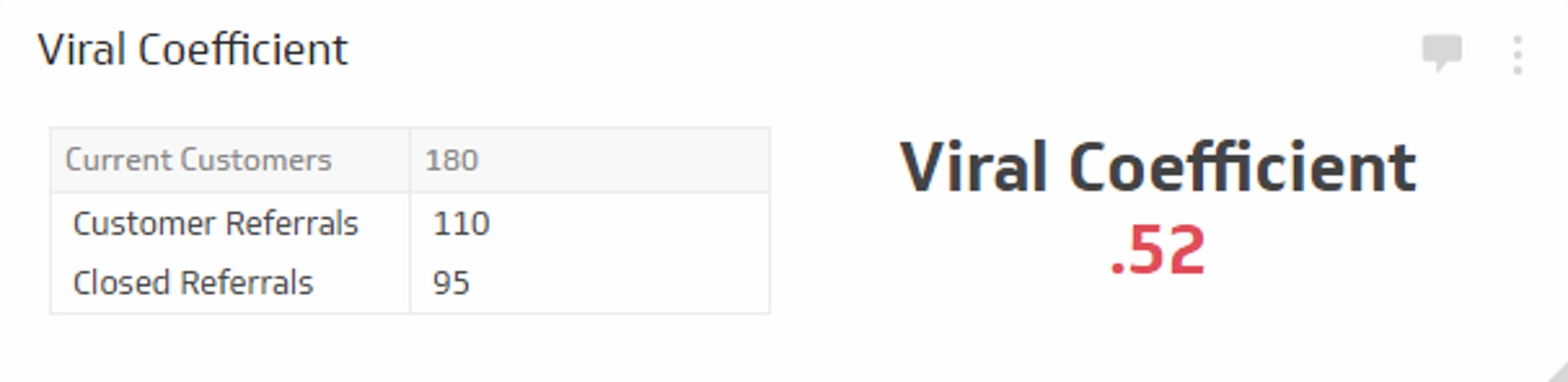
Example 2: You have 180 customers and receive 110 referrals, of which 95 convert to paying accounts.
K = (110 / 180) × (95 / 110) = 0.53
In this case, roughly one new customer is referred for every two existing customers. Growth is positive but not yet exponential.
Why Viral Coefficient matters
For SaaS companies, referral-driven growth is among the most cost-efficient acquisition channels available. When your Viral Coefficient exceeds 1, your customer base compounds without a proportional increase in marketing spend.
Here is what each range signals:
- K > 1: Exponential growth. Each cohort of customers generates more than one new customer.
- K = 1: Steady growth. Referrals replace churn but do not accelerate expansion.
- K < 1: Referrals contribute to growth, but you still depend on paid or organic acquisition to scale.
Tracking Viral Coefficient alongside metrics like Customer Acquisition Cost (CAC) and Monthly Recurring Revenue (MRR) gives you a clearer picture of how sustainable your growth actually is.
What influences your Viral Coefficient
Two levers control your K score directly: how many invitations your customers send, and how many of those invitations convert.
To improve Viral Coefficient, focus on:
- Referral incentives: Give customers a clear reason to share, whether through discounts, credits, or exclusive access.
- Frictionless sharing: Make the invitation process as simple as possible. Fewer steps mean more invitations sent.
- Onboarding quality: New customers who see value quickly are far more likely to refer others. Good customer onboarding directly influences how quickly referred users reach that moment.
- Conversion experience: A referral landing page or trial flow that resonates with referred prospects directly lifts your conversion rate.
Monitoring Viral Coefficient on a dashboard
Once you have established benchmarks and targets for Viral Coefficient, tracking it consistently is what turns the number into action. A SaaS Dashboard lets you monitor Viral Coefficient alongside related KPIs like churn rate and MRR in one place, so you can spot shifts in referral performance before they affect revenue.
Related Metrics & KPIs
.png)