Net Revenue Retention
Net Revenue Retention (NRR) measures the percentage of recurring revenue retained from existing customers over a set period, after accounting for expansion, downgrades, and churn.
Net Revenue Retention
Net Revenue Retention (NRR) measures the percentage of recurring revenue retained from existing customers over a set period, after accounting for expansion, downgrades, and churn.
What is Net Revenue Retention?
NRR is a financial metric that shows whether your existing customer base is generating more or less revenue than it did at the start of a period. It captures the full picture: revenue gained from upsells and price increases, minus revenue lost to cancellations and downgrades.
That makes NRR more informative than Annual Recurring Revenue (ARR) or Monthly Recurring Revenue (MRR) alone, because those figures don't separate the effect of new customers from what your existing base is actually doing.
How to calculate Net Revenue Retention
The formula is:
NRR = (Starting MRR + Expansion MRR - Churned MRR) / Starting MRR × 100
Example: A SaaS company starts the month with $2,000,000 MRR. It adds $200,000 in expansion revenue and loses $75,000 to churn and downgrades.
NRR = ($2,000,000 + $200,000 - $75,000) / $2,000,000 × 100 = 106.25%
An NRR above 100% means the existing customer base is growing on its own, without any new customers added.
Why Net Revenue Retention matters
NRR tells you something subscriber counts and top-line revenue figures can't: whether your existing customers find enough value to stay and spend more.
If 50,000 customers all downgrade to a lower plan, your subscriber count stays flat while your revenue contracts. NRR catches that. Investors rely on it for the same reason: a company with a consistently high NRR is more predictable and less dependent on a constant stream of new sales to stay healthy.
For leaders running lean teams, NRR is one of the clearest signals available. A rising NRR means customers are getting value and expanding. A falling NRR means something is wrong with retention or perceived value, and it's worth knowing that before it shows up in the bottom line.
NRR as a strategic signal
Companies with strong NRR tend to have two things in common: high customer satisfaction and a clear value proposition. That's not a coincidence. When customers understand what they're getting and feel it's worth the price, they stay and often spend more.
NRR is also a useful counterweight to growth targets that prioritize new customer acquisition at the expense of retention. New customers are the hardest and most expensive to win. A business that keeps its existing base healthy grows more efficiently than one that's constantly replacing churned revenue with new sales.
NRR is a good key performance indicator to track alongside MRR Growth Rate and Customer Lifetime Value, because together they show both the pace and the durability of growth.
What is a good NRR?
An NRR at or above 100% means the existing customer base is growing. Below 100% indicates contraction, though not necessarily a loss overall if new customer revenue is strong.
| NRR range | What it signals |
|---|---|
| 125%+ | Strong expansion; customers are actively upselling |
| 100% to 124% | Healthy retention with some expansion |
| 90% to 99% | Modest churn; common for early-stage companies |
| Below 90% | Retention problem worth addressing urgently |
The 125% range is often cited as a benchmark for high-performing SaaS companies. Smaller companies should aim to stay above 90%, recognizing that churn tends to be higher early on and flattens as the product matures and the customer base stabilizes.
Context matters. Seasonal products, enterprise sales cycles, and market conditions all affect NRR in ways that benchmarks don't capture. The number is most useful as a trend over time, not a single snapshot.
How to improve Net Revenue Retention
The strategies that move NRR depend on who your customers are and where the revenue is leaking. These are the most effective levers.
Identify and reduce churn early
Churn potential accumulates before a customer cancels. Usage patterns, support ticket frequency, and billing changes are all signals worth monitoring. Teams that catch these early can intervene before a customer decides to leave.
Most customers won't churn if they're satisfied. The question is whether you know they're dissatisfied before it's too late.
Focus upsells on customer value
Upselling works when customers already see value in what they have. Pushing upgrades on customers who aren't getting full use of their current plan tends to backfire. A better approach is identifying customers who are using the product heavily and showing them specifically what a higher tier would give them.
Free trials of higher-tier features are a low-pressure way to do this. Give a customer access to a feature they'd benefit from, long enough to see a real difference, and let the value make the case.
Create custom dashboards for you and your team.
Get started with KlipsImprove how customers experience value
Some customers churn not because the product is wrong for them, but because they never fully understood how to use it. Personalized onboarding, proactive check-ins, and targeted training can close that gap, especially for higher-value accounts where the effort is worth it.
Revisiting your messaging is also worth considering. Customers who don't understand your value propositions at different pricing tiers are less likely to upgrade, even when an upgrade would genuinely benefit them.
Expand what you offer
You can't upsell a product you don't have. Adding services or features that existing customers would find valuable creates new expansion revenue opportunities. This takes time, but it compounds: more products mean more reasons to stay and more paths to a higher NRR.
Segment by customer type
Enterprise clients typically have more budget and more appetite for upsells, especially when you can demonstrate ROI at scale. Smaller customers are more price-sensitive, so retention depends more on satisfaction and perceived fairness than on upsell conversion. Knowing which segment you're working with shapes which tactics make sense.
NRR and company valuation
Investors treat a consistently high NRR as evidence that a business is durable. An NRR above 100% functions like compound interest: existing customers generate more revenue each period without additional acquisition cost.
Even well-run companies see NRR fluctuate. Seasonal demand, product changes, and economic conditions all play a role. What investors want to see is a trend that holds above 100% over time, not a single strong quarter.
Frequently asked questions
What is the difference between NRR and gross revenue retention?
Gross Revenue Retention measures recurring revenue retained from existing customers without counting expansion revenue. It captures only the downside: churn and downgrades. NRR includes expansion, so it can exceed 100%. Gross Revenue Retention is capped at 100% and is useful for isolating how well a company holds onto its base without the effect of upsells.
Why is Net Revenue Retention important?
NRR shows whether existing customers are generating more or less revenue over time. A company that can't retain recurring revenue is more fragile than one with a stable, expanding base, regardless of how many new customers it acquires.
How does NRR differ from MRR?
MRR is the total monthly recurring revenue at a point in time. NRR is a ratio that measures how that revenue from existing customers changed over a period. MRR tells you the size of the number; NRR tells you whether the existing base is growing or shrinking.
Tracking Net Revenue Retention
Watching NRR as a number in a spreadsheet means you're always looking backward. The more useful version surfaces the metric automatically and flags when it moves, so you know without having to check.
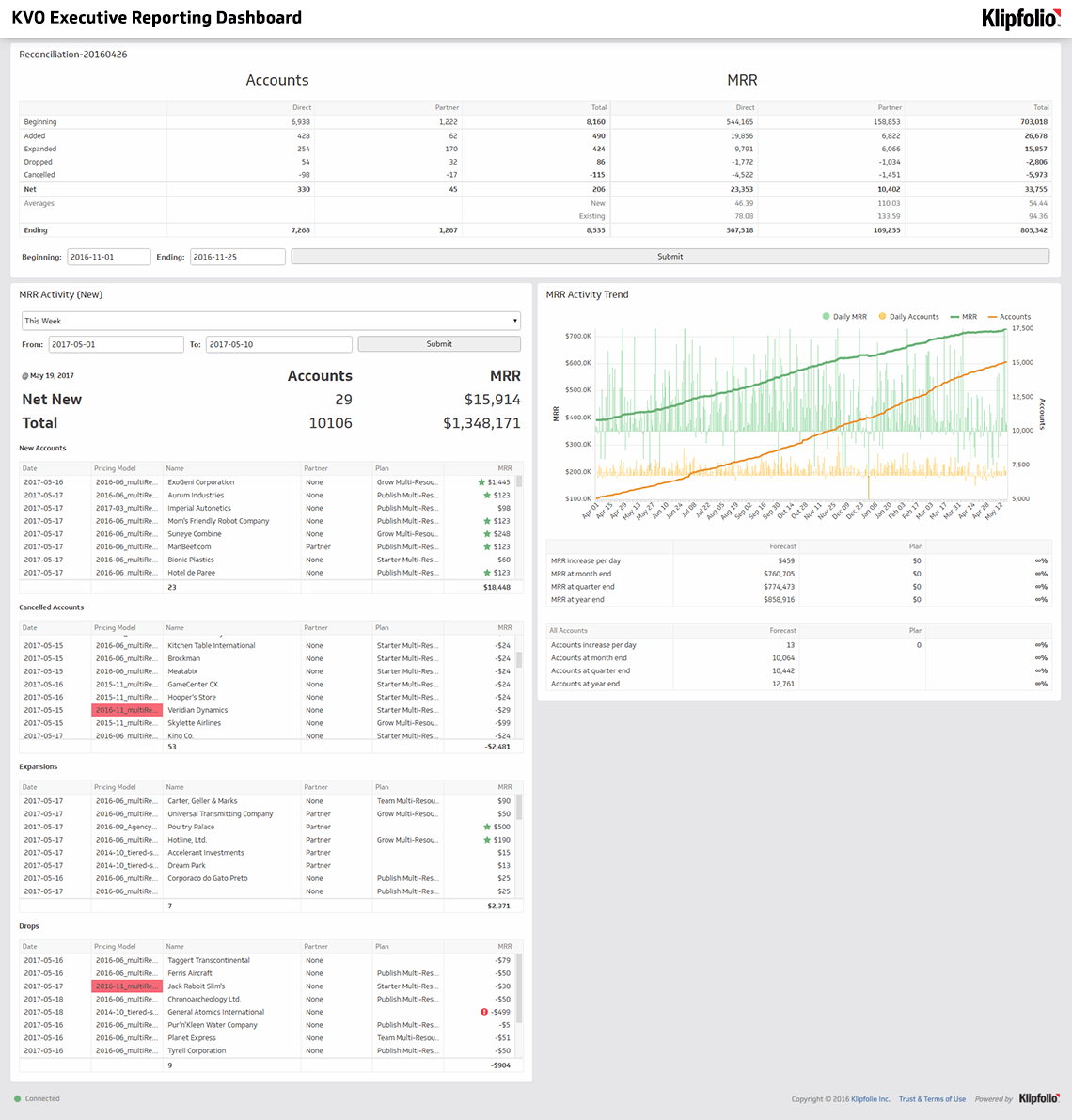
Klipfolio connects to your billing and CRM data to keep Net Revenue Retention current alongside the other metrics that affect it: MRR, churn rate, and expansion revenue. When everything is in one place and refreshed automatically, the number works harder than it does in a monthly report.