Monthly Recurring Revenue
Measures the predictable revenue a subscription business generates from active accounts in a given month.
Monthly Recurring Revenue
What is Monthly Recurring Revenue (MRR)?
Monthly Recurring Revenue (MRR) is the predictable revenue a subscription business generates from active accounts in a given month.
For SaaS companies, telecoms, and other subscription-based businesses, Monthly Recurring Revenue sits at the centre of the business model. It is one of the most closely watched KPIs because it tells you, clearly and consistently, whether the business is growing, holding steady, or losing ground.
How to calculate Monthly Recurring Revenue
The standard formula is:
MRR = Number of Active Subscribers × Average Revenue Per Account (ARPA)
If your pricing tiers vary, calculate MRR by summing the monthly revenue from each active subscription individually, then add it all together.
Example: You have 200 subscribers paying $50/month and 80 paying $150/month.
MRR = (200 × $50) + (80 × $150) = $10,000 + $12,000 = $22,000
Types of Monthly Recurring Revenue
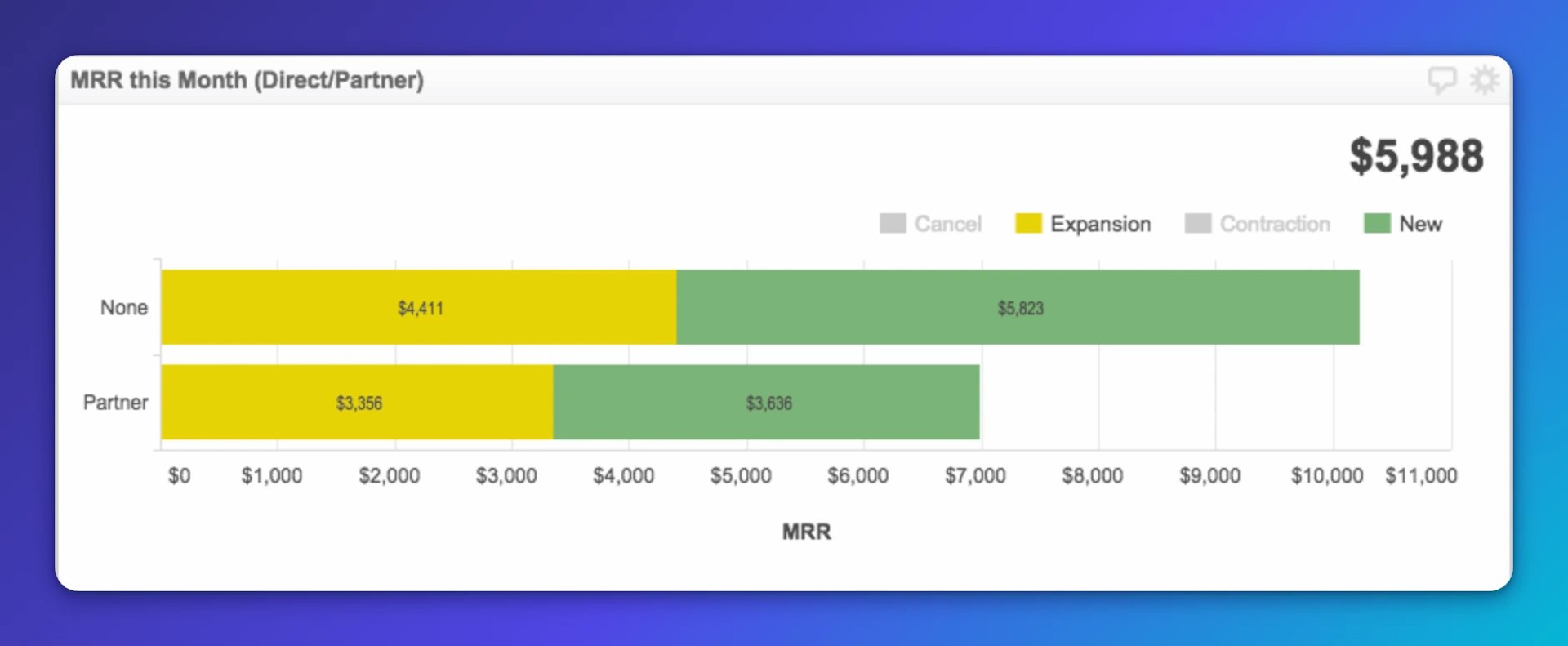
Monthly Recurring Revenue is not a single number. Breaking it into components tells you where growth is coming from and where it is leaking.
New MRR: Revenue added from new customers acquired during the month
Expansion MRR: Additional revenue from existing customers who upgraded or purchased add-ons
Contraction MRR: Revenue lost from existing customers who downgraded
Churned MRR: Revenue lost from customers who cancelled entirely
Net New MRR: New MRR plus Expansion MRR, minus Contraction MRR and Churned MRR
Net New MRR is the number that tells you whether the business is actually growing. A healthy subscription business grows Expansion MRR faster than Churned MRR, which is the foundation of Net Revenue Retention.
Why Monthly Recurring Revenue matters
Monthly Recurring Revenue gives leaders a reliable baseline for decisions that cannot wait. When you know what is coming in each month, you can commit to hiring, plan marketing spend, and forecast growth with confidence rather than guesswork.
The alternative, pasting numbers from different sources into a spreadsheet or explaining your revenue picture to an AI tool from scratch each month, introduces errors and delays the decisions that matter.
MRR also connects directly to the health signals that investors and leadership teams watch most closely: churn, expansion, and retention. A rising MRR built on expansion revenue signals a product customers value. A rising MRR built entirely on new acquisition, while churn quietly climbs, is a warning sign the raw number alone will not surface.
MRR targets and benchmarks
Monthly Recurring Revenue targets vary by industry, growth stage, and business model. A seed-stage SaaS company and a mature telecom are both tracking MRR, but against very different benchmarks.
A few principles apply broadly:
Targets should reflect lifecycle stage. Early-stage businesses prioritize growth rate over absolute MRR. Later-stage businesses balance growth with retention.
MRR Retention matters as much as MRR growth. Expanding revenue from existing accounts compounds over time and is far less expensive than replacing churned customers with new ones.
Consistency beats peaks. A steadily growing MRR is a stronger signal than a high number with volatile month-to-month swings.
MRR and revenue retention
MRR Retention, often called Net Revenue Retention Rate, measures whether existing customers are generating more or less revenue over time. It is the clearest indicator of long-term subscription health.
A Net Revenue Retention Rate above 100% means expansion revenue from existing accounts is outpacing losses from churn and contraction. That is the target for high-growth subscription businesses: grow the base, and have existing customers carry part of the growth themselves.
Tracking both Monthly Recurring Revenue and MRR Retention together gives a complete picture. MRR tells you the size of the engine. Retention tells you whether it is running efficiently.
Create custom dashboards for you and your team.
Get started with KlipsHow to track Monthly Recurring Revenue
Tracking Monthly Recurring Revenue accurately requires pulling data from billing systems, CRMs, and subscription management tools into one consistent view. When those sources stay separate, numbers drift and decisions get made on stale figures.
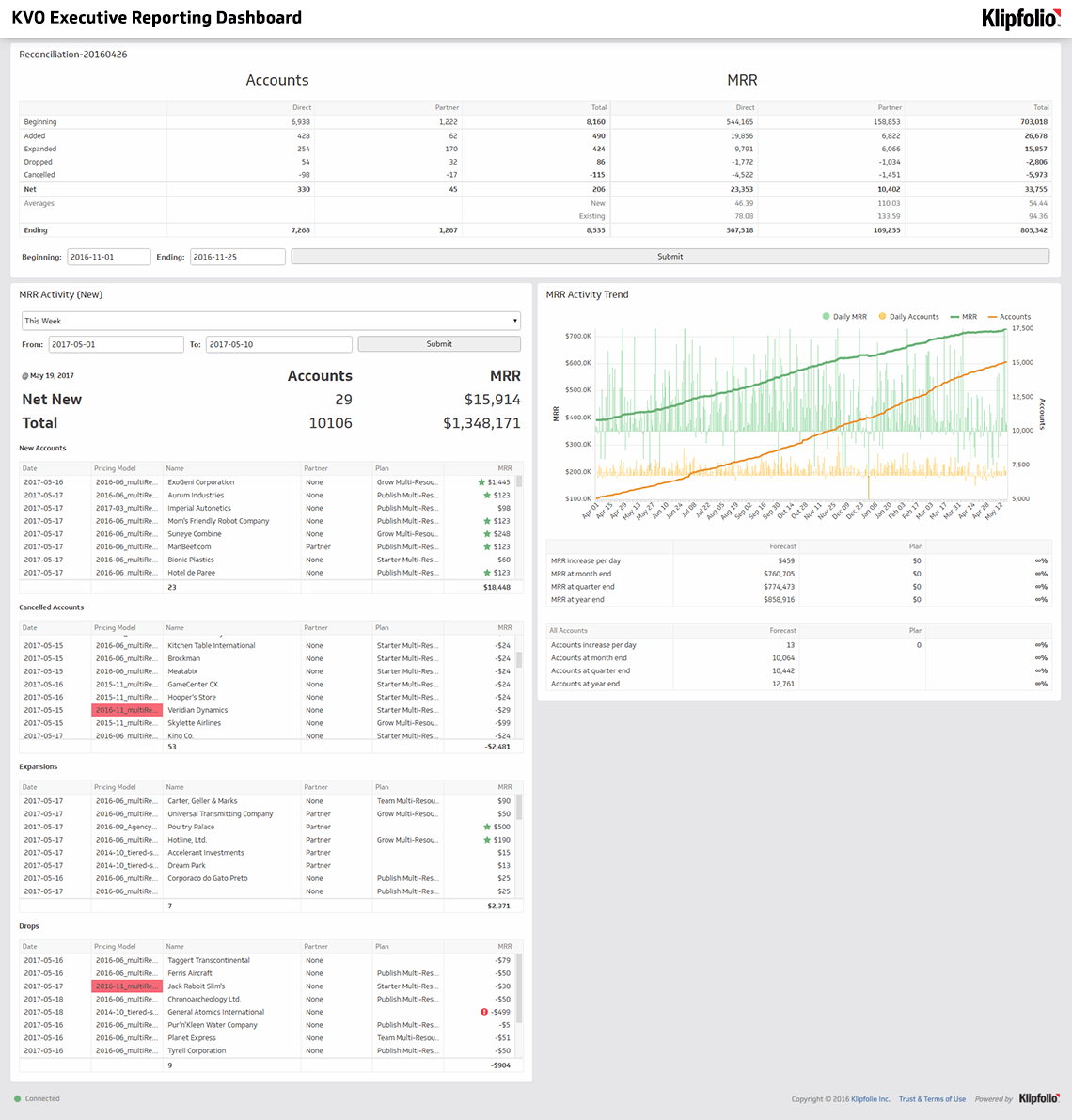
A SaaS Dashboard centralizes Monthly Recurring Revenue alongside related KPIs like Churned MRR, Expansion MRR, and Net Revenue Retention so your team sees the same numbers at the same time, without anyone having to pull a report first.