Cost per Hire Metric
Track and optimise one of the most critical recruitment metrics.
Track all your HR KPIs in one place
Sign up for free and start making decisions for your business with confidence.
What is Cost per Hire?
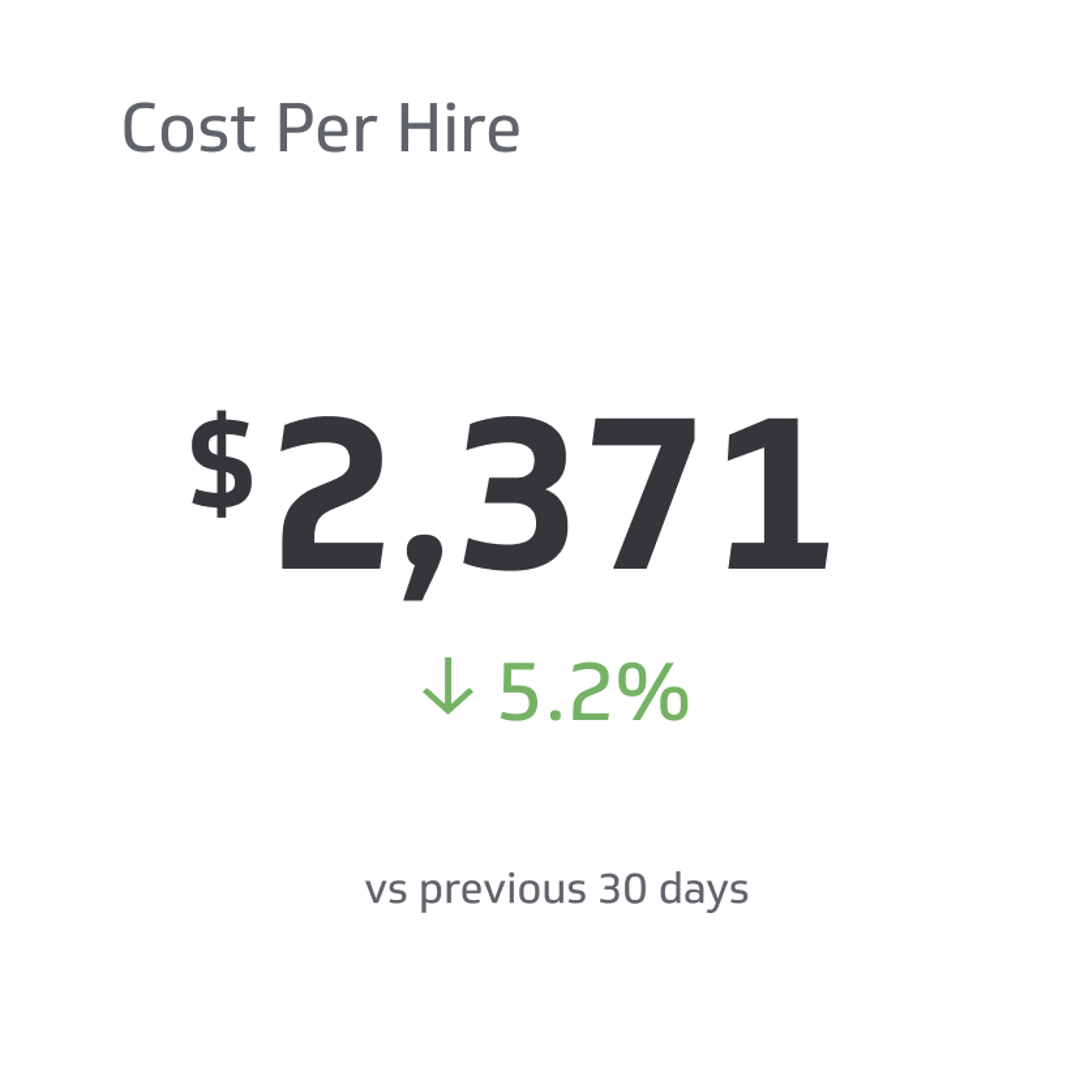
Hiring new talent is essential for growth, but how much does it actually cost your business? If you can't answer that question precisely, you're not alone. Cost per Hire is a key performance indicator (KPI) that measures the total expense invested to find and hire a new employee.
Tracking this metric is fundamental for building a scalable and efficient recruitment process. It allows you to budget more accurately, justify your team's spending, and make data-driven decisions to optimise your hiring strategies. For growing companies, where every dollar counts, managing this cost effectively can be the difference between sustainable growth and wasted resources.
How to Calculate Cost per Hire
To get a clear picture, you need to account for all expenses associated with filling a position. The formula breaks down all your recruitment spending against the number of new hires in a specific period.
(Total Internal Recruitment Costs + Total External Recruitment Costs) / Total Number of Hires
Internal costs
Salaries: The portion of salaries for your in-house recruiters and hiring managers dedicated to recruitment activities.
Time: The hours spent by interviewers and other staff involved in the hiring process, valued at their hourly rate or salary equivalent.
Referral bonuses: Any incentives paid to current employees for referring successful candidates.
Administrative costs: The overhead associated with your HR department's hiring functions, including equipment and workspace.
External costs
Advertising: Fees for posting on job boards like LinkedIn, Indeed, or niche industry sites.
Agency fees: Costs paid to external recruitment agencies or headhunters.
Recruitment events: Expenses for attending or hosting career fairs and networking events.
Software and tools: Subscriptions for an Applicant Tracking System (ATS) or other recruitment software.
Candidate expenses: Costs related to travel, background checks, and skills assessments.
Why Cost per Hire matters
Blindly cutting recruitment costs can backfire. A bad hire costs you more than five times the candidate's salary in lost productivity, mistakes, and eventual replacement. This is why reducing Cost per Hire without sacrificing hire quality is critical.
When you track this metric, you can identify inefficiencies in your process and invest in strategies that improve outcomes, not just cut corners. The goal is to hire better people faster and more affordably—not to hire cheaper people.
What is a good Cost per Hire?
There is no single "good" number for Cost per Hire, as it varies significantly based on several factors:
Industry: Hiring a specialized software engineer will naturally cost more than hiring a retail associate.
Role level: Executive and senior-level positions require a more extensive—and expensive—search than entry-level roles.
Location: Recruitment costs are higher in competitive urban markets compared to rural areas.
Company size: Larger organisations often have established recruiting infrastructure that reduces per-hire costs.
Instead of aiming for a universal number, benchmark your Cost per Hire against your own historical data and industry averages. For many growing companies, a realistic Cost per Hire can range from a few thousand dollars to upwards of £15,000 for specialised roles in fields like professional services, finance, or software development.
How to reduce Cost per Hire without sacrificing quality
Promote existing employees where appropriate
Promoting existing employees to new positions works wonders for keeping costs down and productivity high. You barely incur recruitment costs, you already know their strengths and weaknesses, and they're familiar with your company culture and colleagues. Even if they need additional training, they should be a reliable fit and less likely to leave quickly.
The trade-off is that you'll need to fill their old role, which may offset some savings—but promoting internally still reduces overall turnover and builds employee engagement.
Ask for referrals instead of advertising externally
Employee referrals are one of the most cost-effective hiring methods available. Research shows that referrals:
- Take 10–26 fewer days on average to start work compared to job board hires
- Cost significantly less and are faster than other hiring methods
- Stay at a company longer, with 47% remaining for more than three years
Referrals also have the advantage of going into their new job with a friend or acquaintance already in the company. This helps them get up to speed quicker and eases their transition into your culture. Employees who referred successful hires are also more likely to stay longer, feeling more content and engaged with the company.
Document your recruitment process
One of the best ways to increase efficiency is to document your recruitment process as a standard operating procedure. This means it can be performed in less time, more consistently, and with fewer errors.
Without a set process, you'll waste time deciding where to begin, which resources to use, and how to track progress. Simple process documents can reduce wasted time and money while improving your success rate and getting new hires up to speed faster.
Create an inclusive, welcoming culture
A welcoming and supportive team culture helps new hires settle in and get up to speed quickly. It also reduces employee turnover—a critical factor in Cost per Hire. Research shows that 31% of employees leave their job within six months, which means you'll need to hire and train a replacement at significant cost.
An inclusive culture helps hires overcome training hurdles with colleague support, encouraging them to stay longer and reducing the need for repeat hiring cycles.
How to monitor your Cost per Hire
You should track your Cost per Hire on a monthly or quarterly basis to identify trends and measure the impact of your initiatives.
While it's possible to track this in a spreadsheet, the process can quickly become a major headache. Manually pulling data from different sources is time-consuming, prone to errors, and makes it difficult to share up-to-date information with department heads or executives.
A more effective approach is to monitor your recruitment KPIs on a dashboard. This allows you to connect your data sources—like your accounting software and ATS—to automate data retrieval. You get a real-time view of your spending, helping you and your team stay aligned and make smarter, faster decisions.
With Klipfolio Klips, you can build a dashboard to track your Cost per Hire alongside other essential HR metrics. Connect your data, create beautiful visualisations, and get everyone on the same page.
Who monitors this KPI?
Typically, the HR Manager and Department Heads are the primary audience for this metric. They use it to manage their budgets and refine their hiring processes. However, in many growing companies, the CEO and CFO also watch this KPI closely to ensure the company's financial health and resource allocation are on track.
Related Metrics & KPIs