Cost Per Click (CPC)
Cost Per Click (CPC) measures how much you pay for each click on a paid ad — a core metric for evaluating the efficiency of digital advertising spend.
Track all your Digital Marketing KPIs in one place
Sign up for free and start making decisions for your business with confidence.
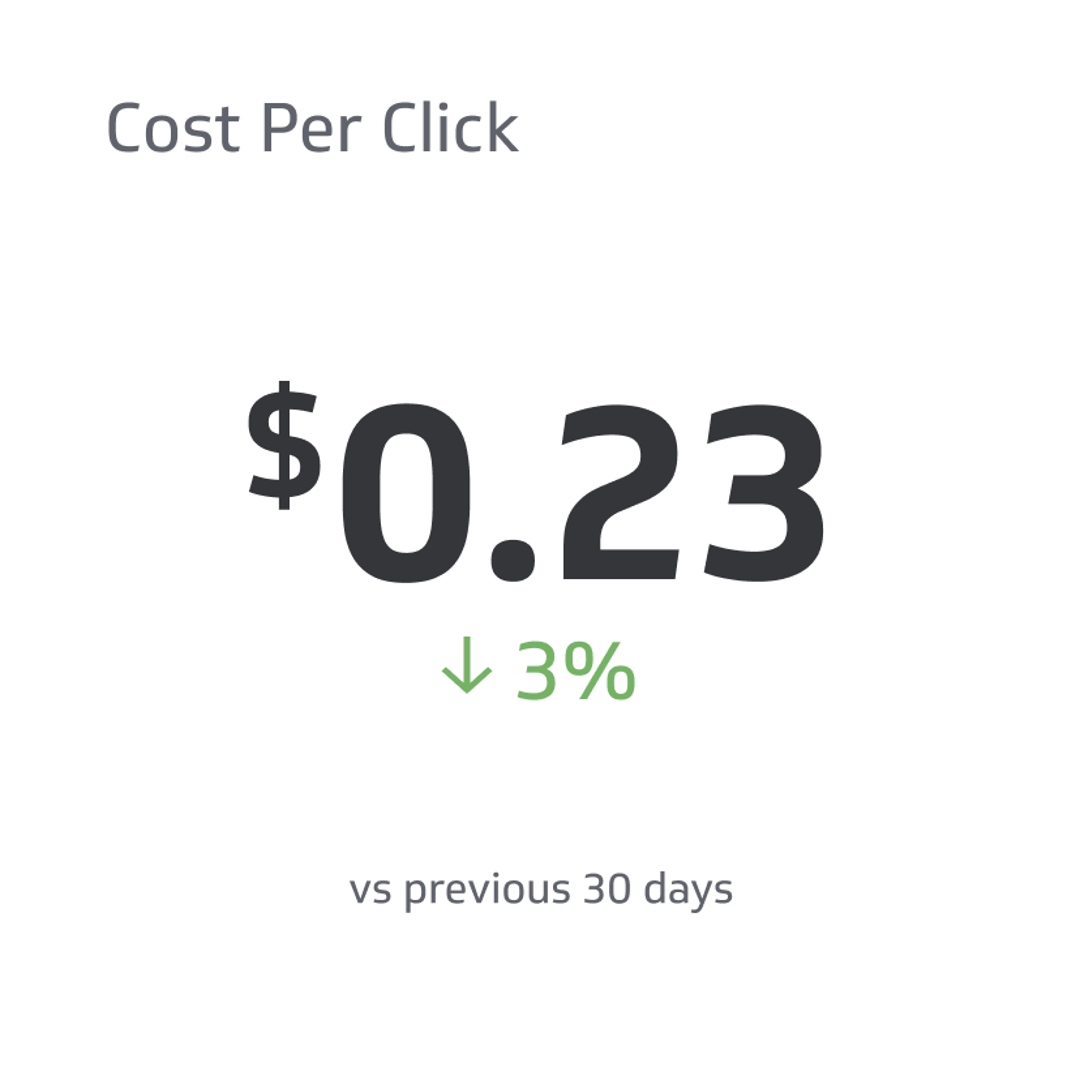
Cost Per Click (CPC) is the amount an advertiser pays each time someone clicks on a digital ad. It's a core metric in paid media campaigns and a direct measure of ad spend efficiency.
Tracking CPC helps marketers understand whether their budget is working. A lower CPC means you're getting more clicks for the same spend — but only if those clicks are relevant and converting.
What is Cost Per Click (CPC)?
Cost Per Click (CPC) is a digital advertising metric that measures how much you pay for each click on a paid ad.
CPC is the standard billing method in platforms like Google Ads and Microsoft Advertising. You're charged only when someone clicks your ad, not when it's shown. That makes it a more accountable model than impression-based billing, where you pay regardless of engagement.
CPC applies across search ads, display ads, social media campaigns, and app install campaigns. Industries that rely heavily on CPC include e-commerce, healthcare, insurance, and SaaS.
Why is CPC important?
CPC connects your ad budget directly to audience action. Every dollar spent corresponds to a user who chose to engage with your ad — which makes it easier to evaluate campaign efficiency and justify spend.
Here's why CPC matters:
- Budget control: You only pay when someone clicks, which limits wasted spend on uninterested audiences.
- Performance visibility: CPC data reveals which ads, keywords, and audiences are delivering value — and which aren't.
- ROI measurement: When combined with conversion data, CPC helps you calculate the true cost of acquiring a customer.
- Targeting precision: Platforms that use CPC billing also offer granular targeting by demographics, intent, and behaviour, so your spend reaches the right people.
CPC is most useful when tracked alongside click through rate or CTR, conversion rate, and ad spend. Together, these metrics give a complete picture of campaign performance.
How to calculate CPC
To calculate CPC, divide total ad spend by the number of clicks received during the same period.
CPC = Total Ad Spend / Number of Clicks
Example: If you spent $500 on a campaign and received 250 clicks, your CPC is $2.00.
$500 / 250 = $2.00 CPC
Most ad platforms calculate CPC automatically in their reporting dashboards. Still, it's worth understanding the formula so you can cross-check results and catch anomalies.
Common calculation mistakes
A few errors can distort your CPC figures:
- Including invalid or bot clicks: These inflate click counts and make CPC appear lower than it is. Filter them out using platform-level tools or third-party verification.
- Mixing campaign types: Comparing CPC across search and display campaigns without segmenting the data leads to misleading averages.
- Ignoring impression share: A low CPC may look efficient, but if your ads aren't showing frequently enough, the metric doesn't tell the full story.
What is a good CPC?
There's no universal benchmark. A "good" CPC depends on your industry, target keywords, and the value of a converted customer.
A $10 CPC might be excellent for a SaaS product with a $500 average contract value, but unsustainable for a $15 e-commerce product. The right question isn't "Is my CPC low?" — it's "Does my CPC support a profitable return on ad spend?"
Use your target cost per acquisition (CPA) and conversion rate to work backward to a maximum acceptable CPC:
Max CPC = Target CPA × Conversion Rate
Example: If your target CPA is $50 and your conversion rate is 5%, your maximum CPC is $2.50.
$50 × 0.05 = $2.50
How to improve your CPC
Reducing CPC without sacrificing click quality comes down to relevance — matching your ads, keywords, and landing pages to what your audience is actually searching for.
Choose keywords strategically
Broad, high-competition keywords drive up costs. Long-tail keywords — more specific phrases with lower search volume — typically have lower CPCs and attract higher-intent traffic.
Use keyword research tools to identify terms with strong relevance to your offer but manageable competition. Negative keywords are equally important: excluding irrelevant search terms prevents wasted spend on clicks that won't convert.
Write stronger ad copy
Ad quality directly affects CPC on most platforms. Google Ads, for example, uses a Quality Score that factors in expected CTR, ad relevance, and landing page experience. A higher Quality Score can lower your CPC even if your bid stays the same.
Ad copy should be specific, match the searcher's intent, and include a clear call to action. Vague or generic copy tends to produce lower CTRs, which raises costs over time.
Improve landing page relevance
A click is only valuable if the landing page delivers on the ad's promise. Pages that are slow to load, hard to navigate, or misaligned with the ad's message increase bounce rates and hurt Quality Scores.
Ensure your landing page has a clear headline that matches the ad, a focused call to action, and fast load times on mobile and desktop.
Expand into lower-cost markets
If your campaigns are running in high-cost regions, consider testing audiences in markets with lower average CPCs. Localized ad sets — adapted for language and regional context — can open new traffic sources at a fraction of the cost of saturated markets.
Risks and challenges of CPC advertising
CPC is effective, but it comes with trade-offs worth understanding before scaling spend.
- Click fraud: Competitors or bots can inflate click counts, draining budget without generating real leads. Monitor for unusual click patterns and use platform fraud detection tools.
- Competitive bidding: Popular keywords attract multiple advertisers, which drives up CPCs. In some industries, top keywords can cost tens of dollars per click.
- Budget depletion without conversion: A well-clicked ad that doesn't convert is still expensive. CPC measures engagement, not outcomes — always pair it with conversion tracking.
- Keyword drift: Search behaviour changes over time. Keywords that performed well last quarter may attract different intent today. Regular audits keep campaigns aligned with actual user behaviour.
Tracking CPC on a dashboard
Monitoring CPC in real time helps you catch overspend before it becomes a problem. A digital marketing dashboard that pulls data directly from your ad platforms gives you a live view of CPC alongside CTR, conversion rate, and ROAS — so you can act on the data rather than just report it.
Klips connects to Google Ads, Microsoft Advertising, and other paid media platforms, letting you build dashboards that surface CPC trends across campaigns, ad groups, and time periods without manual exports.
Related Metrics & KPIs