EBITDA vs. Revenue
Revenue tells you how much came in. EBITDA tells you how much you kept from operations. Understanding the difference helps you make better decisions, faster, and with more confidence.
Revenue vs. EBITDA
Knowing whether your business is truly profitable, or just busy, comes down to which numbers you trust and what they're actually telling you.
Revenue and EBITDA are two of the most common financial metrics leaders rely on, but they answer different questions. Revenue tells you how much came in. EBITDA tells you how much you kept from operations. Understanding the difference helps you make better decisions, faster, and with more confidence.
What is EBITDA?
EBITDA is a measure of a company's operational profitability, calculated before accounting for interest, taxes, depreciation, and amortization. The acronym stands for Earnings Before Interest, Taxes, Depreciation, and Amortization.
Investors, analysts, and business owners use EBITDA to assess how efficiently a company runs its core operations, stripped of financing decisions and accounting conventions that can distort the picture.
What EBITDA does
EBITDA gives you a cleaner view of operational performance than revenue alone. Revenue only shows what came in. EBITDA accounts for operating expenses, so it reflects what the business actually earned from its operations before non-operational costs enter the picture.
This makes EBITDA especially useful for comparing companies in the same industry. Because it neutralizes differences in capital structure, tax treatment, and accounting practices, it allows for a more equitable comparison of operational effectiveness across businesses with different debt levels.
EBITDA also works as a benchmark. Tracking your EBITDA margin over time, or against industry peers, tells you whether your core business is getting more or less efficient.
That said, EBITDA is not a complete picture on its own. Pair it with net income, cash flow, and revenue to understand the full financial situation.
How to calculate EBITDA
EBITDA is calculated by adding interest, taxes, depreciation, and amortization back to net income:
EBITDA = Net Income + Interest + Taxes + Depreciation + Amortization
Note that EBITDA excludes capital expenditures, working capital changes, and other non-operating costs. Those exclusions are precisely why EBITDA should never be your only financial metric.
What is Revenue?
Revenue is the total income a company generates from selling its products or services, before any expenses are deducted. It is the starting point for every profitability calculation.
What Revenue does
Revenue is the top line. It tells you how much money came in before taxes, operating expenses, and interest payments are subtracted.
Tracking Revenue over time shows whether the business is growing, plateauing, or contracting. Comparing Revenue to expenses reveals efficiency: a company with high Revenue but significant costs may be less profitable than one with lower Revenue and tighter margins.
Revenue is also a standard tool for comparing businesses in the same industry. Because it is a GAAP metric, it is calculated consistently across companies, making it reliable for identifying market leaders and identifying companies worth monitoring.
How to calculate Revenue
For most businesses, Revenue is calculated by multiplying the price of a product or service by the number of units sold:
Revenue = Price × Units Sold
For example, if a company sells 1,000 units at $100 each, Revenue is $100,000.
When a business has multiple income streams, Revenue is the sum of all of them. A company earning $50,000 from product sales and $25,000 from rental income has total Revenue of $75,000.
Create custom dashboards for you and your team.
Get started with KlipsComparing EBITDA vs. Revenue
Both metrics are essential to evaluating a business, but they serve different purposes and answer different questions.
Similarities
EBITDA and Revenue both measure financial performance and both support comparisons over time. Tracking either metric across quarters or years reveals growth trends and helps stakeholders understand how the business is progressing.
Both metrics can also be manipulated. Companies may use accounting techniques to inflate Revenue or adjust EBITDA in ways that don't reflect true performance. That's why neither should be evaluated in isolation.
Differences
The core difference is scope. Revenue measures what came in. EBITDA measures what the business earned from operations after accounting for its costs, before interest, taxes, depreciation, and amortization.
| Revenue | EBITDA | |
|---|---|---|
| What it measures | Total income from sales | Operational profitability |
| Expenses included | None | Operating expenses |
| GAAP status | GAAP metric | Non-GAAP metric |
| Best used for | Top-line growth, sales performance | Comparing operational efficiency across companies |
| Limitations | Ignores all costs | Excludes capex, working capital, debt payments |
Because EBITDA is a non-GAAP financial metric, different businesses may calculate it differently. Revenue, as a GAAP metric, is standardized, making cross-company comparisons more straightforward.
Pros and cons of EBITDA
Advantages
Easier cross-company comparison. By removing interest, taxes, depreciation, and amortization, EBITDA allows you to compare operational efficiency across companies with different capital structures or accounting approaches.
Insight into debt servicing capacity. Excluding interest expenses lets you assess whether a business generates enough from operations to handle its obligations and fund future investments.
A cleaner view of cash generation. EBITDA focuses on earnings from core operations, giving a clearer picture of a company's ability to generate cash and meet short-term financial obligations.
Limitations
Excludes costs that matter. EBITDA omits interest, taxes, and one-time charges. For capital-intensive businesses, ignoring depreciation can make profitability look better than it is.
Vulnerable to manipulation. Some businesses adjust EBITDA in ways that don't reflect actual operational performance. Scrutinize the components and adjustments before relying on the number, and avoid potential pitfalls that come with taking EBITDA at face value.
Unreliable for asset-heavy businesses. When a company's profitability depends on efficiently using significant fixed assets, omitting depreciation from the calculation distorts the picture. In those cases, net income or operating income gives a more accurate read.
Tracking EBITDA and Revenue together
Revenue and EBITDA answer different questions, and you need both. Revenue tells you the business is generating sales. EBITDA tells you whether those sales are producing operational profit.
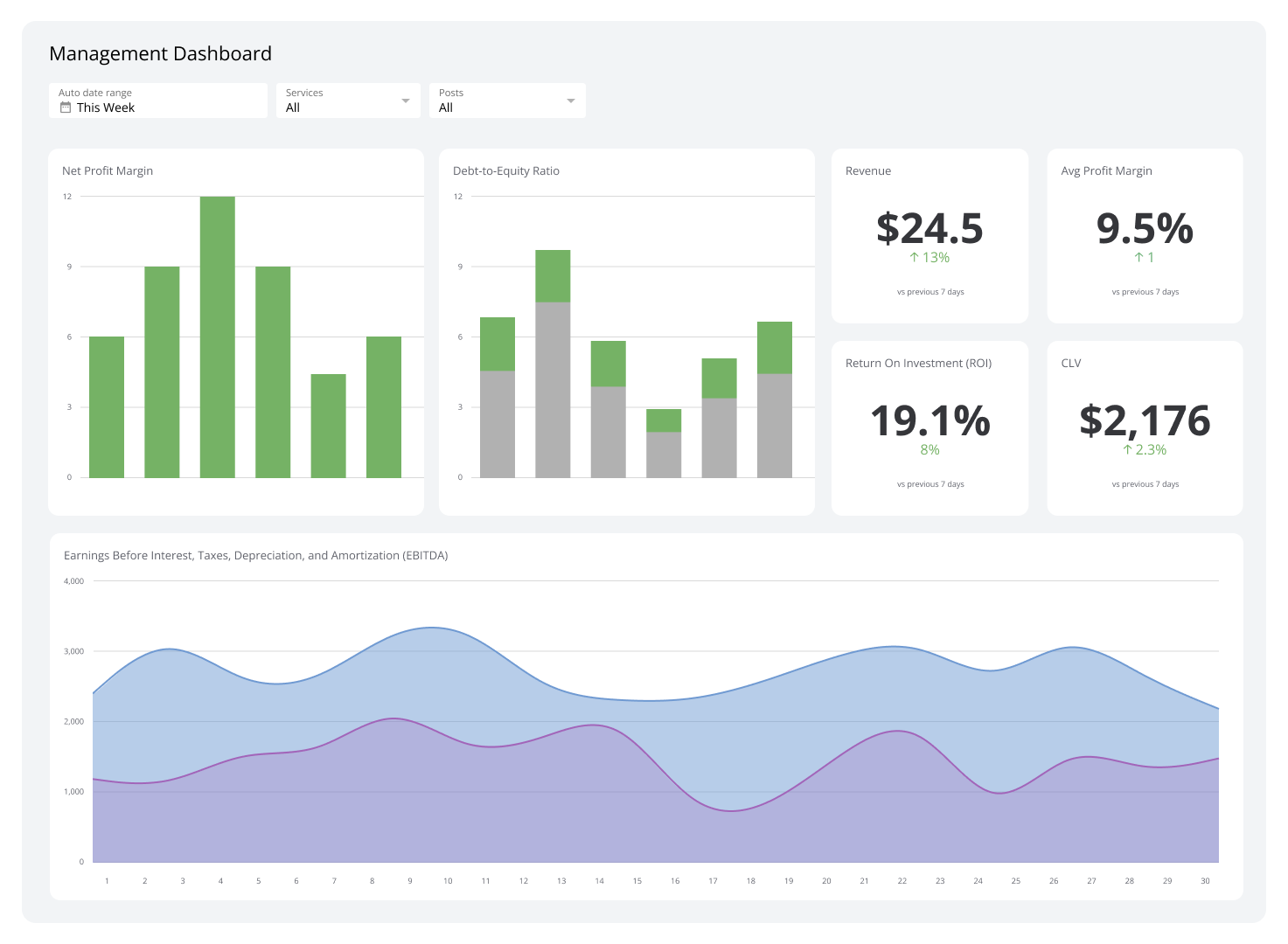
Watching them together, on a financial dashboard that updates automatically, means you're not waiting for a report or pasting numbers into a spreadsheet to figure out where you stand. You know, and you can act on it.
Klipfolio connects to your financial data sources and keeps both metrics visible in real time, so you and your team stay aligned on what the business is actually producing. Explore financial KPI examples to see how other teams track these numbers.