MRR vs ARR: key differences for subscription businesses
ARR and MRR are the two core revenue metrics for subscription businesses — ARR measures annual recurring revenue, MRR measures it monthly.
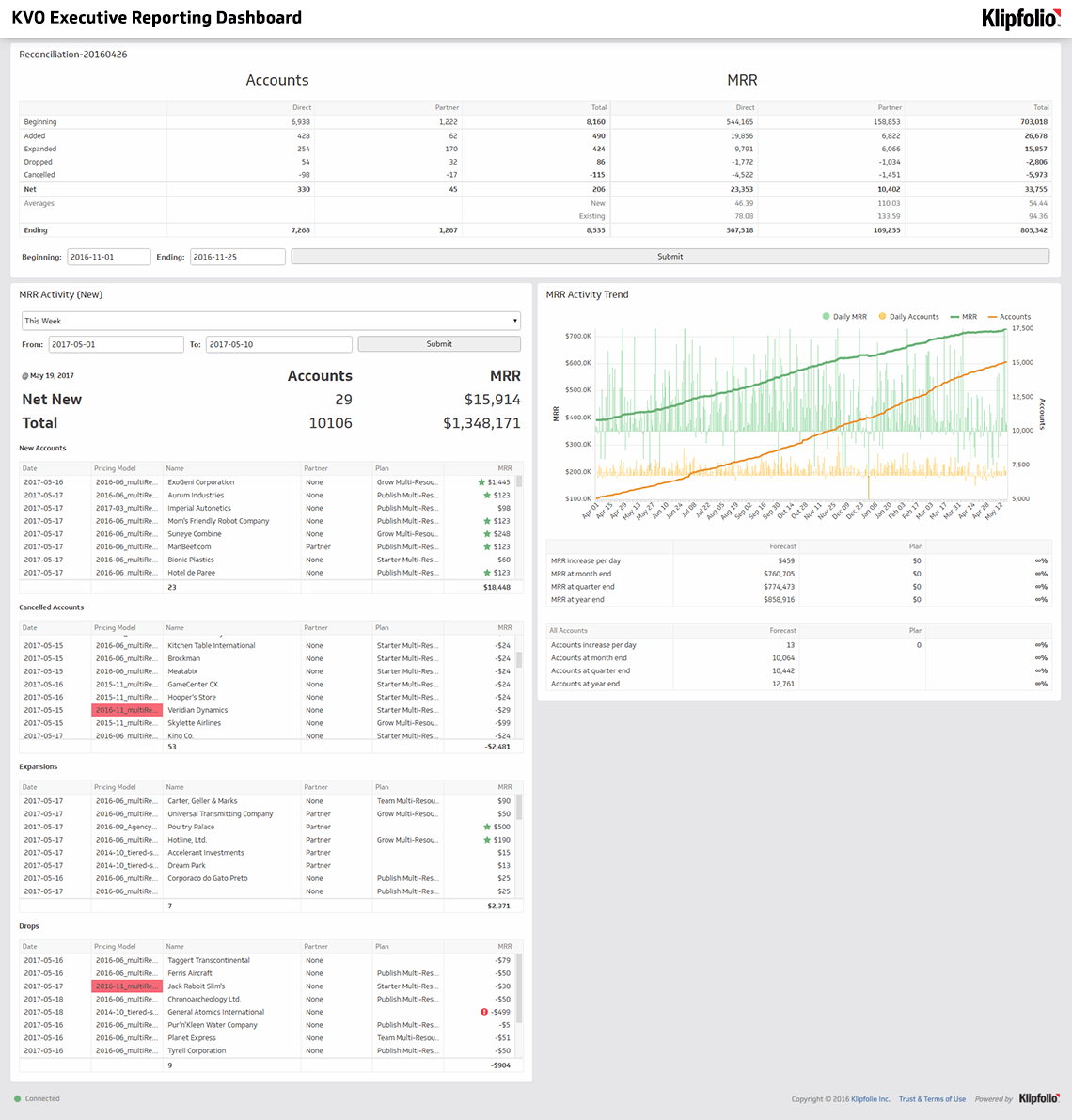
MRR movement by type
ARR and MRR are the two core revenue metrics for subscription businesses. Both measure recurring revenue — ARR annually, MRR monthly — and together they give you a complete picture of financial health and growth.
What is Annual Recurring Revenue (ARR)?
Annual Recurring Revenue (ARR) is the total recurring revenue a subscription business expects to generate over a 12-month period. It excludes one-time fees and gives you a stable, forward-looking view of revenue.
ARR is the number investors, boards, and executives reach for first. It anchors financial reporting, forecasting, and valuation conversations because it smooths out the month-to-month noise and shows the trajectory of the business over time.
ARR formula
ARR is calculated by summing all annual subscription contracts in effect, regardless of their start or end dates. One-time or non-recurring fees are excluded.
ARR = Annual recurring revenue from existing customers + Annual recurring revenue from new customers
What is Monthly Recurring Revenue (MRR)?
Monthly Recurring Revenue (MRR) is the total recurring revenue generated from active subscriptions within a given month. It changes with every new sign-up, cancellation, upgrade, or downgrade, making it the most responsive signal you have for what is happening in the business right now.
MRR is the number most leaders check first when they want to know whether growth is on track. Because it reflects changes month to month, it catches problems early, before they show up in annual figures.
MRR formula
MRR is calculated by summing the monthly subscription revenue from all active customers during a particular month.
MRR = Monthly recurring revenue from existing customers + Monthly recurring revenue from new customers
Key differences between ARR and MRR
ARR and MRR measure the same underlying revenue stream at different time scales. The right one to lead with depends on the decision you are making and who needs the answer.
| Dimension | ARR | MRR |
|---|---|---|
| Timeframe | Annual | Monthly |
| Granularity | High-level, aggregated view | Granular, month-by-month view |
| Responsiveness | Slower to reflect changes | Reflects fluctuations quickly |
| Primary use | Reporting, forecasting, valuation | Operations, day-to-day management |
| Audience | Investors, executives | Finance, growth, and product teams |
Timeframe
ARR looks at the total revenue expected over a full year. MRR looks at the total revenue generated in a single month. Neither is more accurate; they answer different questions.
Granularity
ARR aggregates all subscription revenue into a single annual figure. MRR breaks that revenue down month by month, making it easier to spot short-term trends or seasonal patterns before they compound.
Flexibility
MRR responds immediately to changes in your subscriber base. If you lose three enterprise accounts this month, MRR shows it now. ARR captures those same changes more slowly, which makes it more stable but less useful when you need to act quickly.
Comparability
ARR is the standard for annual financial reporting, investor updates, and company valuation. MRR is better suited to tracking the day-to-day pulse of your subscription business and catching problems while there is still time to respond.
ARR and MRR metric types
Both ARR and MRR break down into sub-types that show you where revenue is coming from and where it is leaking. These are the SaaS metrics worth tracking alongside the top-line figures:
Gross ARR/MRR: Total recurring revenue from all active customers before any adjustments for discounts, refunds, or cancellations.
Net ARR/MRR: Recurring revenue after accounting for discounts, refunds, and cancellations. This is a more accurate picture of revenue you will actually realize.
New ARR/MRR: Revenue generated from customers who have newly subscribed. Reflects how effectively your business is acquiring and converting customers.
Expansion ARR/MRR: Additional revenue from existing customers through upsells, cross-sells, or upgrades. Strong expansion revenue signals healthy customer relationships and growing account value.
Churn ARR/MRR: Revenue lost due to cancellations. Tracks the cost of customer attrition to your recurring revenue base.
Net Revenue Retention (NRR): Net Revenue Retention combines expansion and churn ARR/MRR to show the net change in recurring revenue from your existing customer base. It is one of the most important indicators of long-term revenue health for a subscription business.
Create custom dashboards for you and your team.
Get started with KlipsTracking ARR and MRR with a dashboard
Monitoring ARR and MRR in a spreadsheet works at first. As your subscriber base grows and your data sources multiply, the manual work compounds and the numbers start lagging behind reality. By the time you have pulled everything together, the moment to act may have passed.
Pasting figures into a spreadsheet or a chat tool to get a quick read on the business is a workaround, not a system. It breaks down the moment your data lives in more than one place, and it means every update requires someone to do the work again from scratch.
A dedicated SaaS dashboard pulls your subscription data together automatically, so gross, net, expansion, and churn figures are always current and in one place. You stop waiting for someone to pull a number and start knowing it without having to ask.
Klipfolio connects to your billing tools, CRMs, and data sources to keep your ARR and MRR metrics current. The right people see the right numbers, automatically, so decisions are based on what is actually happening, not on last week's export.