Sales Value Productivity
Measure the average revenue generated by each sales agent on your team.
Sales Value Productivity
Sales Value Productivity measures the average revenue generated by each member of your sales team. It's a direct read on whether your sales investment is paying off, and how much revenue each agent is actually responsible for.
Tracking this metric consistently tells you whether your team is becoming more or less efficient over time, where to focus coaching, and whether your headcount decisions make financial sense.
What is Sales Value Productivity?
Sales Value Productivity is total sales revenue divided by the number of sales agents. It shows you the average dollar amount each agent brings in during a specific period.
Sales Value Productivity = Total sales revenue / Total number of sales agents
Why Sales Value Productivity matters
Sales agents are among your biggest operational investments. This metric tells you whether that investment is translating into revenue, or where it isn't.
Here's what it helps you do:
- Benchmark performance: Compare individual agents against team averages to spot top performers and those who need support.
- Justify headcount: Determine whether adding or reducing sales staff makes financial sense based on revenue per agent.
- Set realistic targets: Establish achievable quotas grounded in actual team productivity data.
- Identify coaching needs: When productivity dips, it often signals a skill or process gap worth addressing before it compounds.
- Forecast revenue: Project future sales based on consistent productivity trends.
The underlying payoff isn't just a number on a dashboard. It's confidence in your hiring decisions, clearer conversations with your team, and fewer surprises at quarter-end.
How to calculate Sales Value Productivity
Step 1: Add up all revenue generated by your sales team for a specific period (monthly, quarterly, or annually).
Step 2: Count the total number of sales agents during that same period.
Step 3: Divide total revenue by the number of agents.
Example: If your sales team generated $600,000 in revenue last month and you have 5 agents, your Sales Value Productivity is $120,000 per agent per month.
Sales Value Productivity vs. related metrics
Sales Value Productivity works best alongside other metrics. Here's how it differs from similar measures:
| Metric | What it measures |
|---|---|
| Sales Value Productivity | Average revenue output per agent |
| Sales Quota Attainment | Whether individual agents hit their assigned targets |
| Revenue per transaction | Deal size, not total agent output |
| Win Rate | Percentage of opportunities closed, not dollar value generated |
| Average Customer Lifetime Value | Long-term customer worth, not immediate agent output |
No single metric tells the whole story. Sales Value Productivity gives you the team-level efficiency view; the others help you understand why it's moving.
Typical targets and benchmarks
Sales Value Productivity varies widely by industry, product complexity, and sales model. These ranges are a starting point:
- SaaS companies: $150,000 to $300,000 per agent annually, depending on deal size and sales cycle.
- Professional services: $200,000 to $500,000 per agent annually.
- Retail or transactional sales: $50,000 to $150,000 per agent annually.
- Enterprise sales: $500,000+ per agent annually, reflecting longer cycles and larger deals.
Your target should reflect your business model, market conditions, and growth stage. Adjust based on your own historical data before benchmarking against industry figures.
How to improve Sales Value Productivity
If your productivity metric is below target, these strategies tend to move the needle:
Streamline your sales process. Remove bottlenecks between lead qualification and close. Every unnecessary step costs your team time they could spend selling.
Invest in coaching. Regular skill development, especially in objection handling, discovery, and closing, directly lifts agent output. When productivity dips, coaching is usually the fastest lever.
Tighten your target market. Focus your team on high-value prospects. Better-fit leads close faster and at higher values, which improves productivity without adding headcount.
Reduce administrative burden. Automate data entry, follow-ups, and scheduling so agents spend more time on conversations that close, not tasks that don't.
Align incentives with outcomes. Commission structures that reward the right behaviours, not just volume, tend to produce more consistent results.
Act on what the data shows. A productivity metric that flags a problem is only useful if someone does something about it. Build a habit of connecting what the numbers show to a specific next step.
Create custom dashboards for you and your team.
Get started with KlipsTracking Sales Value Productivity with dashboards
Pulling this number manually from spreadsheets means you're always looking at last week's reality, not today's. A dashboard approach changes that.
With Klips, you connect directly to your CRM or sales data source, and Sales Value Productivity updates automatically as deals close. You're not waiting for someone to compile a report or pasting numbers into a tool that has no context about your business or your targets.
What you get instead:
- Real-time visibility: See productivity updates as deals close, not days or weeks later.
- Automated calculations: Reduce errors and eliminate manual updates.
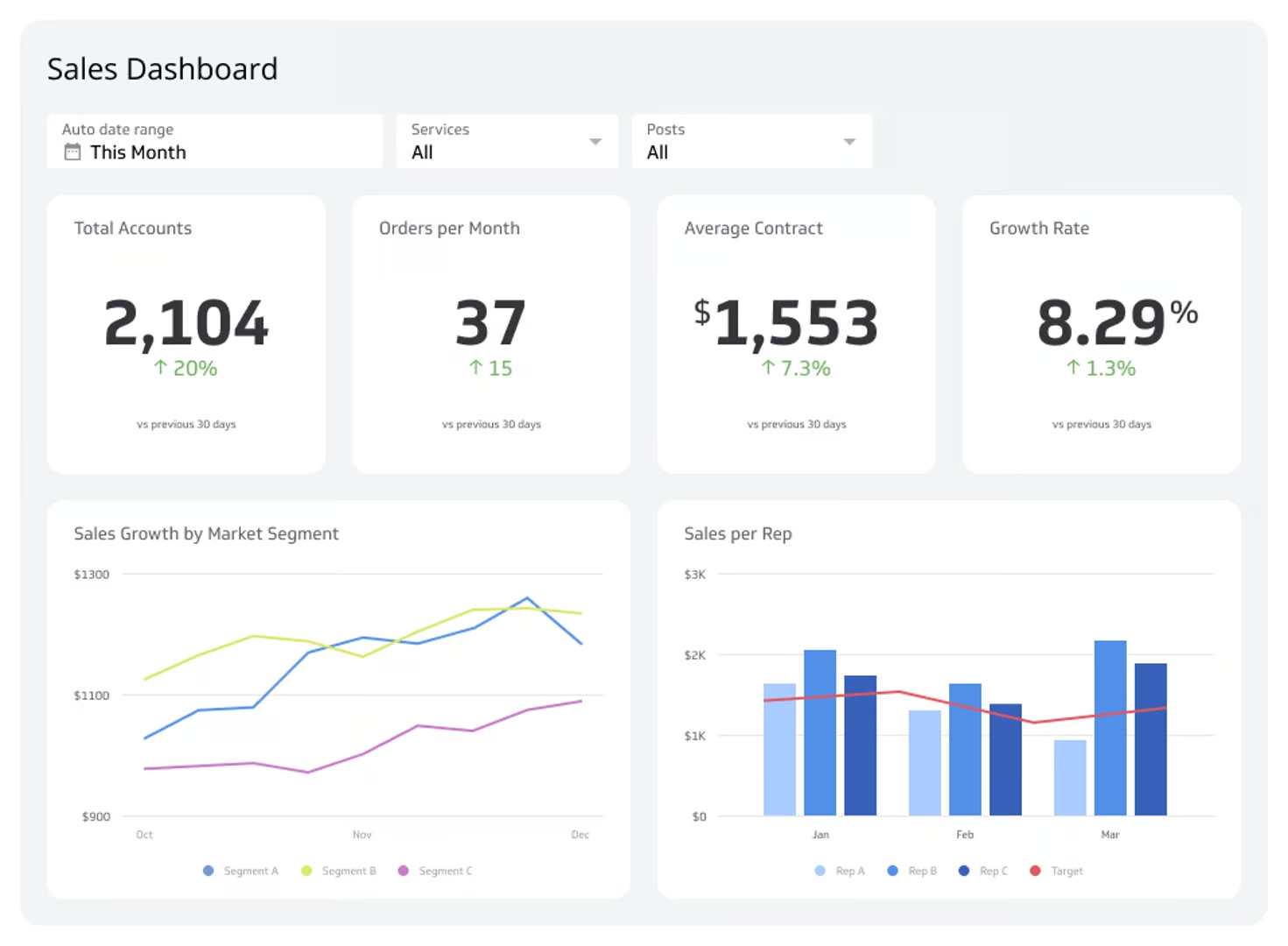
- Visual trends: Spot seasonal dips, ramp periods, and growth trajectories without digging through rows of data.
- Comparative views: Compare agents, teams, and time periods side by side.
- Threshold alerts: Flag when productivity drops below target so you can act before it compounds.
The goal isn't a better-looking report. It's knowing where your team stands without having to ask, and having enough confidence in the number to act on it.