Social Sentiment
A measure of the overall emotional tone of public conversations about your brand, drawn from social media posts, reviews, and comments.
Brand Sentiment by tone
What is Social Sentiment?
Social Sentiment is a measure of the overall emotional tone of public conversations about your brand, product, or topic, drawn from social media posts, reviews, and comments.
Also called sentiment analysis or opinion mining, Social Sentiment classifies mentions as positive, negative, or neutral. The goal is to understand how people feel, not just what they say.
Why Social Sentiment matters
What people say about your brand online shapes perception faster than any campaign you run. Social Sentiment gives you a read on whether those conversations are working for you or against you.
Platforms like Hootsuite, Brandwatch, and Talkwalker track brand mentions across social media, blogs, and press coverage, then score each one. That score tells you whether the conversation is trending in a direction you need to act on.
Without this signal, you're making brand decisions based on guesswork. With it, you know when to engage, when to correct course, and whether a campaign landed the way you intended.
How Social Sentiment is measured
Each mention is scored at the word level. Positive words carry a higher score; negative words pull it down. But word-level scoring alone isn't enough.
Natural Language Processing (NLP) handles sentence structure, so a phrase like "I am not happy" registers as negative even though it contains the word "happy." The negation is caught and factored in.
The result is a sentiment score for each mention, which aggregates into an overall picture of how your brand is perceived across channels.
Social Sentiment benchmarks
There is no universal benchmark for Social Sentiment. Consumer behaviour varies too much across industries and platforms to set a single standard.
The practical approach: benchmark against your closest competitors. Tools like Brandwatch and Talkwalker include competitive benchmarking features so you can measure your sentiment relative to others in your category, not against an abstract ideal.
Accuracy and limitations
Automated sentiment analysis is accurate roughly 70 to 75 percent of the time. The gap comes from humour, irony, and cultural nuance that machines still struggle to interpret the way a human reader would.
Two things help close that gap:
- Volume: Social Sentiment works best with large data sets. Sparse mentions produce unreliable scores.
- Methodology awareness: Every platform handles edge cases differently. Know the margin of error in the tool you use before drawing conclusions from the numbers.
Social Sentiment best practices
Before acting on your Social Sentiment data, a few habits make the signal more reliable.
- Understand your platform's methodology. The margin of error matters. A Moz primer on social media metrics is a useful starting point for grounding your interpretation.
- Track before and after campaigns. Sentiment snapshots taken at campaign launch and close show you whether the campaign moved perception in the right direction.
- Watch for spikes, not just averages. A sudden shift in sentiment often signals a PR moment in the making, positive or negative, before it shows up anywhere else.
How to monitor Social Sentiment
Spot-checking sentiment manually doesn't scale. The useful version of Social Sentiment monitoring surfaces shifts automatically, so you know when something changes without having to go looking.
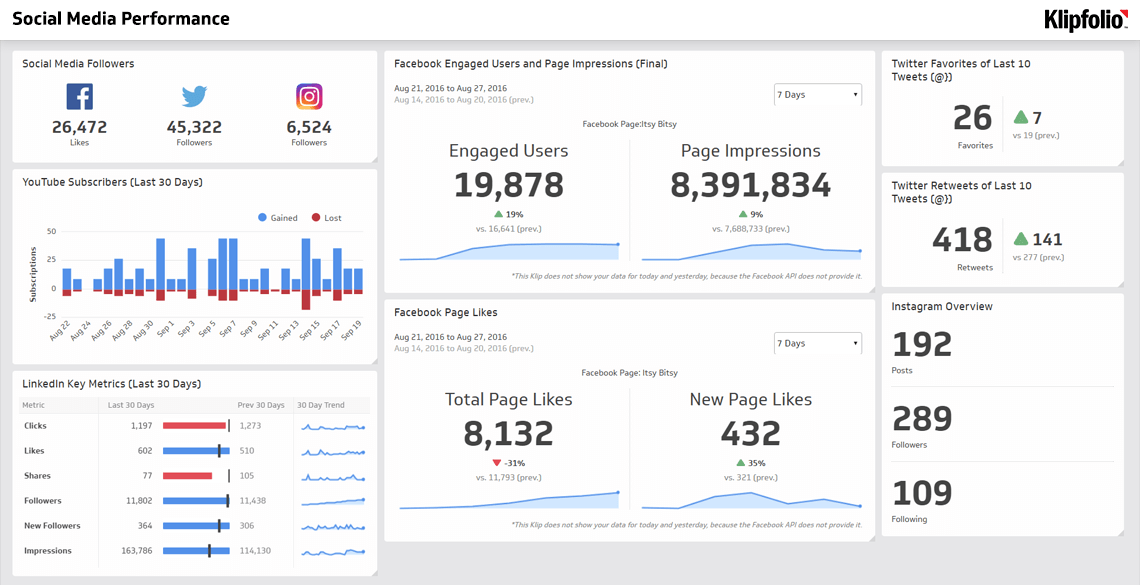
Connecting your sentiment data to a live dashboard keeps it visible alongside other social media KPIs. You can track trends over time, compare sentiment across campaigns, and catch early signals before they become bigger issues.
Klipfolio's Social Media Dashboard brings your key social metrics into one place, so your team is working from the same numbers without anyone having to pull a report or paste figures into a spreadsheet.
Create custom dashboards for you and your team.
Get started with KlipsFurther reading
For a deeper look at sentiment analysis methodology and how it applies to brand tracking, Brandwatch and Talkwalker both publish detailed documentation on how their NLP engines classify mentions.