Lead Conversion Rate
Measure the percentage of leads that become paying customers.
Track all your Digital Marketing KPIs in one place
Sign up for free and start making decisions for your business with confidence.
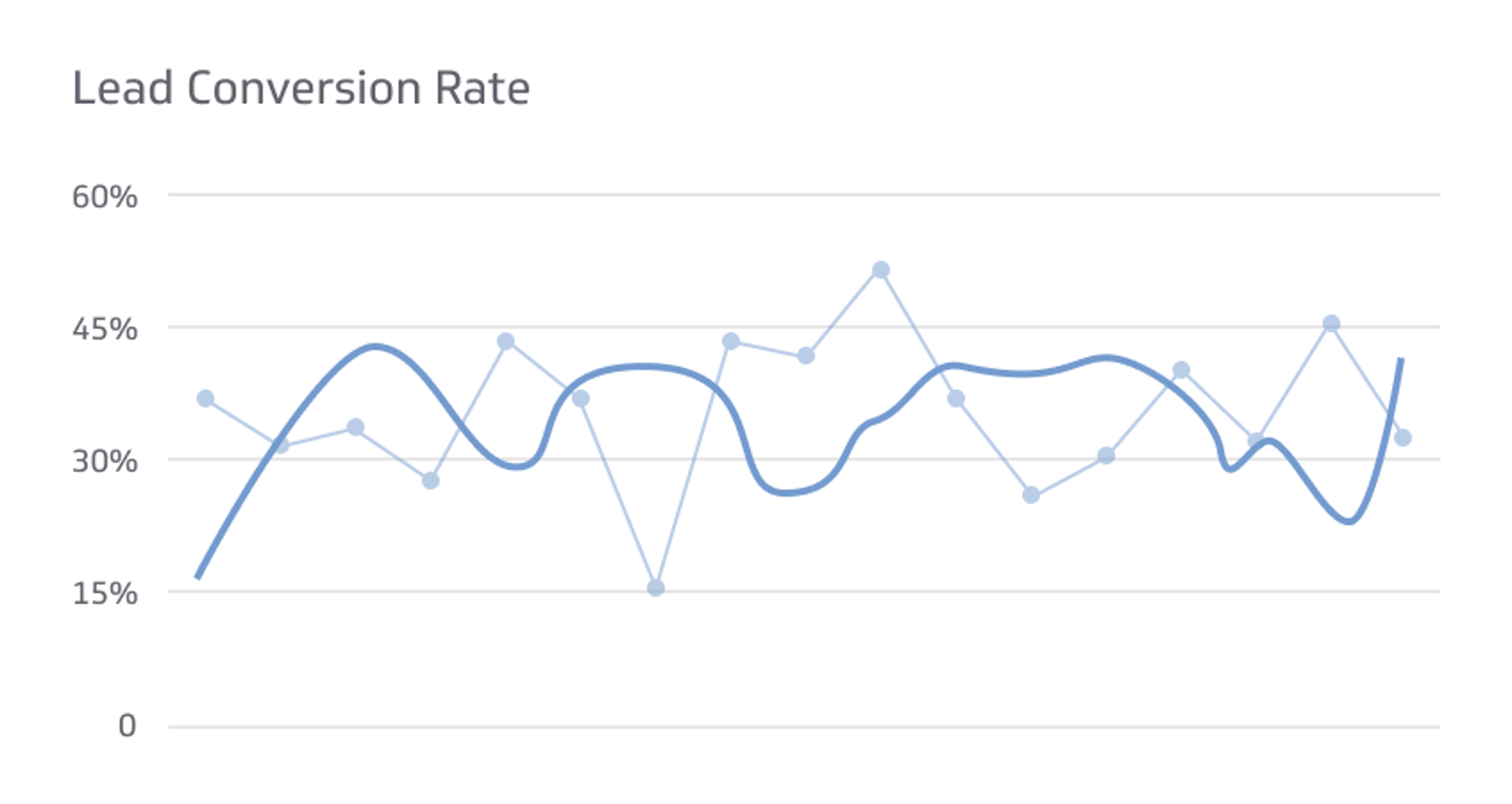
Lead Conversion Rate measures the percentage of leads that become paying customers. It shows how effectively your marketing and sales efforts turn prospects into revenue.
Lead Conversion Rate formula
Lead Conversion Rate = (Number of leads converted to customers) / (Total number of leads generated) × 100
Example: If you generate 500 leads in a month and 50 become customers, your lead conversion rate is (50 / 500) × 100 = 10%.
Why Lead Conversion Rate matters
Your lead conversion rate reveals how well your sales and marketing teams work together. A strong rate means your lead generation attracts qualified prospects and your sales process closes deals efficiently. A weak rate signals that either your leads lack quality, your sales process needs refinement, or both.
Tracking this metric helps you:
- Identify bottlenecks in your sales funnel where prospects drop off
- Optimize your lead generation to attract higher-quality prospects
- Measure sales effectiveness and team performance
- Forecast revenue based on lead volume and conversion patterns
- Allocate resources more strategically across marketing and sales
How to improve your Lead Conversion Rate
Qualify your leads better. Not all leads are equal. Focus on attracting prospects who match your ideal customer profile rather than chasing volume alone.
Shorten your sales cycle. The faster you move leads through your pipeline, the less time they have to lose interest. Streamline handoffs between marketing and sales, and remove unnecessary steps.
Align marketing and sales. When both teams agree on what constitutes a qualified lead (MQL vs SQL), you avoid wasted effort and improve conversion odds.
Personalize your outreach. Generic follow-ups underperform. Use the information you've gathered about each prospect to tailor your messaging.
Test and iterate. A/B test your email subject lines, call scripts, landing pages, and offers. Small improvements compound over time.
Track the full journey. Monitor which campaigns, channels, and messages produce leads that actually convert. Double down on what works.
Lead Conversion Rate by industry
Conversion rates vary significantly by industry, sales model, and sales cycle length. B2B companies typically see lower conversion rates (2–5%) due to longer decision cycles and multiple stakeholders. B2C e-commerce often sees higher rates (5–15%) because purchase decisions are faster. SaaS companies commonly report 5–10% depending on their pricing and product complexity.
Use your industry benchmarks as a baseline, but focus on improving your rate over time rather than matching competitors exactly.
Reporting frequency
Track your lead conversion rate monthly to spot trends and catch problems early. Review it weekly if you're actively optimizing your sales process or running campaigns.
Related KPIs
- Cost Per Lead — How much you spend to acquire each lead
- Sales Qualified Leads — Leads your sales team deems ready to close
- Customer Acquisition Cost — Total cost to acquire a paying customer
- Lead-to-Customer Ratio — Another name for lead conversion rate
- Sign-Up Conversion Rate — Percentage of visitors who sign up
Typical targets
A healthy lead conversion rate depends on your industry and sales model. Most B2B companies target 2–5%, while B2C and SaaS companies often aim for 5–10%. If you're new to tracking this metric, start by establishing your baseline, then set incremental improvement goals—such as 10–20% quarter-over-quarter gains.
Who should track this metric
- Sales leaders and managers — Monitor team performance and pipeline health
- Marketing managers — Evaluate campaign quality and lead generation effectiveness
- Business owners and CEOs — Understand revenue generation efficiency and growth potential
- Sales development representatives (SDRs) — Track personal and team conversion performance
How to track Lead Conversion Rate in Klipfolio
Klipfolio makes it simple to monitor your lead conversion rate alongside related metrics like cost per lead and customer acquisition cost. Connect your CRM, marketing automation platform, or data warehouse to pull lead and customer data in real time. Then visualize your conversion rate on a dashboard alongside your sales pipeline, revenue, and team performance metrics.
With Klipfolio, you can set performance targets, track progress, and share results with stakeholders—all without manual spreadsheet updates.
Try Klipfolio free to start tracking your lead conversion rate and other critical sales metrics.
Related Metrics & KPIs
.png)