Revenue per Successful Call
Measures the average revenue generated from each completed call that results in a sale or desired outcome.
Revenue per Successful Call
$121.48
vs. $119.70 previous period
What is Revenue per Successful Call?
Revenue per Successful Call measures the average revenue generated from each completed call that results in a sale or desired outcome. It tells sales and customer service leaders whether their team is converting calls into real business results, not just activity.
For call centres focused on sales, this metric shows how effectively agents close deals. For support teams, it captures upsells or additional revenue opportunities during customer interactions. Either way, it's a direct indicator of call centre profitability.
Why Revenue per Successful Call matters
Busy doesn't mean profitable. A team that logs hundreds of calls a week but generates thin revenue per outcome is working hard without the results to show for it. This metric closes that gap.
Tracking Revenue per Successful Call helps you answer the questions that matter:
- Are your calls generating value? A low figure points to coaching gaps, weak scripts, or insufficient product knowledge.
- Where should you invest? High-performing teams show where your sales approach works, so you can replicate it.
- Is performance improving? Benchmarking against your own historical data reveals whether changes are actually moving the number.
- What's the ROI of your calling programme? You can see whether the cost of staffing, tools, and training delivers acceptable returns.
Without this visibility, you're managing effort, not outcomes. Revenue per Successful Call connects the two.
How to calculate Revenue per Successful Call
Formula:
Total revenue from successful calls ÷ Total number of successful calls = Revenue per Successful Call
Example:
Your team completed 500 successful calls in a month and generated £22,500 in revenue.
£22,500 ÷ 500 = £45 per successful call
What counts as "successful"?
Define this clearly before you start tracking. A successful call typically means one of the following:
- A sale was closed.
- An appointment was booked.
- A customer problem was resolved (for support teams tracking upsells).
- A qualified lead was captured.
Be consistent with your definition so the metric stays reliable month to month. Changing the definition mid-stream makes historical comparisons meaningless.
How to improve Revenue per Successful Call
Coach your top performers. Identify agents with the highest Revenue per Successful Call and have them mentor others. Record calls (with permission) to surface what effective conversations actually sound like.
Refine your targeting. Calls reaching high-intent prospects or existing customers who are likely to buy will always outperform broad, low-quality lists. Poor list quality is one of the fastest ways to drag this metric down.
Strengthen product knowledge. Agents who understand your offering deeply close more deals and upsell more naturally. Confidence in the product comes through on the call.
Test your process. Try different scripts, call flows, and objection-handling approaches. Small improvements in conversion rate compound quickly when you're running high call volumes.
Set targets grounded in your own data. Industry benchmarks vary widely (£30 to £100+ per call, depending on product, market, and sales cycle). Start from your own baseline and build from there.
Revenue per Successful Call vs. related metrics
| Metric | What it measures | Why it matters |
|---|---|---|
| Revenue per Successful Call | Average revenue per completed sale or outcome | Shows the profitability of individual calls |
| Call Conversion Rate | Percentage of calls that result in a sale | Reveals how many calls actually convert |
| Average Handle Time | How long agents spend on each call | Indicates efficiency, but not value |
| Cost per Call | Total call centre cost divided by total calls | Helps calculate net profit per call |
| Customer Lifetime Value | Total revenue from a customer over time | Shows long-term value beyond a single call |
Revenue per Successful Call is most useful alongside Call Conversion Rate and Cost per Call. Together, they give you a complete picture of call centre health: how often calls succeed, how much each success is worth, and what it costs to get there.
How to track Revenue per Successful Call
Manual spreadsheets work for small teams, but they break down quickly at scale. Data entry errors, stale numbers, and time spent pulling figures from your CRM, phone system, or accounting software all add up. By the time the report is ready, the moment to act has often passed.
A dashboard connected to your data sources updates automatically, so you always know where you stand without having to ask someone to pull the numbers. That kind of visibility means you can:
- Spot performance dips before they become entrenched problems.
- Share results with your team to build accountability and morale.
- Make confident decisions about hiring, coaching, or process changes.
- Justify budget requests to leadership with current, reliable data.
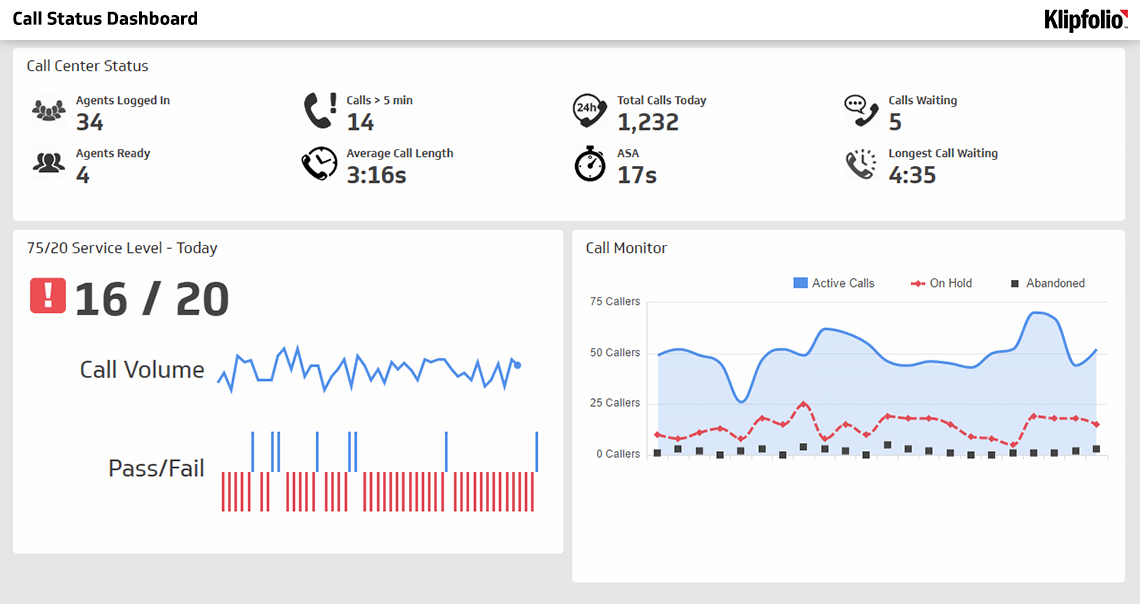
Klipfolio connects to your CRM, telephony platform, and other data sources to keep Revenue per Successful Call, and the metrics around it, current and visible to the right people.
Reporting frequency and targets
How often to review: Monthly is the standard cadence, though high-volume sales teams often track weekly or daily to catch issues before they compound.
Setting a target: Use your own historical baseline first. Once you have a stable benchmark, research your industry range. B2B software, insurance, and financial services typically see different figures than retail or hospitality.
What to watch alongside it: A rising Revenue per Successful Call paired with a falling Call Conversion Rate can mean your team is closing bigger deals but reaching fewer of them. Context matters.
Create custom dashboards for you and your team.
Get started with KlipsKey takeaway
Revenue per Successful Call turns a volume metric into an outcome metric. It holds teams accountable for the quality of their calls, not just the quantity, and gives leaders a clear signal about whether their calling strategy is actually profitable. Track it consistently, share it transparently, and use it to guide coaching and process improvements.