Current ER Occupancy
Measures the percentage of beds currently occupied in your emergency department compared to total available beds.
Current ER Occupancy
What is Current ER Occupancy?
Current ER Occupancy measures the percentage of beds currently occupied in your emergency department compared to total available beds.
Real-time monitoring keeps your staff informed of actual ER conditions and enables rapid response to capacity challenges. When occupancy approaches maximum capacity, you can proactively reroute patients to partner facilities, adjust staff deployment, and maintain service quality during surge periods.
Why Current ER Occupancy matters
Emergency departments operate under constant pressure. Patient arrivals are unpredictable, and bed availability directly affects your ability to deliver timely care.
Tracking Current ER Occupancy in real-time helps you:
- Anticipate bottlenecks: Identify when your ER is approaching full capacity before a crisis hits.
- Adjust staffing: Shift nurse and physician schedules based on actual demand patterns.
- Improve patient outcomes: Reduce wait times and handoff delays by managing flow proactively.
- Support clinical decisions: Make informed choices about patient admission, discharge, or transfer.
- Plan for growth: Understand peak occupancy trends to guide facility expansion or resource allocation.
The value isn't just knowing the number. It's knowing the number before you need it, without having to chase it down.
How to calculate Current ER Occupancy
Current ER Occupancy (%) = (Currently Occupied Beds ÷ Total Available Beds) × 100
Example
If your ER has 50 total beds and 38 are currently occupied:
(38 ÷ 50) × 100 = 76%
That tells you three-quarters of your capacity is in use. Many healthcare organizations set occupancy thresholds, for example, triggering a surge protocol when occupancy exceeds 85%.
Benchmarks and targets
Current ER Occupancy benchmarks vary by facility type, geographic region, and patient population. General industry guidance suggests three operational bands:
- 60 to 75%: Healthy operational range. Staff can manage patient flow without strain.
- 75 to 85%: Elevated activity. Monitor closely and prepare surge protocols.
- Above 85%: High stress. Consider activating overflow beds, diverting non-emergent patients, or calling in additional staff.
Your specific targets should reflect your facility's design capacity, staffing model, and community needs. Rural hospitals, urban trauma centres, and suburban urgent care facilities often operate at different optimal levels.
How to monitor Current ER Occupancy
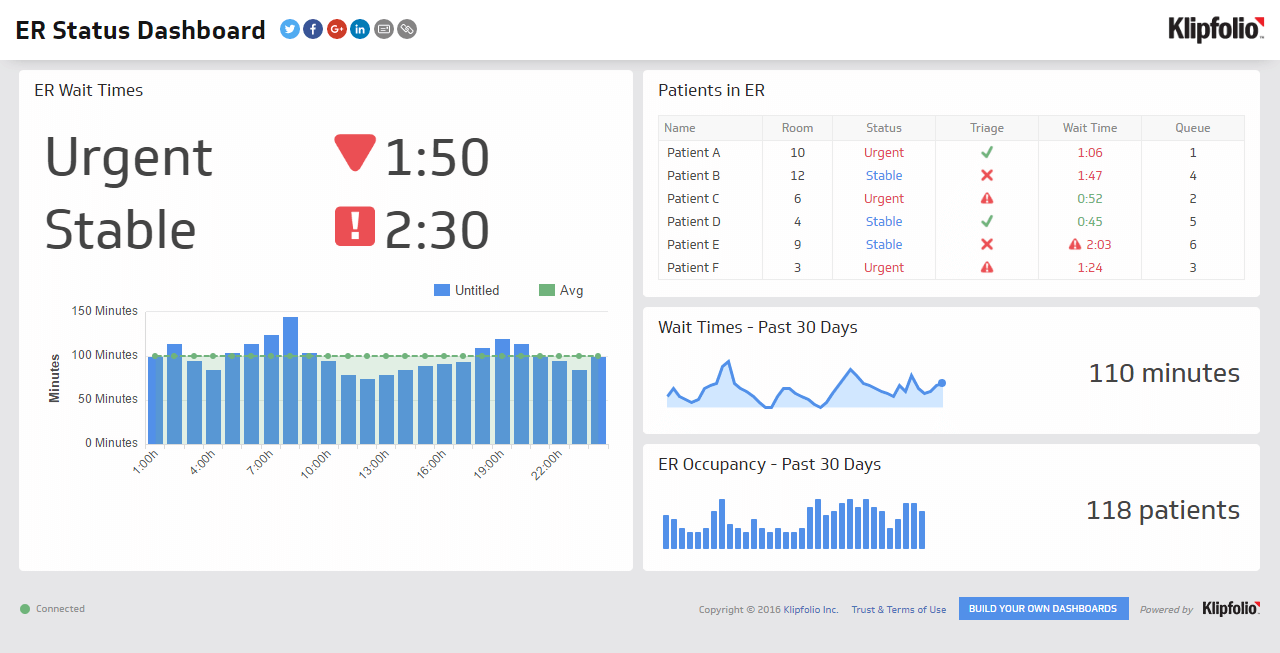
Once you've set benchmarks, establish a consistent monitoring process. Many healthcare organizations use real-time dashboards to track occupancy alongside related metrics such as:
- Average Length of Stay (LOS)
- Bed turnover rate
- Left Without Being Seen (LWBS) rate
- Door-to-provider time
A centralized dashboard lets your team, from frontline staff to operations leadership, see occupancy at a glance and respond quickly to changing conditions. Automated alerts can notify managers when occupancy crosses critical thresholds, so the right people know without having to go looking.
That's the difference between a number you check and a number that works for you.
Create custom dashboards for you and your team.
Get started with KlipsRelated healthcare KPIs
Current ER Occupancy tells you where capacity stands right now. Pair it with these metrics to build a complete picture of ER performance:
- ER Wait Time: How long patients wait from arrival to being seen.
- Average Length of Stay (LOS): How long patients remain in the ER before discharge or admission.
- Bed Turnover Rate: How quickly beds are cleaned and readied for the next patient.
- Left Without Being Seen (LWBS): Patients who leave before receiving care, often a sign of excessive wait times.
- ER Admission Rate: The percentage of ER patients admitted to inpatient beds.
Monitoring these metrics together gives your leadership team a reliable, consistent view of ER efficiency and patient flow, and the confidence to act on it.