Lab Turnaround Time
Lab Turnaround Time measures how quickly your laboratory processes and reports test results, from specimen receipt to result delivery.
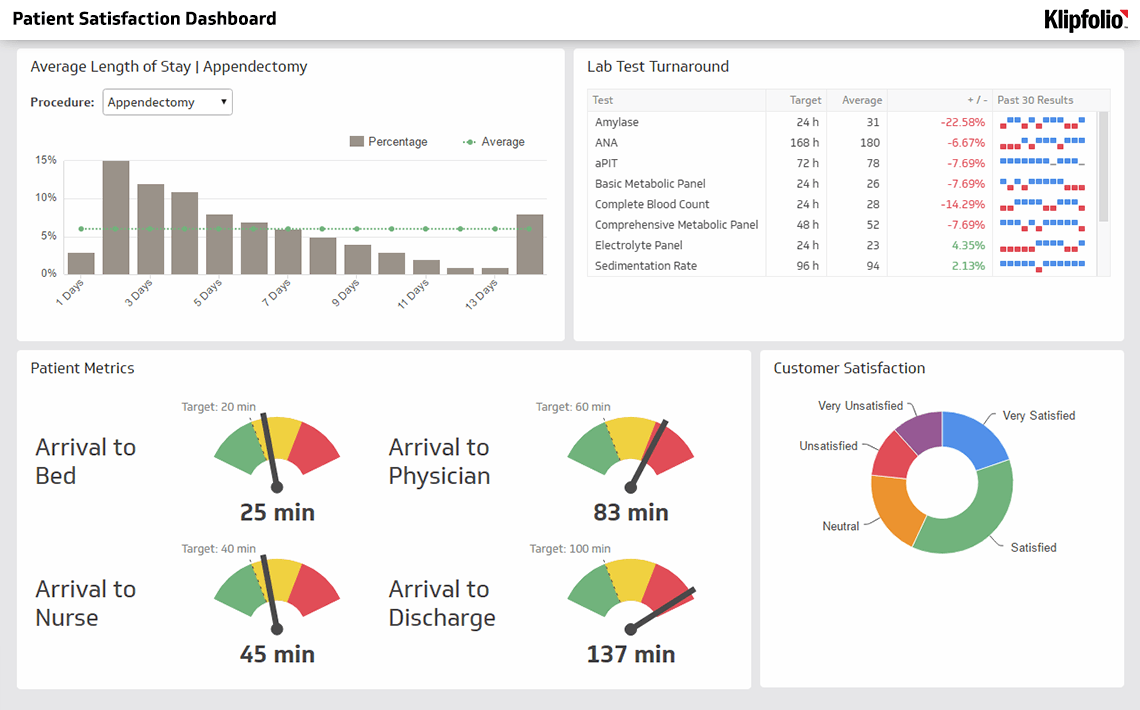
Average turnaround time by test type
Lab Turnaround Time measures how quickly your laboratory processes and reports test results, from specimen receipt to result delivery.
It reflects your lab's operational efficiency and directly influences patient satisfaction and clinical outcomes. Fast turnaround times enable faster diagnosis and treatment, while delays frustrate patients and clinicians alike.
This KPI is a foundational performance metric for any laboratory operation. Because different test types require different processing times, a blood culture may take 24 to 48 hours while a basic metabolic panel takes 2 to 4 hours, track turnaround time separately for each test category. That segmented view gives you a realistic picture of performance and helps you pinpoint which test types need attention.
Why Lab Turnaround Time matters
Lengthy delays create patient anxiety, reduce confidence in your facility, and hold up critical treatment decisions. From an operational perspective, turnaround time also reveals bottlenecks in your lab workflow, from specimen collection and processing through to analysis and reporting.
Tracking this KPI helps you:
Identify workflow inefficiencies in specimen handling, testing, or reporting stages.
Set realistic benchmarks based on test complexity and industry standards.
Improve patient outcomes by enabling faster clinical decisions.
Allocate resources more effectively to high-demand test categories.
How to calculate Lab Turnaround Time
Lab Turnaround Time is the elapsed time from specimen receipt to result reporting.
Lab Turnaround Time = Result Report Time - Specimen Receipt Time
If a specimen arrives at 8:00 AM and results are reported at 2:00 PM, the turnaround time is 6 hours.
Breaking it down by test type
Processing times vary significantly by test, so segment your calculation by category:
Stat tests (emergency): Often required within 1 hour or less.
Routine tests: Typically 24 to 48 hours.
Specialty tests: May require 48 to 72 hours or longer.
For each category, calculate the average turnaround time over a set period, weekly or monthly, then compare it against your established benchmark or industry standard.
Example calculation
If your lab processes 50 blood cultures in a week:
Average Turnaround Time = Sum of All Turnaround Times / Number of Tests
Average Turnaround Time = 1,850 hours / 50 = 37 hours
A 37-hour average against a 48-hour benchmark tells you performance is strong. The same number against a 24-hour benchmark tells you something needs to change.
Setting benchmarks and targets
Establishing realistic benchmarks is critical. Industry standards vary by test type and lab size, but here are typical ranges:
| Test type | Typical turnaround | Target |
|---|---|---|
| Stat (urgent) | 30 to 60 minutes | Less than 1 hour |
| Routine blood work | 24 hours | 24 to 48 hours |
| Cultures | 24 to 72 hours | 48 to 72 hours |
| Specialty tests | 48 to 96 hours | 72 to 96 hours |
Work with your lab director and clinical teams to set benchmarks that balance speed with accuracy. A benchmark that's too aggressive may compromise quality; one that's too lenient won't drive improvement.
Key factors affecting turnaround time
Several operational factors influence how quickly your lab can process results:
Staffing levels: Understaffed labs experience longer processing delays.
Equipment capacity: Older or limited equipment can bottleneck throughput.
Specimen quality: Poor collection or labelling causes rework and delays.
Test complexity: More complex assays naturally take longer.
Peak demand periods: High-volume times, such as morning collections, can slow processing.
IT systems: Outdated lab information systems (LIS) may slow data entry and reporting.
Create custom dashboards for you and your team.
Get started with KlipsMonitoring Lab Turnaround Time on a dashboard
Once you've established benchmarks, you need a reliable way to track performance over time. A dedicated dashboard means you're not waiting for someone to pull the numbers or piecing together data from separate sources. Performance is visible, consistent, and ready when you need it.
An effective lab dashboard should display:
Current average turnaround time by test type.
Trend charts showing performance over weeks or months.
Comparison to benchmark so you can see at a glance whether you're on target, at risk, or exceeding expectations.
Peak delay periods to identify when bottlenecks occur.
Performance by shift or technician (if applicable) to support coaching and training.
That kind of consistent visibility helps your lab team respond quickly to delays. It also gives leadership a reliable, up-to-date picture of operational performance, so decisions are based on numbers everyone trusts, not the most recent spreadsheet export or a figure someone pasted into a message.
For more on healthcare performance tracking, explore our healthcare dashboard examples and KPI examples & templates.