Full-Time Employee
A full-time employee works enough hours per week to meet employer or legal thresholds, but the exact definition depends on which law applies and what benefits are at stake.
Full-Time Employee Headcount
What is a Full-Time Employee?
A full-time employee is a worker whose weekly hours meet or exceed the threshold set by their employer or applicable law, typically between 30 and 40 hours per week.
The definition sounds simple. In practice, it depends on which law you're looking at, what benefits are involved, and how your organization has defined the threshold internally. Here's what you need to know.
The federal baseline: FLSA and overtime
The Fair Labor Standards Act (FLSA) does not define full-time employment. What it does define is overtime: any hourly employee who works more than 40 hours in a week must be paid at least 1.5 times their regular rate for those additional hours.
That 40-hour threshold became the de facto standard for full-time across most industries, even though the FLSA never explicitly required it. Employers adopted it because it was clean, widely understood, and already embedded in payroll systems.
The FLSA also draws a line between two categories of employees:
- Exempt employees are salaried workers not entitled to overtime pay. Their compensation is fixed regardless of hours worked.
- Non-exempt employees are paid hourly and must receive overtime once they cross the 40-hour threshold.
Exempt status depends on both salary level and job duties. Most executive, administrative, and professional roles qualify as exempt, but the classification is not automatic.
How the ACA changed the definition
The Affordable Care Act (ACA), passed in 2010, introduced a separate definition of full-time: an employee who averages 130 hours of service per month, which works out to roughly 30 hours per week.
This matters for any organization with 50 or more full-time equivalent employees. Those employers are required to offer health coverage to employees who meet the ACA threshold. An employee who works 32 hours a week is full-time under the ACA, even if your internal policy requires 40 hours to qualify for other benefits.
FMLA eligibility and hours
The Family and Medical Leave Act (FMLA) does not define full-time either, but it sets an hours-based eligibility threshold: an employee must have worked at least 1,250 hours over the previous 12 months to qualify for up to 12 weeks of unpaid, job-protected leave.
That works out to roughly 24 hours per week. An employee working 25 to 30 hours per week may qualify for FMLA leave even if your organization classifies them as part-time for benefits purposes.
Employer-defined thresholds
Outside of what federal law requires, employers have flexibility to set their own full-time threshold for benefits like:
- Paid vacation and sick time
- Retirement plan eligibility
- Health insurance (above ACA minimums)
- Training investment and promotion eligibility
Most organizations land somewhere between 30 and 40 hours as their internal definition. The practical effect is that an employee might be full-time for ACA healthcare purposes at 30 hours, eligible for FMLA at 25 hours, but not eligible for the company's retirement plan until they hit 35 hours per week.
Keeping these thresholds clearly documented protects both the employer and the employee.
Full-time versus part-time: what it means for your team
Hiring decisions are rarely just about hours. The classification affects your labour costs, your legal obligations, and your team's stability.
Full-time employees tend to bring deeper institutional knowledge and longer tenure. The trade-off is higher fixed labour costs, including benefits, overtime exposure, and training investment. If workload drops, you carry those costs regardless.
Part-time employees offer scheduling flexibility and lower baseline costs. The trade-off is higher turnover risk and less continuity, especially in roles that require significant onboarding.
Neither is universally better. The right mix depends on your workload patterns, your budget, and the complexity of the roles you're filling.
Create custom dashboards for you and your team.
Get started with KlipsTracking Full-Time Employee count as a KPI
Full-Time Employee count is a core HR metric. Leaders use it to track headcount growth, calculate cost per employee, and measure ratios like revenue per Full-Time Employee.
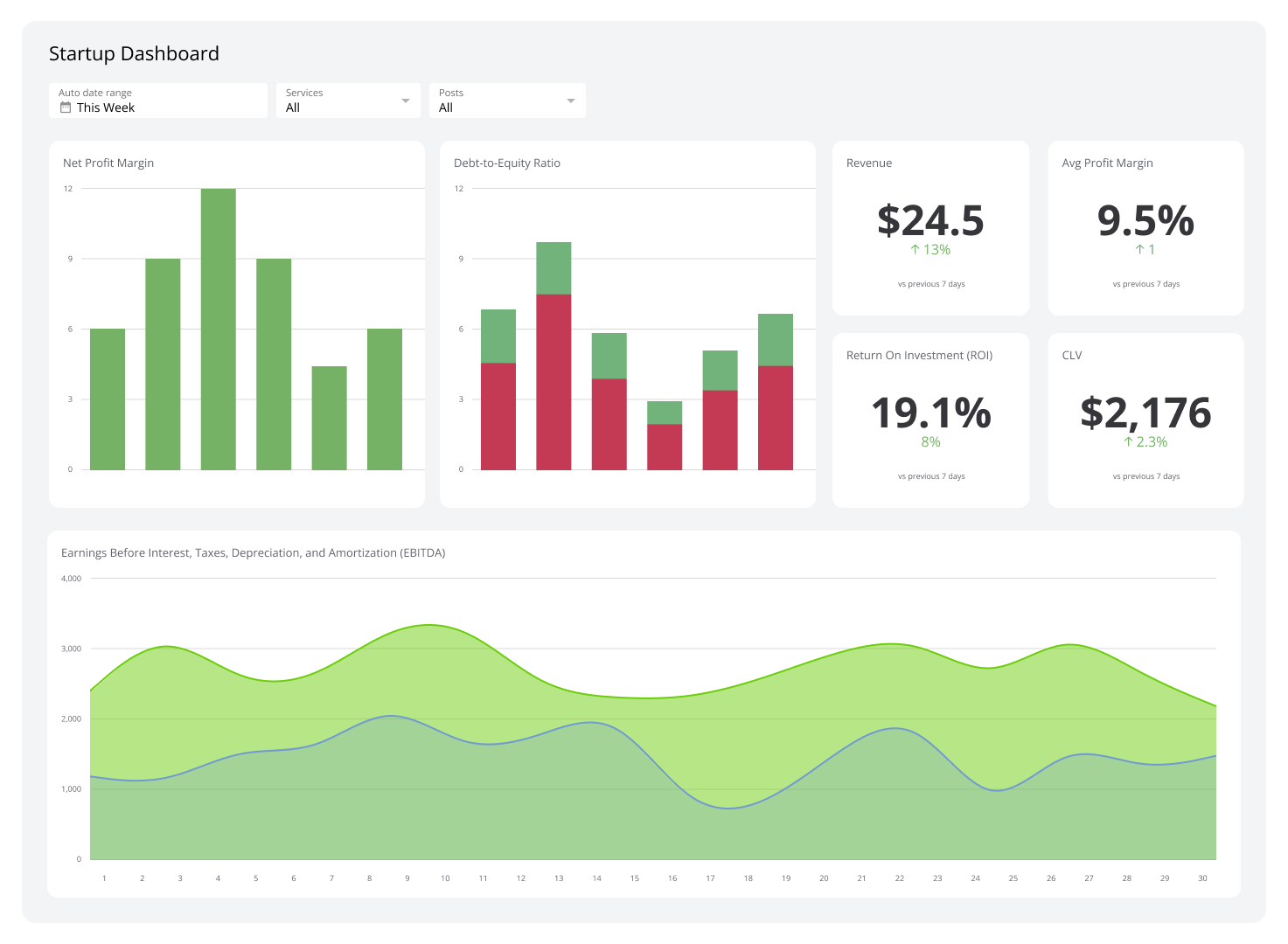
Knowing your current count is one thing. Knowing how it's trending, and what it means for your labour costs and capacity, is where the insight lives. A dashboard that pulls headcount, hours worked, and benefits eligibility data into one view means you're not piecing that picture together from separate spreadsheets every time you need an answer.
Klipfolio connects to your HR systems and payroll data so your Full-Time Employee metrics stay current without manual updates. Your team sees the same numbers you do, and you spend less time explaining the data and more time acting on it.