Customer Acquisition
Measure how effective your team is at gaining new customers during a specified time period.
New customers acquired
Customer Acquisition is the count of new customers added to your business over a defined period. It measures how effectively your team converts prospects into paying customers.
What is Customer Acquisition?
Customer Acquisition is the number of new customers your business gains within a specific time period. It is one of the most direct signals of whether your growth efforts are working.
Most businesses set growth targets. Customer Acquisition tells you whether you are hitting them. A rising number means your marketing and sales efforts are landing. A flat or falling number is worth investigating before it quietly compounds into a larger problem.
Why Customer Acquisition matters
Every new customer represents future revenue, not just a single transaction. Tracking Customer Acquisition over time shows you whether your pipeline is healthy, whether your team's efforts are converting, and whether your growth rate is sustainable.
Without a clear acquisition number, you are making decisions based on instinct instead of evidence. With it, you can spot trends early, adjust your approach, and set targets with confidence.
A few things this metric helps you answer:
- Is growth accelerating or stalling? Consistent acquisition growth signals a healthy pipeline and effective outreach.
- Are campaigns actually working? Acquisition numbers tied to specific periods or channels tell you what is driving results.
- Are you replacing churn? If you are losing customers at roughly the same rate you are gaining them, revenue stays flat even when acquisition looks healthy.
How to calculate Customer Acquisition
Customer Acquisition is a count, not a ratio. You are simply measuring how many new customers joined your business during a defined window.
Customer Acquisition = Number of new customers in a given period
Example: If you had 500 customers at the start of the month and 560 at the end, your Customer Acquisition for that month is 60 new customers.
When you want to express this as a growth rate, the calculation becomes:
Customer Acquisition Rate = (New customers / Starting customer count) × 100
Example: 60 new customers / 500 starting customers × 100 = 12% acquisition rate
This rate lets you compare performance across periods of different sizes, which is more useful than comparing raw counts alone.
What counts as a new customer
A new customer is a unique profile added to your customer base for the first time during the measurement period. Depending on your business model, this could mean:
- A first purchase (e-commerce or transactional businesses)
- A new account or subscription (SaaS or recurring revenue businesses)
- A signed contract (professional services or enterprise sales)
Be consistent in your definition. Mixing these across periods makes your trend data unreliable.
Reporting frequency and benchmarks
Most teams track Customer Acquisition weekly or monthly. Weekly tracking gives you enough sensitivity to catch problems early. Monthly reporting is better for spotting trends and aligning with business planning cycles.
Typical KPI target: A 10% to 15% monthly acquisition rate is a common benchmark for growing businesses, though what is healthy varies significantly by industry, company stage, and average customer lifetime.
Audience: This metric is most relevant to CEOs, Sales Managers, and the sales team.
Customer Acquisition vs. Customer Acquisition Cost
Customer Acquisition tells you how many new customers you gained. Customer Acquisition Cost (CAC) tells you how much it cost to gain each one.
Both metrics belong together. A strong acquisition number paired with a rising CAC can signal that growth is becoming less efficient. Tracking them side by side gives you a more complete picture of whether your acquisition engine is healthy.
How to improve Customer Acquisition
Knowing your acquisition number is the starting point. Acting on it is where the value comes from.
- Identify your best channels. Break acquisition down by source (paid search, referrals, organic, outbound) to see where new customers are actually coming from. Invest more in what works.
- Shorten the sales cycle. Faster time-to-close means more customers acquired per quarter without adding headcount.
- Improve lead quality. More qualified leads convert at higher rates. A smaller, better-targeted pipeline often outperforms a large, unfocused one.
- Reduce friction in onboarding. Customers who get to value quickly are more likely to stay, and to refer others, which lowers the cost of future acquisition.
Create custom dashboards for you and your team.
Get started with KlipsTracking Customer Acquisition on a dashboard
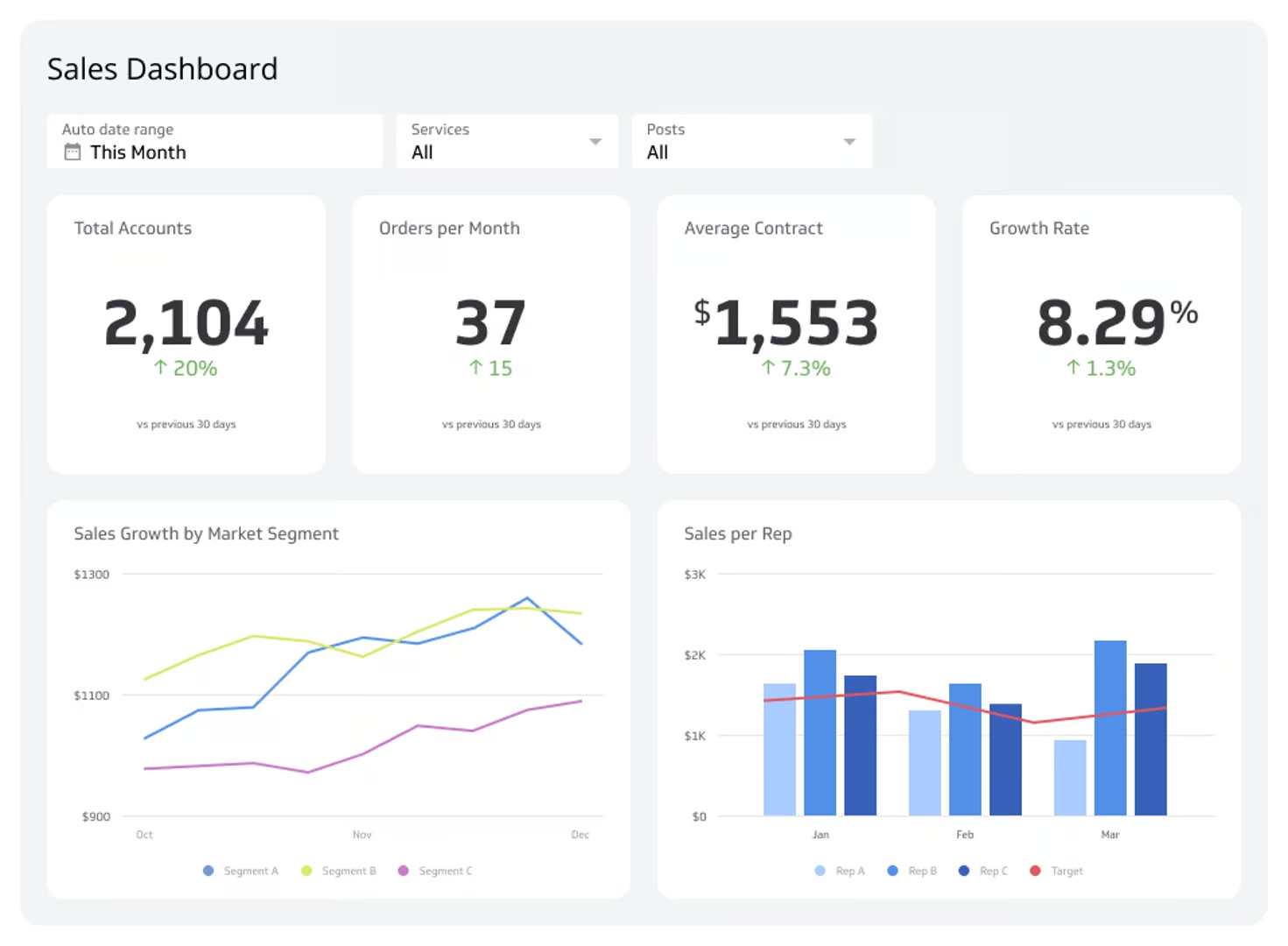
Checking your acquisition number once a quarter is not enough to act on it. A live dashboard keeps the number current and visible to everyone who needs it, without waiting for someone to pull a report.
Klips connects to 130+ data sources and lets you track Customer Acquisition alongside related metrics like Customer Acquisition Cost, churn rate, and Monthly Recurring Revenue, so you always have the full picture in one place. The numbers update automatically and stay consistent across your team.