Sales per Agent
Measure the total number of sales closed by each individual agent to assess productivity and identify coaching opportunities.
Sales per Agent
| Agent | Sales closed | Target | vs. target |
|---|---|---|---|
| Anna Petrov | 21 | 18 | +3 |
| Marcus Chen | 18 | 16 | +2 |
| Sarah Williams | 16 | 16 | — |
| James Rodriguez | 14 | 16 | -2 |
| Elena Kowalski | 12 | 14 | -2 |
| David Park | 11 | 14 | -3 |
What is Sales per Agent?
Sales per Agent measures the total number of sales closed by each individual agent over a specific period. It tells you who is producing, who needs support, and what a realistic performance benchmark looks like across your team.
Why Sales per Agent matters
Individual sales volume is one of the clearest signals a sales manager has. It shows you where results are coming from, where they are not, and what to do about it.
Without this metric, you are either treating every agent the same or relying on gut feel. Neither holds up when you need to make decisions about coaching, compensation, or hiring.
Tracking Sales per Agent gives you:
- Performance visibility: See exactly who is closing deals and who may need coaching or support.
- Fair accountability: Compare agents against their own historical baseline, not a blanket team target.
- Coaching direction: Identify patterns. Top performers can mentor others; underperformers can receive targeted training.
- Compensation clarity: Use actual performance data to justify commission structures and bonuses.
- Staffing insight: Understand whether gaps come from agent capability, territory size, or market conditions.
How to calculate Sales per Agent
The formula is direct:
Sales per Agent = Total number of sales closed by Agent N during the reporting period
If Agent Sarah closed 18 deals in a month and Agent Marcus closed 12, their Sales per Agent figures are 18 and 12 respectively.
When deal sizes vary significantly, Revenue per Agent gives you a more complete picture:
Revenue per Agent = Total revenue from all deals closed by Agent N during the reporting period
This variation matters most in environments where one agent might close 20 small accounts while another closes 3 enterprise deals. Volume alone would favour the first; revenue tells the fuller story.
Setting targets and reporting frequency
Avoid one-size-fits-all goals. A blanket target ignores tenure, territory, and segment, and you end up either setting the bar too low for experienced agents or setting up newer hires to fail.
Instead:
- Benchmark individually: Use each agent's own historical performance as the starting point.
- Account for tenure: New hires typically close fewer sales in their first months. Build a ramp curve.
- Factor in territory and segment: A complex B2B rep working 90-day cycles should not be measured against a high-volume outbound agent.
- Adjust for seasonality: Sales cycles shift. Targets should reflect what is realistic in a given period, not just what looked good last quarter.
For reporting frequency, daily or weekly updates work well for high-volume, short-cycle sales environments. Weekly or monthly reporting suits longer sales cycles where daily movement is not meaningful.
Who should monitor this metric
- Sales managers: Track team performance, identify coaching needs, and forecast pipeline.
- Individual agents: Monitor personal progress and stay motivated without waiting for a quarterly review.
- Sales leadership: Assess team capacity, hiring needs, and overall revenue health.
- Finance and operations: Use the data for forecasting, commission calculations, and resource planning.
Related metrics to pair with Sales per Agent
Sales per Agent tells you how much each agent is producing. These metrics explain why:
- Conversion Rate: The percentage of opportunities that close. Low conversion with high activity points to a pipeline quality or skills issue.
- Average deal size: Revenue per deal, which shows whether agents are closing high-value or low-value opportunities.
- Sales cycle length: Time from first contact to close. A longer cycle is not always a problem, but an agent whose cycle keeps growing may be stalling on decisions.
- Customer Acquisition Cost: Cost per new customer acquired. Useful for understanding whether high-volume agents are actually profitable.
- Sales per capita: Average sales per agent across the entire team, useful for tracking overall team output over time.
Create custom dashboards for you and your team.
Get started with KlipsHow to track Sales per Agent
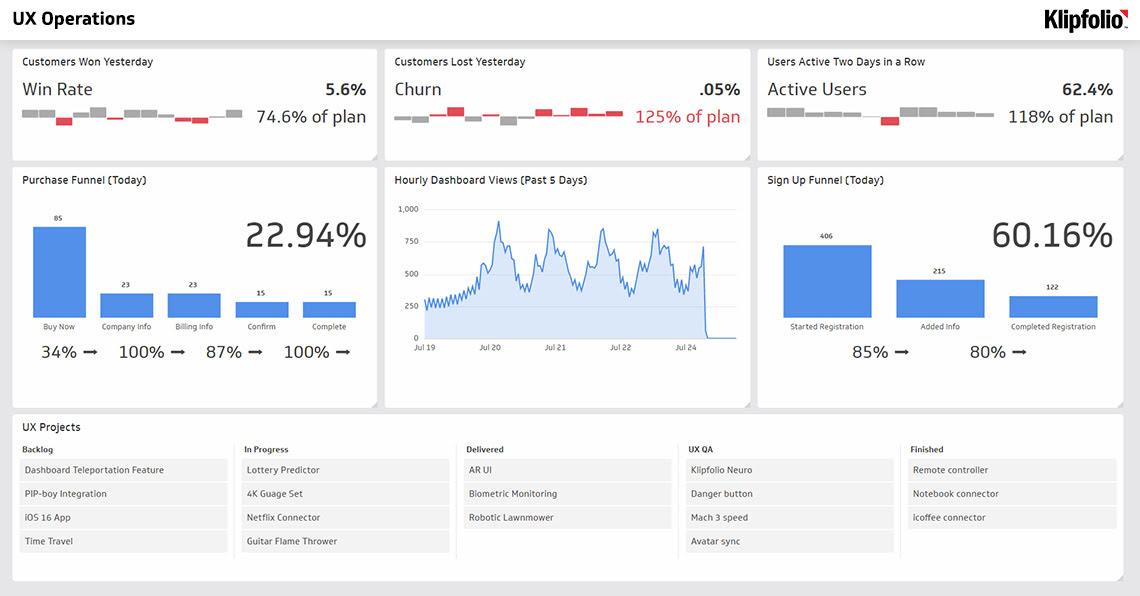
A real-time dashboard removes the lag between performance and awareness. Instead of waiting for a weekly report or pasting numbers into a spreadsheet, your team knows where things stand as deals close.
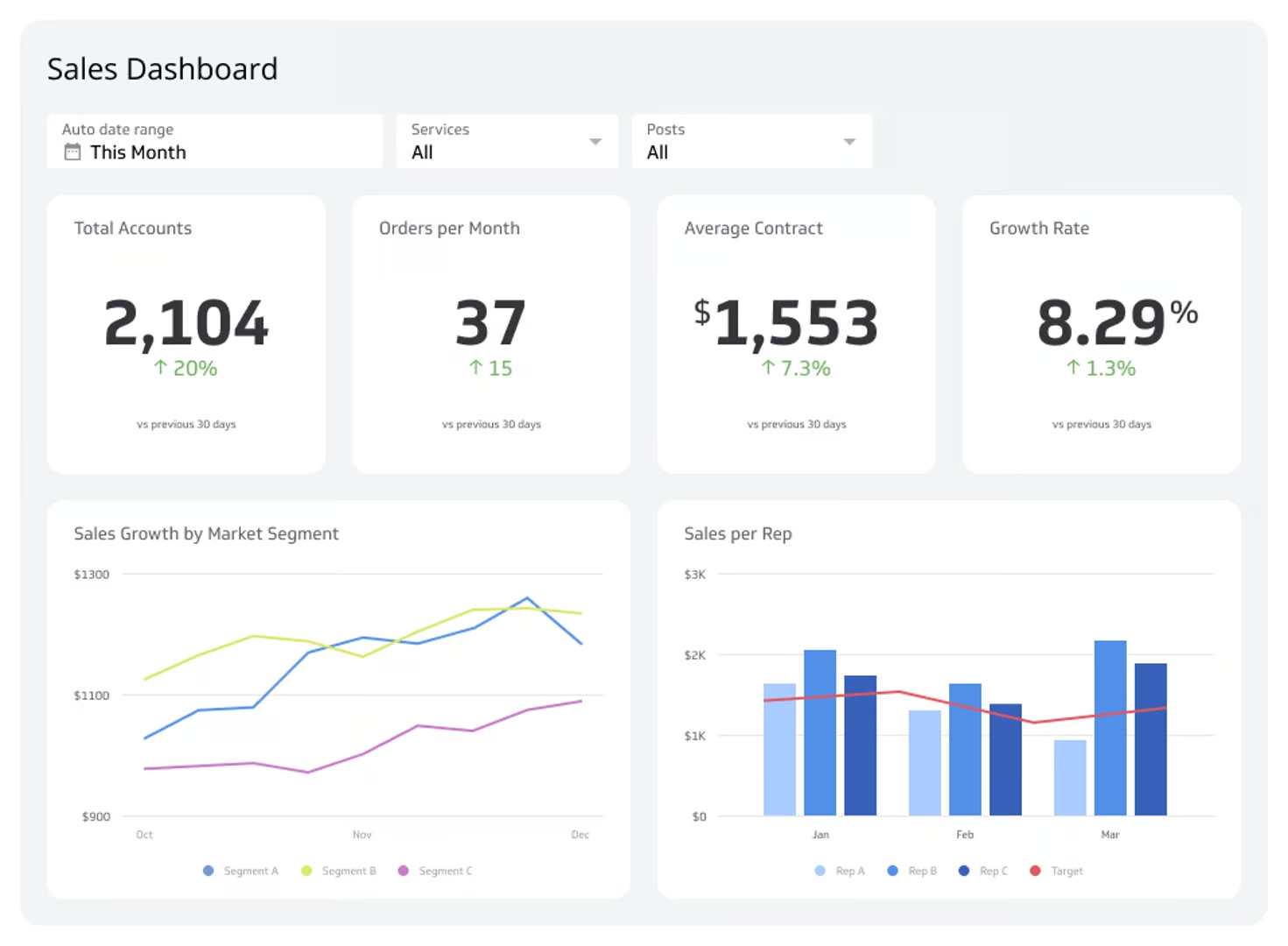
Effective ways to visualize Sales per Agent include:
- Leaderboard: Rank agents by sales closed. Motivates top performers and makes underperformance visible early.
- Trend chart: Plot each agent's sales over weeks or months to spot improvement or decline before it becomes a pattern.
- Target vs. actual: Show how each agent tracks against their individual goal, not a team average.
- Heatmap: Display sales volume by agent and time period to surface patterns in when and where production clusters.
Klipfolio connects to your CRM and sales data sources so your Sales per Agent dashboard stays current without anyone pulling numbers manually. Your team sees the same data, updated automatically, without having to ask for it.