Unique Online Buyers
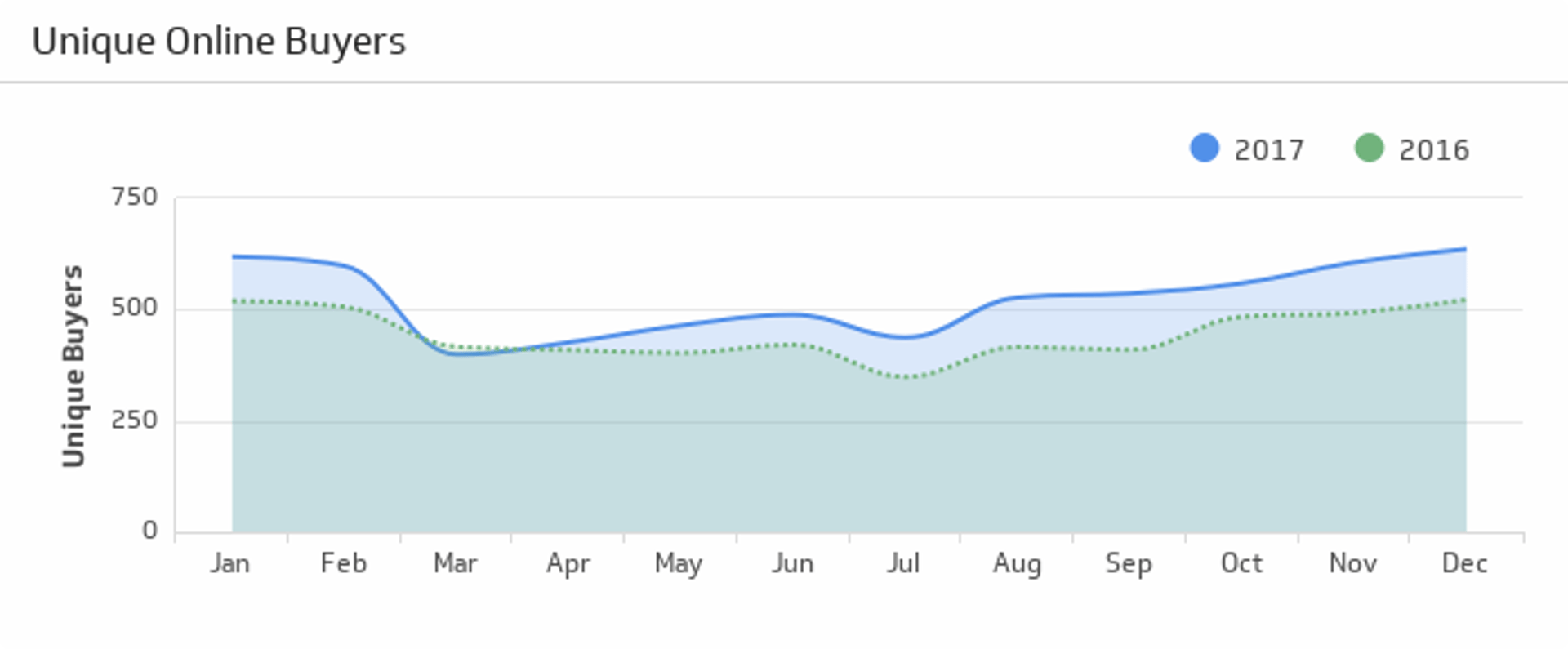
Track the number of distinct customers who purchased on your site.
Overview
Unique Online Buyers is the count of distinct customers who completed a purchase on your website during a selected period. Each buyer is counted once, regardless of how many orders they placed.
Deduplicate by a stable identifier like customer ID or verified email.
Why this matters
Signals customer base growth: More Unique Online Buyers means a wider paying audience, not just more orders from the same people.
Separates breadth from depth: Order count and revenue can rise on repeat purchases alone. Unique Online Buyers tells you whether your actual customer base is expanding.
Improves forecasting: Pair it with repeat purchase rate and Average Order Value to model future revenue with confidence.
Formula
Count of distinct online buyers in the chosen period
How to calculate it
Pull all orders for the period.
Filter to successful, paid orders.
Extract the buyer identifier (customer_id or email).
Count distinct identifiers.
Tip: If you allow guest checkout, normalize emails and handle case and whitespace to avoid double-counting. Consider merging accounts created after a guest order.
Example
In March, your store recorded 980 paid orders from 650 customers. Some customers ordered twice. Unique Online Buyers for March = 650.
Reporting frequency
Track monthly for trend analysis and weekly to catch shifts early.
Audience
Store Owner, Ecommerce Manager, Online Sales Manager
Benchmarks and ranges
Benchmarks vary by price point and traffic volume. Early-stage stores often see a few dozen to a few hundred monthly buyers; mature stores can reach thousands. Rather than chasing a fixed number, track your month-over-month trend and your unique buyer conversion rate (Unique Online Buyers divided by unique website visitors) for a clearer read on whether growth is real.
How to improve this KPI
Attract qualified visitors: Focus on product-led search terms and high-intent channels rather than broad traffic volume.
Reduce friction: Streamline checkout, enable guest checkout, and surface shipping costs and taxes before the final step.
Build trust: Display reviews, clear return policies, and recognized payment options where buyers hesitate.
First-order incentives: Offer a measured new-customer promotion that protects margin rather than training buyers to wait for discounts.
Stay in stock: Keep top products available and show smart substitutes when an item runs out.
Diagnostic checks when the number dips
Traffic mix shift: Did paid campaigns change, or did referral traffic drop?
Checkout issues: Were there recent theme, app, or payment configuration changes?
Price or shipping changes: Did thresholds or fees increase?
Stockouts: Did key SKUs run out during the period?
How to monitor it
Track Unique Online Buyers monthly and weekly to catch shifts before they compound. In Klips, connect your commerce platform or database, create a distinct-count query on customer ID or email, and chart a 6 to 12 month trend with annotations for major campaigns and product releases. You'll know what changed without having to pull the numbers yourself each time.
Create custom dashboards for you and your team.
Get started with KlipsVariations
Unique customers on website