Leads Generated by Agents
Measure the number of qualified prospects each sales agent brings into your pipeline.
Leads Generated by Agents
- Agent 14353
- Agent 11642
- Agent 11139
- Agent 10336
- Agent 29231
- Agent 28122
A sales lead is a prospect you have contact information for, with a genuine interest in your product or service. Tracking Leads Generated by Agents tells you who's driving pipeline growth and where your prospecting efforts are paying off.
What is Leads Generated by Agents?
Leads Generated by Agents measures the number of qualified prospects each sales agent brings into your pipeline during a specific period.
This metric reveals individual agent productivity and identifies your top lead generators. Unlike total leads, which may come from marketing campaigns or inbound channels, Leads Generated by Agents focuses on outbound prospecting and direct agent activity. It tells you not just what's in the pipeline, but who put it there.
Tracking this metric helps you:
- Identify top performers. See which agents consistently source the most leads.
- Benchmark productivity. Compare agent output fairly and set realistic targets.
- Allocate resources wisely. Invest training and support where it's needed most.
- Forecast pipeline growth. Predict future revenue based on current lead generation rates.
How to calculate Leads Generated by Agents
The formula is straightforward:
Leads Generated by Agents = Total New Leads Sourced by Agent in Period
Example: If Agent Sarah generates 45 leads in January, her Leads Generated by Agents for January is 45.
For a team view:
Team Leads Generated = Sum of All Leads from All Agents in Period
Example: If your five-person team generates 40, 35, 50, 38, and 42 leads respectively, your team total is 205 leads for the month.
Key metrics to pair with Leads Generated by Agents
Leads alone don't tell the full story. Pair this metric with others to understand whether volume is translating into results:
- Lead Conversion Rate. What percentage of an agent's leads convert to opportunities or closed deals? High volume with a low conversion rate often signals a quality problem.
- Cost Per Lead. How much does it cost to generate each lead? Comparing this across agents helps you understand where effort is efficient and where it isn't.
- Lead Response Time. How quickly does an agent follow up? Faster response consistently correlates with higher conversion.
- Sales Cycle Length. How long does it take an agent's leads to move through the pipeline? Shorter cycles point to higher-quality prospects.
- Sales Quota Attainment. Does an agent's lead generation actually translate to hitting their revenue target?
Reporting frequency and benchmarks
Reporting frequency: Monthly or weekly, depending on how actively you're managing pipeline.
Example targets:
- 40 leads per agent per month (outbound prospecting roles)
- 25 to 30 leads per agent per month (inside sales with blended inbound/outbound)
- 15 to 20 leads per agent per month (enterprise sales with longer cycles)
Benchmarks vary by industry, deal size, and sales model. Adjust targets based on your historical performance and growth goals rather than industry averages alone.
Why Leads Generated by Agents matters
Drives accountability. When agents see their lead generation tracked and visible, they stay consistent and focused. Transparency creates healthy competition without requiring constant management oversight.
Reveals training gaps. If one agent generates significantly fewer leads than peers, that's a coaching signal, not just a performance number. It points to where skill development or process support is needed.
Supports forecasting. Predictable lead generation gives you the confidence to forecast pipeline value and revenue. You stop guessing at quarterly targets and start building them from real data.
Identifies what works. Comparing agent output highlights which prospecting techniques, channels, and messaging are most effective. Those insights are worth scaling across the whole team.
Reduces dependence on gut feel. Without this metric, leaders often rely on instinct or wait for end-of-quarter results to know how pipeline is developing. Tracking Leads Generated by Agents means you know where things stand without having to ask, chase a report, or piece together numbers from different sources.
Create custom dashboards for you and your team.
Get started with KlipsBuilding a Sales Team Leaderboard
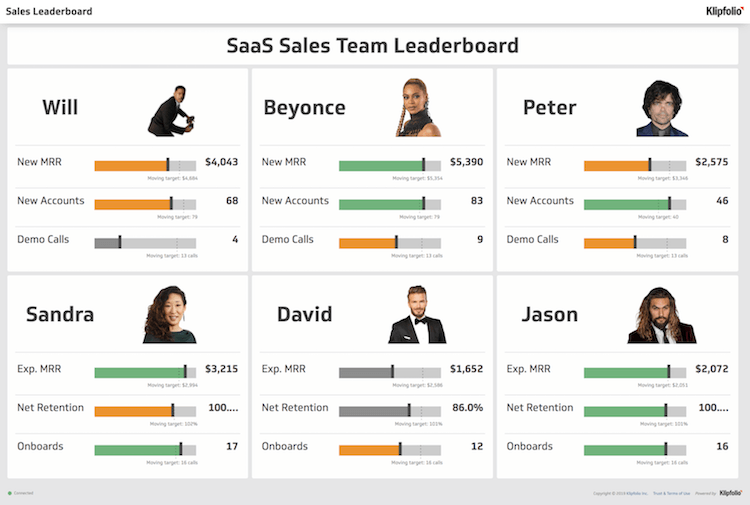
A bit of friendly competition goes a long way. A sales leaderboard dashboard displays real-time lead generation metrics for each agent, creating transparency and motivation across your team. This approach has proven effective for many growing sales organizations.
Key reasons to build a sales leaderboard
- Track individual sales performance in real-time. See who's generating leads and how consistently.
- Track team sales performance in real-time. Monitor aggregate pipeline growth and team health.
- Directly compare performance across multiple sales metrics or KPIs, such as Lead Conversion Rate, average deal size, or sales cycle length.
- Use friendly competition to fuel motivation in the sales team. Public visibility of top performers encourages others to raise their game.
- Create a transparent, data-driven work environment. Everyone understands expectations and can see progress toward goals.
- Make quick decisions based on data instead of waiting for end-of-quarter reports. Weekly or daily updates enable faster coaching and strategy adjustments.
Best practices for tracking Leads Generated by Agents
Define what counts as a lead. Ensure all agents use the same criteria. A lead should meet minimum qualification standards (for example, correct company size, industry, or decision-making authority) to avoid inflated numbers.
Use consistent data sources. Pull lead data from your CRM (Salesforce, HubSpot, Pipedrive) to eliminate manual entry errors and ensure accuracy. If agents are logging leads inconsistently, the metric loses its value.
Track by channel. Break down leads by source (cold calling, email, LinkedIn, referrals) to identify which prospecting methods work best for each agent and where to focus effort.
Review trends, not just totals. Look for patterns over time. Is lead generation seasonal? Are certain agents ramping up while others decline? Use these insights to coach and support proactively, before a trend becomes a problem.
Celebrate wins and provide support. Recognize top performers publicly, and offer additional training or resources to those who are struggling. A leaderboard should motivate, not demoralize.
Common challenges and solutions
Quality versus quantity. Agents may prioritize volume over lead quality to rank higher on the leaderboard. Pair Leads Generated by Agents with conversion rate and deal size to discourage this.
External factors. Market conditions, territory size, and customer type all affect lead generation. Adjust targets based on these variables rather than applying a single benchmark across the whole team.
Data accuracy. CRM data gets messy when agents don't log consistently. Establish clear logging protocols and audit data regularly. The metric is only as reliable as the inputs behind it.
Pressure without support. Constant public comparison can create stress. Balance leaderboard visibility with coaching conversations that recognize effort, not just results.
Measuring success with dashboards
A well-designed dashboard makes Leads Generated by Agents easy to track and act on. Include:
- Individual agent lead counts for the current month and year-to-date
- Trend lines showing lead generation over the past 3 to 6 months
- Conversion funnels from lead to opportunity to closed deal
- Comparative views of team performance and top performers
- Drill-down capability to see which leads came from which channels or campaigns
Klipfolio connects directly to your CRM, automates data refresh, and displays real-time metrics to your entire team. No manual spreadsheet updates, no waiting for someone to pull the numbers, and no pasting figures into a general-purpose AI tool and hoping the interpretation is right. Your team sees the same accurate picture, always current, without anyone having to chase it.
Conclusion
Leads Generated by Agents is a foundational metric for any sales team focused on pipeline growth. It tells you who's driving results, where coaching is needed, and whether your prospecting activity is consistent enough to support your revenue targets. Pair it with conversion rate, deal size, and sales cycle length for a complete view of sales health. Track it on a live dashboard, and your team always knows where things stand without waiting for someone to explain the numbers.