

Inside the mind of a successful data-driven startup founder
Hjalmar Ståhlberg Nordegren, CEO and co-founder of Karma, shares how his team went from a product with no retention to a food-waste startup operating across three countries. The story covers their pivot to Product-Market Fit, how they used Klips to replace manual spreadsheet reporting, and what it really means to be data-driven when you're scaling fast.
How Karma went from idea to growth
As a startup coach, I meet a lot of inspiring entrepreneurs. Some stand out more than others, especially when they're behind big startup success stories. I get curious about exactly what was going on in their minds, and what they did differently that put them in the top 10% of startups that survive.
I sat down with Hjalmar Ståhlberg Nordegren, CEO and co-founder of Karma, to find out. In this spotlight, he opens up about the ups and downs and how the team pushed through some of their toughest moments.
Meet the team
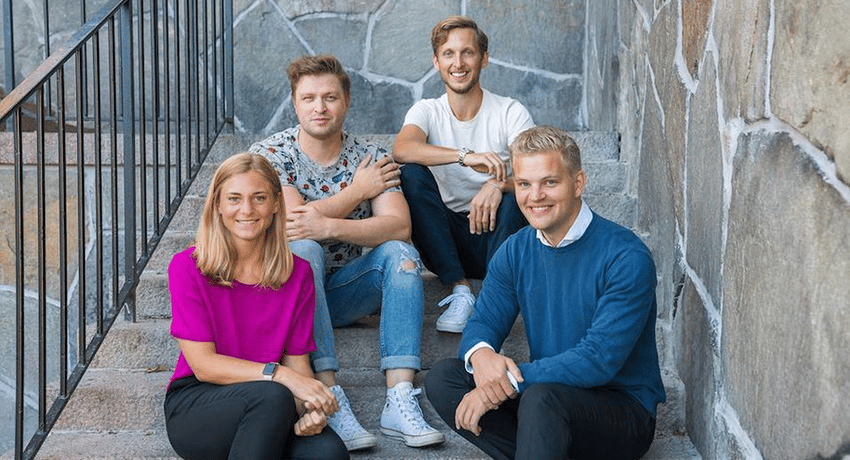
Karma was founded by Hjalmar Ståhlberg Nordegren, Elsa Bernadotte, Ludvig Berling, and Mattis Larsson, four Swedish entrepreneurs. Hjalmar (CEO), Mattis (CTO), and Ludvig (CPO) previously built Responster, a survey tool connecting companies with their customers. Elsa Bernadotte (COO) co-founded Pop Fruits, a successful startup that was later acquired.
Successful startups don't just appear fully formed. How did this team get started, and how did they grow into a company with over 60 employees operating across three countries?
In the fall of 2015, the team was accepted into Sting, a well-regarded Swedish accelerator, for a 20-week program. They were among the few chosen from hundreds of applicants.
At that stage, Karma's purpose was to give companies and vendors key data about their customers so they could build closer relationships and offer tailored shopping experiences, delivered through a marketplace of deals inside the app.
The idea was simple: companies listed their deals, and customers could act on them or not.
The problem no one wants to face
Early results looked promising. Users were downloading and opening the app. But the team quickly noticed that almost no one came back.
Hjalmar remembers it clearly: "Many users were coming in, so our performance looked good on paper." The problem was retention. There was no stickiness. Users didn't have a clear reason to return, and nothing in the experience prompted them to.
They had no Product-Market Fit. A year of work, and the product wasn't holding anyone's attention.
Their runway was shrinking by the day. Without retention, raising more capital was nearly impossible. No investor would back a product that couldn't keep users. They knew something had to change fast.
What they realized was that the product was too broad. As Hjalmar puts it, "Users didn't really understand how, when, and why they would use Karma." That clarity, painful as it was, gave them something to work with. And unlike many founders who stall at this stage, they knew exactly where to look for answers: the users themselves.
Create custom dashboards for you and your team.
Get started with KlipsThe aha moment
The team didn't guess their way out. They had a process.
First, they looked at the data to find what was actually working. They pulled everything from their database and exported it to a spreadsheet to see which deals users engaged with and which ones led to purchases. Two categories stood out: clothes and food.
But knowing what wasn't enough. They needed to know why. So they went back to the humans behind the data, speaking directly with the restaurants and clothing stores using the app.
Food kept rising to the top. A third of all food produced globally ends up wasted, Hjalmar explains. Even the most efficient restaurants and supermarkets can't avoid it. Local efforts exist, but they don't come close to solving the scale of the problem.
That was the insight they needed. They stopped trying to be everything to everyone and pivoted to a single, urgent problem: helping consumers discover food that would otherwise go to waste, at half the regular price.
The pivot worked. Retention tripled. That was their confirmation of Product-Market Fit.
With a product users actually wanted to keep using, they brought on a new investor. Norrsken, the Swedish impact-oriented fund, invested €600k.
When the data got too big to manage manually
Growth created a new problem. As the numbers scaled, the old process of pulling data from the database and dropping it into spreadsheets became unmanageable. Hjalmar wanted to keep making decisions based on user behaviour, the same approach that had saved the company during the pivot. But the manual work was eating hours, and the picture was always slightly out of date.
That's when he found Klips.
Hjalmar describes Klips as a "marriage" between an efficient TV dashboard and a powerful data management tool. Instead of pasting numbers into a spreadsheet and figuring out what they meant, the team could see what was happening in real time, without waiting for someone to pull a report. They tracked how different actions affected user behaviour, measured whether a new feature was landing, and stopped guessing at things the data could answer.
The real payoff wasn't the dashboards themselves. It was that the team stopped spending hours on manual reporting and started spending that time acting on what the numbers told them. For a lean team scaling fast, that shift from reactive to always-on visibility made the difference between feeling in control and feeling behind.
What to measure (and when to stop)
Getting the dashboards right wasn't immediate. Hjalmar is candid about the learning curve.
"At the beginning, we started to measure everything we could," he says. "Yet, you grow out your number of metrics more and more, and then at some point you have to say: which are the 10 most important metrics? And strip away the rest. Then you start growing again, and you have to stop and strip away again. All the time growing and stripping away."
That discipline, knowing what to cut, matters as much as knowing what to track. More metrics don't mean more clarity. They often mean less.
Today, every team at Karma has a TV dashboard showing the metrics they're directly responsible for. The sales team monitors theirs constantly. To keep dashboards relevant day to day, all metrics are set to a rolling 30-day window. The goal isn't a dashboard that displays everything; it's one that tells each team exactly what they need to act on.
When asked whether Karma is data-driven, Hjalmar is honest: "We try to be, maybe we're on the threshold of being data-driven. It's very hard to make informed decisions and actions only based on data. Often it's a bit of a guessing game mixed with data."
He gives a clear example: "We saw our sales slow down during Easter, then we guessed that we have to do something when people leave town so they remember that Karma exists. Some of our decisions and processes are completely data-driven though. For example, our decision on how much we should spend on paid advertising is based on how many signups we've had from paid ads during previous campaigns."
That's a useful frame for any founder: data narrows the guesswork, it doesn't eliminate it. The goal is to make better decisions faster, not to hand every decision to a spreadsheet or paste numbers into a chatbot and hope the context holds.
Where they are now
By 2017, Karma raised €3.4 million from firms including e.ventures and eQuity. In 2018, they closed a $12 million Series A, with Kinnevik among the investors. That same year, Elsa, Ludvig, and Hjalmar were named to the Forbes 30 Under 30 list.
Karma now works with over 6,300 businesses and has more than 890,000 users. They've expanded to the UK, with over 1,700 partner establishments in London, and have begun operating in Paris.
Beyond the financials: 650 tonnes of food rescued, 980 tonnes of CO2 saved, and 65,000 days of car use compensated.
The lesson isn't that dashboards built a food-waste company. It's that the team made a habit of knowing what was true, acting on it quickly, and not letting noise crowd out the signal. A small team with reliable numbers and the discipline to act on them can move faster than a larger one drowning in reports. That's what kept Karma moving forward.
Updated 2026-08-27
More in Case Study

How a seasonal ice cream shop used KPIs to go viral

Customer spotlight: How Spoonity tracks restaurant loyalty with Klipfolio

The top 12 SaaS metrics with benchmarks

Top venture capital blogs to follow in 2026

Thriving in a tempest: What we learned about product management during Klipfolio's start-up phase

Electrolux tracks sales metrics and KPIs for European offices with Klipfolio
Most recent
- SEP 25What SOC 2 taught a small team about trust
- SEP 15The AI race: progress, humanity, and trust
- SEP 9The good advisor
- AUG 11Beyond simple sign-ups: how True Trials and Activation predict growth
- JUL 7Why business leaders miss important trends in their dashboards
- JUN 19The best chart for the job: Visualizing data for non-technical users