Keyword Performance
Measure keyword rankings to understand how effective your SEO efforts are at driving traffic to your website.
Track all your Digital Marketing KPIs in one place
Sign up for free and start making decisions for your business with confidence.
What is Keyword Performance?
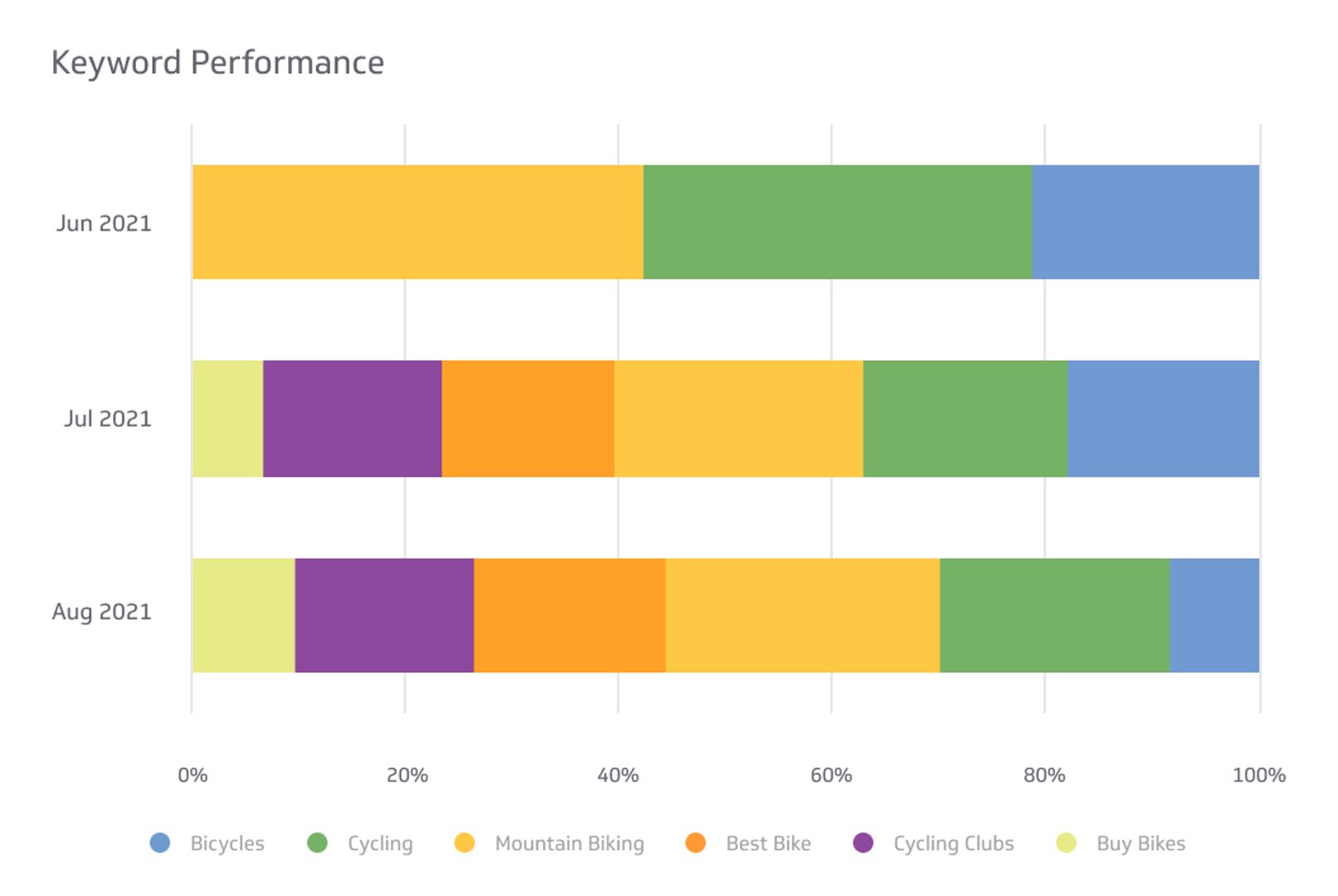
Keyword Performance measures how well your target keywords rank in search engines and how effectively they drive traffic to your website. It's a leading indicator of SEO success—showing whether your optimization efforts are moving the needle on visibility and organic reach.
Keyword rankings alone don't tell the full story. You'll also want to monitor related metrics like organic search traffic, click-through rate, and goal completion rate to understand the complete impact of your SEO strategy.
Key Terms
Keyword — A search term entered into a search engine (like Google or Bing) by a user looking for information, products, or services.
Ranking — The position your web page occupies in search results for a specific keyword. Higher rankings (closer to position 1) mean greater visibility.
Click-through rate (CTR) — The percentage of search impressions that result in a click to your website. CTR shows whether your page title and meta description compel searchers to visit.
Organic traffic — Visitors who arrive at your site through unpaid search results, as opposed to paid ads or referrals.
Search volume — The average number of times a keyword is searched per month. Higher volume means more potential traffic, but often more competition.
Why Keyword Performance Matters
Strong keyword performance directly correlates with organic visibility and traffic growth. When your target keywords rank higher, more potential customers find you through search. This makes keyword tracking essential for:
Identifying winning keywords — See which terms drive the most qualified traffic and conversions.
Spotting ranking drops — Catch algorithm changes or technical issues before they tank your traffic.
Prioritizing optimization efforts — Focus on keywords with high search volume and conversion potential.
Benchmarking against competitors — Understand where you stand in your market.
How to Calculate Keyword Performance
Keyword Performance isn't a single formula—it's a combination of metrics tracked over time:
Average ranking position — Add up all ranking positions for your tracked keywords and divide by the number of keywords.
Average Ranking = Sum of All Keyword Positions / Number of Keywords
Ranking distribution — Count how many keywords rank in each tier (top 3, top 10, top 20, etc.).
Organic traffic from keywords — Use Google Search Console or your analytics platform to see traffic attributed to specific keywords.
Keyword visibility score — Some SEO tools calculate a weighted score based on ranking position, search volume, and CTR.
Success Indicators for Keyword Performance
Improving rankings — More keywords moving into the top 10 or top 3.
Increasing organic traffic — Higher click-through rates on ranked keywords.
Better CTR — Your page titles and meta descriptions are compelling enough to drive clicks.
New keyword rankings — Ranking for additional keywords in your target market.
Higher conversion rates — Organic visitors from your target keywords are completing goals (purchases, signups, etc.).
Common Challenges
Algorithm updates — Google's core updates can shift rankings unpredictably. What worked last quarter may not work this quarter.
Keyword saturation — Highly competitive keywords require sustained effort and high-quality content to rank.
Ranking volatility — Some keywords fluctuate daily. Short-term ranking drops don't always signal a real problem.
Attribution complexity — Organic visitors often take multiple touchpoints before converting, making it hard to credit keywords directly.
Changing search intent — Search engines increasingly prioritize user intent over exact keyword matches, so ranking for a keyword doesn't guarantee relevant traffic.
Best Practices for Keyword Performance
Keep your keyword list current — Update it regularly to reflect new products, market trends, and seasonal demand. Stale keyword lists miss opportunities.
Monitor rankings consistently — Track your keywords weekly or monthly. Daily tracking can be noisy; monthly tracking may miss important shifts.
Pair rankings with traffic data — A keyword ranking in position 5 means nothing if it drives no clicks. Always cross-check rankings with actual traffic and conversions.
Focus on search intent — Rank for keywords that match what your audience is actually searching for. High-volume keywords are worthless if they don't fit your business.
Balance short-tail and long-tail keywords — Short-tail keywords (1–2 words) are competitive but high-volume. Long-tail keywords (3+ words) are easier to rank for and often higher-intent.
Optimize for CTR, not just rankings — A higher ranking means nothing if your title and meta description don't compel clicks. Test different messaging to improve CTR.
How to Monitor Keyword Performance in Real-time
Once you've identified your target keywords and set baseline rankings, you'll want to track performance continuously. Dashboards make this easy—displaying rankings, traffic trends, and goal completions all in one view.
Real-time monitoring helps you:
Spot ranking changes immediately — Respond quickly to drops or gains.
Correlate rankings with traffic and conversions — See the full impact of your SEO efforts.
Share progress with stakeholders — Automated reports keep everyone aligned.
Learn more about tracking Keyword Performance on a Digital Marketing Dashboard or SEO Performance Dashboard.
Tools for Tracking Keyword Performance
Google Search Console — Free, official data on your rankings, impressions, and CTR.
SEO tools — Ahrefs, Semrush, Moz, and similar platforms offer detailed ranking tracking and competitive analysis.
Analytics platforms — Google Analytics, Klipfolio, and others let you correlate rankings with traffic and conversions.
Dashboards — Centralize keyword data from multiple sources for easier monitoring and reporting.
Related Metrics
To get a complete picture of SEO performance, also track:
Organic search traffic
Click-through rate
Goal completion rate
Return on marketing investment
Bounce rate
Related Metrics & KPIs