Free Trial Conversion Rate
Free Trial Conversion Rate is the percentage of trial users who become paying customers. It shows how well your product, onboarding, and pricing turn interest into revenue.
Free Trial Conversion Rate
Free Trial Conversion Rate is the percentage of users who convert from a free trial to a paid subscription. It tells you how well your product and onboarding turn interest into revenue.
For SaaS companies, this metric is one of the clearest signals of product-market fit. A high rate means your trial is doing its job: showing people enough value that paying feels like an easy decision.
What is Free Trial Conversion Rate?
Free Trial Conversion Rate is the share of free trial users who become paying customers within a given period. It reflects how effectively your trial experience communicates value and removes friction from the buying decision.
Types of SaaS free trials
Before calculating your rate, it helps to know which trial model you're running. Each one produces different conversion benchmarks.
There are several common structures:
- Unlimited free trial: Users get access to all features for a fixed period, typically two weeks. High exposure, but easier to game with multiple accounts.
- Limited free trial: Users access a subset of features or a lower-tier plan, sometimes indefinitely. Creates a natural incentive to upgrade without giving everything away.
- Opt-in free trial: No credit card required. The trial ends and users choose whether to pay. Lower friction to sign up, and the conversion data is cleaner.
- Opt-out free trial: Requires a credit card upfront. Users are billed automatically unless they cancel. Can inflate apparent conversion numbers.
- B2C free trial: Typically 30 days. Consumers need more time to assess personal value.
- B2B free trial: Typically two weeks. Businesses usually have a specific problem to solve, so decisions tend to be faster and conversion rates tend to be higher.
Opt-in vs. opt-out conversion rates
If you run an opt-out trial, interpret your conversion rate carefully. Many users get charged simply because they forgot to cancel, not because they found value. That distorts the signal. Opt-in trials produce messier-looking numbers but more honest ones: every conversion is a deliberate choice.
B2B vs. B2C conversion rates
B2B businesses tend to see higher Free Trial Conversion Rates than B2C companies. The reason is straightforward: a business evaluating software usually has a specific need and a budget allocated to solve it. A consumer browsing a free trial may still be figuring out whether the product applies to them at all.
How to calculate Free Trial Conversion Rate
Free Trial Conversion Rate divides the number of users who converted to paid by the total number of trial users over the same period.
Free Trial Conversion Rate = (Trial-to-paid users / Total trial users) × 100
Example: If 500 people started a free trial last month and 41 converted to a paid plan, your Free Trial Conversion Rate is 8.2%.
You can also approach it from the other direction: subtract the number of users who did not convert from the total, then divide by the total. Both methods produce the same result.
Track this metric by cohort (users who started trials in the same week or month) rather than mixing trial starts and conversions from different periods. Cohort tracking gives you a clean view of how a specific group moved through the funnel.
What is a good Free Trial Conversion Rate?
Benchmarks vary by trial type. A reasonable target for an opt-in trial is 8.2%, while opt-out trials average around 2.5% when you account for involuntary conversions.
Do not read these numbers in isolation. A high Free Trial Conversion Rate paired with a low retention rate often means your trial attracted the wrong users, or your onboarding oversold the product. Pair this metric with Customer Acquisition Cost (CAC), Customer Lifetime Value (LTV), and retention rate to get a complete picture.
Why Free Trial Conversion Rate matters
This metric tells you more than whether people are paying. It tells you whether your product, your messaging, and your onboarding are working together.
A low rate is a signal worth investigating. It could mean:
- Your value proposition is unclear. Users tried the product but never understood what problem it solved for them.
- Your onboarding is too steep. People ran out of time or patience before reaching the moment where the product clicked.
- You're reaching the wrong audience. High sign-up volume with low conversion often points to a targeting mismatch.
- Your pricing creates friction. Users liked the product but balked at the cost when the trial ended.
A high rate, on the other hand, confirms that your trial is doing its job. It also gives you a pool of pre-qualified leads: people who have already seen your product work and decided to pay for it. Those users are far easier to retain, upsell, and learn from than cold prospects.
Your free trial conversion rate also surfaces demographic data. Everyone who signs up provides information about who your product resonates with. That data sharpens your targeting and informs product decisions.
Factors that affect Free Trial Conversion Rate
Several variables move this number. Understanding them helps you make deliberate changes rather than guessing.
- Trial length: Most trials run between one week and 60 days. Longer trials give users more time to build a habit around your product, which increases the likelihood they'll pay to keep it. Shorter trials create urgency but may not allow enough time for value to land.
- Features included: An unlimited trial gives users the full picture but removes the incentive to upgrade. A limited trial creates natural upgrade pressure but may not show enough value to justify the cost.
- Onboarding quality: Users who reach their first meaningful outcome quickly are far more likely to convert. Friction in setup, a confusing interface, or a lack of guidance during the trial period all suppress conversion.
- Customer support: Users who get help during the trial period convert at higher rates. Responsive support signals that the post-purchase experience will be just as good.
- Brand awareness: Users who already know your brand before starting a trial convert more readily. Low awareness means more education is required during the trial itself.
- Pricing: If your paid plan feels like a significant jump from free, users hesitate. Pricing that feels proportional to the value demonstrated in the trial removes that barrier.
How to improve your Free Trial Conversion Rate
Improving this metric requires looking at the full trial experience, not just the moment the trial ends.
Reduce friction in onboarding
Users who get stuck early rarely convert. Walk new users to their first meaningful outcome as quickly as possible. An interactive walkthrough, a checklist of setup steps, or a single well-timed prompt can make the difference between a user who gets it and one who quietly churns.
Create custom dashboards for you and your team.
Get started with KlipsImprove user friendliness
If users find the product hard to navigate during the trial, they'll assume the paid experience will be the same. Prioritize fixing the parts of the interface that cause the most confusion, especially in the first session.
Personalize the trial experience
Use the data users provide at sign-up. Tailor onboarding emails to their industry, role, or stated goal. If a user hasn't taken a key action within the first few days, send a targeted prompt that addresses the most common obstacle for their segment. Generic sequences convert at lower rates than ones that feel relevant.
Market your free trial option actively
Many trials underperform simply because not enough of the right people know about them. Promote the trial specifically, not just the product. Users who sign up knowing exactly what the trial offers convert at higher rates than users who stumble into it.
Embed feedback surveys
Short in-product surveys tell you why users are not converting before they disappear. Even a single question at the point of trial expiry ("What would have made you more likely to subscribe?") produces actionable data. It also signals to users that you're paying attention.
Encourage upgrades before the trial ends
Remind users of what they'll lose when the trial ends. Show them what the paid plan unlocks. A well-timed in-app nudge, a comparison of their trial usage against paid plan limits, or a personal email from a team member can move users who are on the fence.
Adjust trial parameters
If your current structure is not working, test a different one. Switch from opt-in to opt-out, or vice versa. Extend the trial length. Add or remove features from the trial tier. Treat the trial itself as a product that can be iterated.
Tracking Free Trial Conversion Rate on a dashboard
Manually calculating this metric each month creates lag. By the time you spot a drop, you've already lost several cohorts of potential customers.
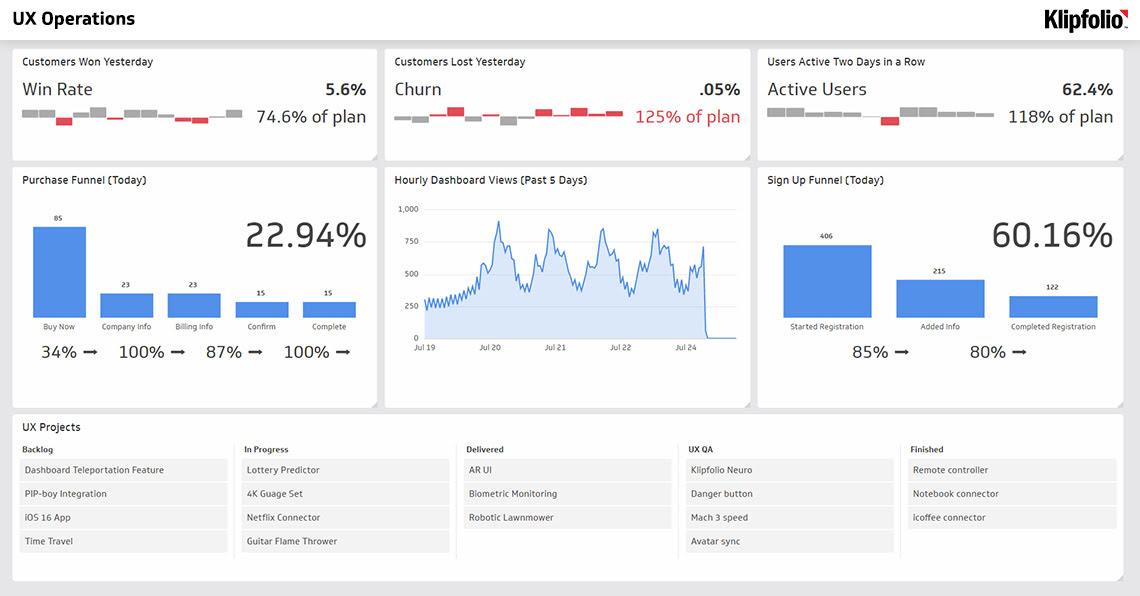
A real-time dashboard connected to your CRM or billing platform surfaces Free Trial Conversion Rate continuously, alongside the related metrics (retention, CAC, LTV) that give it context. You know where things stand without having to ask someone to pull the numbers. Klips connects to many crucial key performance indicators (KPIs) across your stack and lets you build dashboards that keep your whole team looking at the same numbers.
Frequently asked questions
What is a good Free Trial Conversion Rate?
For opt-in trials, a benchmark of around 8.2% is widely cited. Opt-out trials average roughly 2.5%, though that figure includes involuntary conversions. Your target will depend on your product, price point, and trial structure.
What other metrics should I track alongside Free Trial Conversion Rate?
Track CAC, LTV ratio, and retention rate together with Free Trial Conversion Rate. A high conversion rate that pairs with high churn or a poor LTV-to-CAC ratio signals a deeper problem with product fit or pricing.
Which free trial type converts best?
Opt-out trials often show higher raw conversion numbers, but those numbers include users who were charged automatically. Opt-in trials produce more reliable data because every conversion is intentional. For most SaaS products, opt-in trials with strong onboarding outperform opt-out trials on genuine conversion quality.
Create custom dashboards for you and your team.
Get started with KlipsHow does Free Trial Conversion Rate relate to SaaS metrics more broadly?
Free Trial Conversion Rate sits at the top of your revenue funnel. It feeds directly into Monthly Recurring Revenue (MRR), Customer Acquisition Cost, and Customer Lifetime Value. Improving it has a compounding effect across all three.