Cash and Cash Equivalents
Cash and cash equivalents are a company's most liquid short-term assets: money on hand and investments that convert to cash within 90 days. Learn what qualifies, how to calculate the balance, and why it matters for financial decision-making.
Cash and Cash Equivalents
Cash and cash equivalents are a company's most liquid short-term assets: money on hand and investments that convert to cash within 90 days.
The balance sheet groups both under current assets. The two conditions for an asset to qualify as a cash equivalent are that it converts into a known amount of cash easily, and that its maturity date is close enough that interest rate shifts pose negligible risk to its value.
Knowing your Cash and Cash Equivalents balance tells you, at a glance, whether your business can cover what it owes right now without selling anything or borrowing.
Types of cash and cash equivalents
Cash and cash equivalents give businesses the working capital to pay down current liabilities: short-term loans and near-term payments. The line item on your balance sheet combines several distinct asset types.
Cash
Cash is money your business holds in currency or in a demand deposit account at a financial institution. It includes currency notes, coins, and balances in checking, savings, and money market accounts. You can withdraw from a demand deposit account at any time without notice.
Cash totals reflect all demand account balances as of the financial statement date. The balance sheet's current assets section captures these totals alongside any other assets expected to convert to cash within a year or the company's operating cycle.
Petty cash
Petty cash is a small fund kept on hand for minor day-to-day expenses: office supplies, postage, and small repairs. A designated employee tracks expenditures and replenishes the fund on a regular schedule, typically monthly or quarterly, using an imprest system.
Bank drafts
A bank draft is a payment instrument issued by a bank that guarantees funds to a third party. It works like a cashier's cheque: the money leaves the issuer's account immediately, and the recipient can deposit or cash it right away. Bank drafts are treated as equivalent to cash because payment is guaranteed by the issuing institution.
Cash equivalents
Cash equivalents are low-risk, highly liquid investments with maturities of three months or less. Businesses record them on the balance sheet at market value, and that value is not expected to change materially before redemption or maturity. Investments that mature after three months appear as "other investments" instead.
Commercial paper
Commercial paper is an unsecured promissory note issued by a firm with a high credit rating. It typically matures in less than 270 days, trades on a secondary market, and converts to cash quickly. Interest rates vary with the issuer's creditworthiness.
Money market accounts
A money market account is an interest-bearing deposit account that pays a higher rate than a standard savings account while keeping funds accessible. It usually carries a minimum balance requirement and low or no fees.
Short-term government bonds
Short-term government bonds are debt securities issued by national governments. They qualify as cash equivalents when they are highly liquid and mature within 90 days, because the government's ability to tax and issue currency makes default risk negligible.
Treasury bills
Treasury bills are short-term debt instruments issued by the U.S. Department of the Treasury with maturities of one year or less. They trade actively on the secondary market and can be sold before maturity, making them easy to convert to cash.
Certificates of deposit
Certificates of deposit (CDs) qualify as cash equivalents when they mature within 90 days and carry no early-redemption penalty. CDs with longer maturities or penalties for early withdrawal do not qualify and are recorded elsewhere on the balance sheet.
Create custom dashboards for you and your team.
Get started with KlipsForeign currency
Foreign currency holdings can affect the reported value of Cash and Cash Equivalents. When a company presents financial statements in a functional currency different from the one in which its cash is held, it must convert those balances at the exchange rate on the balance sheet date.
If the functional currency strengthens against the foreign currency, the reported value of those assets rises. If it weakens, the reported value falls. Companies with large foreign currency balances often use hedging to limit the impact of exchange rate swings on their reported liquidity.
Exclusions from cash and cash equivalents
Several asset types look liquid on the surface but do not qualify for the Cash and Cash Equivalents line.
Credit collateral
Bank guarantees, standby letters of credit, and similar instruments are excluded because they represent a contingent liability, not a cash asset. They cannot be converted to cash within 90 days, and their value is subject to default risk and market movements.
Unbreakable certificates of deposit
CDs that cannot be redeemed before maturity without a substantial penalty are excluded. They lack the liquidity required for a cash equivalent, may carry a market value below face value due to interest rate exposure, and are classified as investments instead.
Inventory
Inventory represents goods held for sale or in production. It is not highly liquid, its value fluctuates with consumer demand and production costs, and it cannot reliably convert to cash within 90 days.
Prepaid assets
Prepaid assets are amounts paid in advance for future benefits, such as insurance or rent. Even when refundable, the timing and completeness of any refund are uncertain, which disqualifies them from the cash and cash equivalents category.
Accounts receivable
Accounts receivable are amounts owed by customers for goods or services already delivered. They are expected to be collected soon, but they do not count as cash or cash equivalents until payment is actually received. The buyer's creditworthiness is uncertain, and collection is not guaranteed.
Cash vs. cash equivalents
Cash and cash equivalents appear on the same balance sheet line, but they are not the same thing.
| Factor | Cash | Cash equivalents |
|---|---|---|
| Definition | Currency and demand deposits | Short-term liquid investments |
| Availability | Immediately accessible | Requires redemption or sale first |
| Maturity | None | Three months or less |
| Risk | Virtually none | Low, but not zero |
| Yield | Minimal | Slightly higher; some tax-advantaged |
Cash is the safest and most immediately usable asset. Cash equivalents carry slightly more risk because market conditions can affect their value, but they typically offer better yields than cash sitting in a deposit account. The higher yield is a secondary benefit; the primary reason to hold cash equivalents is to keep short-term funds accessible while earning a modest return.
Why firms hold cash and cash equivalents
Leaders hold Cash and Cash Equivalents for several practical reasons, each tied to a specific business need.
Day-to-day operations: Payroll, rent, utilities, and supplier payments require reliable, immediate access to funds. A healthy cash position means those obligations are met without scrambling.
Debt repayment: Current portions of long-term debt and short-term invoices come due on fixed schedules. Having enough liquid assets on hand avoids costly borrowing or asset sales.
Emergency preparedness: Unexpected expenses, economic downturns, or operational disruptions can strain cash flow quickly. A cash buffer keeps the business running while a response is organized.
Financial covenant compliance: Many loan agreements require a firm to maintain certain financial performance metrics, including minimum cash levels or liquidity ratios. Falling short can trigger default provisions.
Investment readiness: When an acquisition or strategic opportunity appears, speed matters. A company with cash on hand can move without waiting for financing approval.
Regulatory requirements: Banks and financial institutions are often required by regulators to hold minimum reserves in liquid assets to protect depositors and limit systemic risk.
How to calculate cash and cash equivalents
Calculating Cash and Cash Equivalents from a balance sheet is straightforward.
Find the current assets section. It appears near the top of the balance sheet and lists assets expected to convert to cash within one year.
Identify qualifying items. Look for cash on hand, demand deposit balances, and short-term investments such as Treasury bills or money market funds.
Add them together. Sum all qualifying balances to get the total Cash and Cash Equivalents figure.
Cash and Cash Equivalents = Cash on hand + Demand deposit balances + Qualifying short-term investments (maturity <= 90 days)
Keep in mind that accounting standards and company policies affect which items qualify. Review the notes to a company's financial statements to confirm what is included in their reported figure.
Frequently asked questions
Create custom dashboards for you and your team.
Get started with KlipsTracking cash and cash equivalents
Knowing your Cash and Cash Equivalents balance is only useful if the number is current and trustworthy. Leaders who rely on month-end spreadsheets or manually assembled reports are always working with a lag, and a lag in liquidity data is a lag in decision-making.
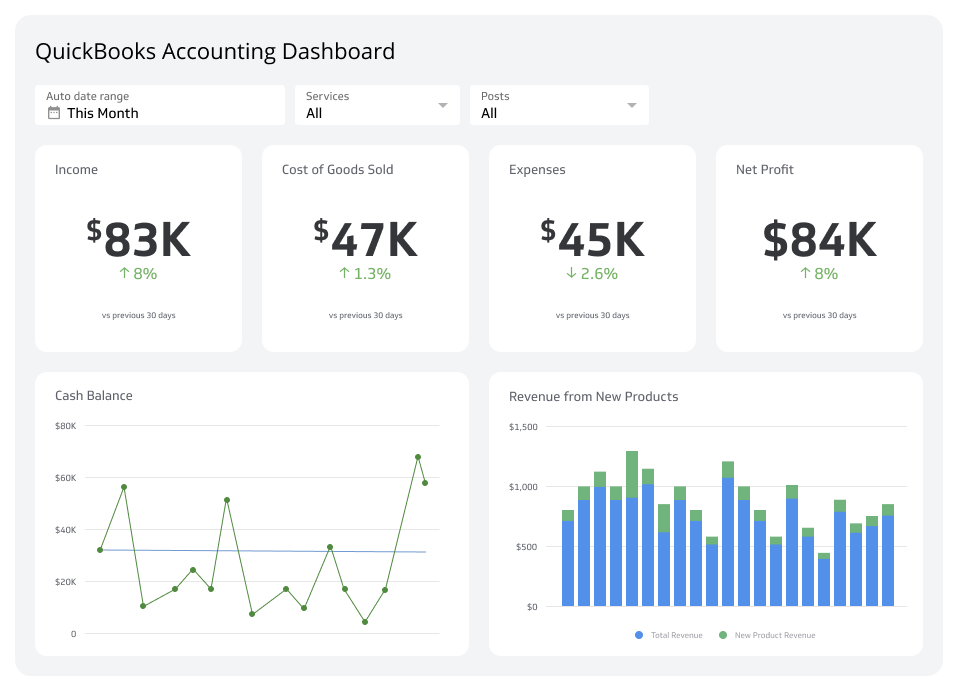
A real-time dashboard that pulls from your accounting system gives you a live view of your liquidity position without waiting for someone to pull a report. You see whether your cash buffer is healthy, whether it is trending in the right direction, and whether anything needs attention, without having to ask.
Klipfolio connects to 130+ data sources and lets you build financial dashboards that keep your most important numbers visible and up to date. When your Cash and Cash Equivalents balance is always a glance away, you spend less time tracking down numbers and more time acting on them.