Revenue vs. Profit
Revenue and Profit represent the top and bottom lines of a company's income statement.
Revenue vs. Net Profit
Revenue and Profit are two of the most important numbers in any business. They tell different parts of the same financial story, and knowing how to read both gives you a clearer picture of whether a company is actually healthy or just busy.
What is Revenue vs. Profit?
Revenue is the total income a business generates from selling its products or services. Profit is what remains after costs are subtracted. A company can have strong Revenue and still lose money.
These two metrics appear on every income statement. Revenue sits at the top; Profit sits at the bottom. That's not a coincidence. Everything in between, every cost, every expense, is what separates one from the other.
What is Revenue?
Revenue is the total amount a business earns from its primary activities during a given period: a month, a quarter, or a year. The basic formula is:
Revenue = Units Sold × Selling Price
Revenue is your first signal. It tells you whether demand is growing, whether pricing is holding, and whether the business is gaining or losing ground in the market. It does not tell you whether the business is sustainable.
As a performance indicator, Revenue highlights trends in sales and marketing:
- Sustained growth can reflect higher sales volumes, stronger pricing, or both
- Flat or declining Revenue signals weakening demand, pricing pressure, or lost market share
- Collapsing Revenue is a warning that the business model itself may be under threat
Revenue is a starting point for financial analysis, not a conclusion.
Types of Revenue
Revenue is not a single figure. Different cuts of Revenue reveal different things about a business:
- Gross Revenue: All earnings from core business activity, before any deductions for operating expenses or costs
- Net Revenue: Gross Revenue minus returns, discounts, and allowances; a cleaner view of actual sales
- Operating Revenue: Earnings from the company's primary operations only (for example, a restaurant's food and beverage sales)
- Non-operating Revenue: Income from secondary sources, such as branded merchandise, interest earned, or gift card sales
Understanding which type of Revenue you are looking at matters. Gross Revenue can look impressive while Net Revenue tells a more sobering story.
What is Profit?
Profit is what a business keeps after paying its costs. It is the number that tells you whether a company is financially viable, not just active.
Profit is also called net income, net earnings, or the bottom line. Unlike Revenue, Profit can be negative. When a business spends more than it earns, it operates at a loss. That loss has to be funded somehow, and it cannot continue indefinitely.
Profit is the number that drives real decisions: whether to hire, where to invest, whether the business can survive a slow quarter.
How to calculate Profit
The general formula is:
Profit = Revenue - Costs and Expenses
The costs deducted typically include:
- Cost of goods sold (COGS): Raw materials, components, and direct labour used in production
- Operating costs: Salaries, rent, software, utilities, and other overhead
- Sales and marketing expenses: Advertising, promotions, and related activities
- Non-operating costs: Interest on debt, taxes, and other charges not tied to core operations
What remains after those deductions is Profit. The larger that number, the more a business has available to reinvest, save, or return to shareholders.
Types of Profit
Different Profit figures serve different purposes. These three are the most commonly used:
- Gross Profit: Revenue minus the direct cost of producing goods or services (COGS). Shows whether the core product is profitable before overhead is considered.
- Operating Profit: Gross Profit minus operating expenses like administrative salaries and R&D. Shows whether the business itself is profitable, independent of financing decisions.
- Net Profit: Operating Profit minus non-operating expenses like interest and taxes. The true bottom line: what the business actually earned.
Each layer strips away another category of cost and gets closer to the real answer.
Revenue vs. Profit: key differences
| Revenue | Profit | |
|---|---|---|
| Where it appears | Top of the income statement | Bottom of the income statement |
| What it measures | Total sales income | Income after all costs |
| Can it be negative? | No | Yes |
| What it signals | Growth, demand, scale | Viability, efficiency, sustainability |
| Primary audience | Sales and marketing leaders | Finance, executives, investors |
Create custom dashboards for you and your team.
Get started with KlipsWhy both metrics matter
Revenue and Profit answer different questions. Revenue tells you whether the business is growing. Profit tells you whether that growth is worth anything.
A company with rising Revenue but shrinking Profit is spending faster than it is earning. That is not a growth story; it is a warning sign. Conversely, a company with stable Revenue but improving Profit has found a way to operate more efficiently, which is often a stronger signal of long-term health.
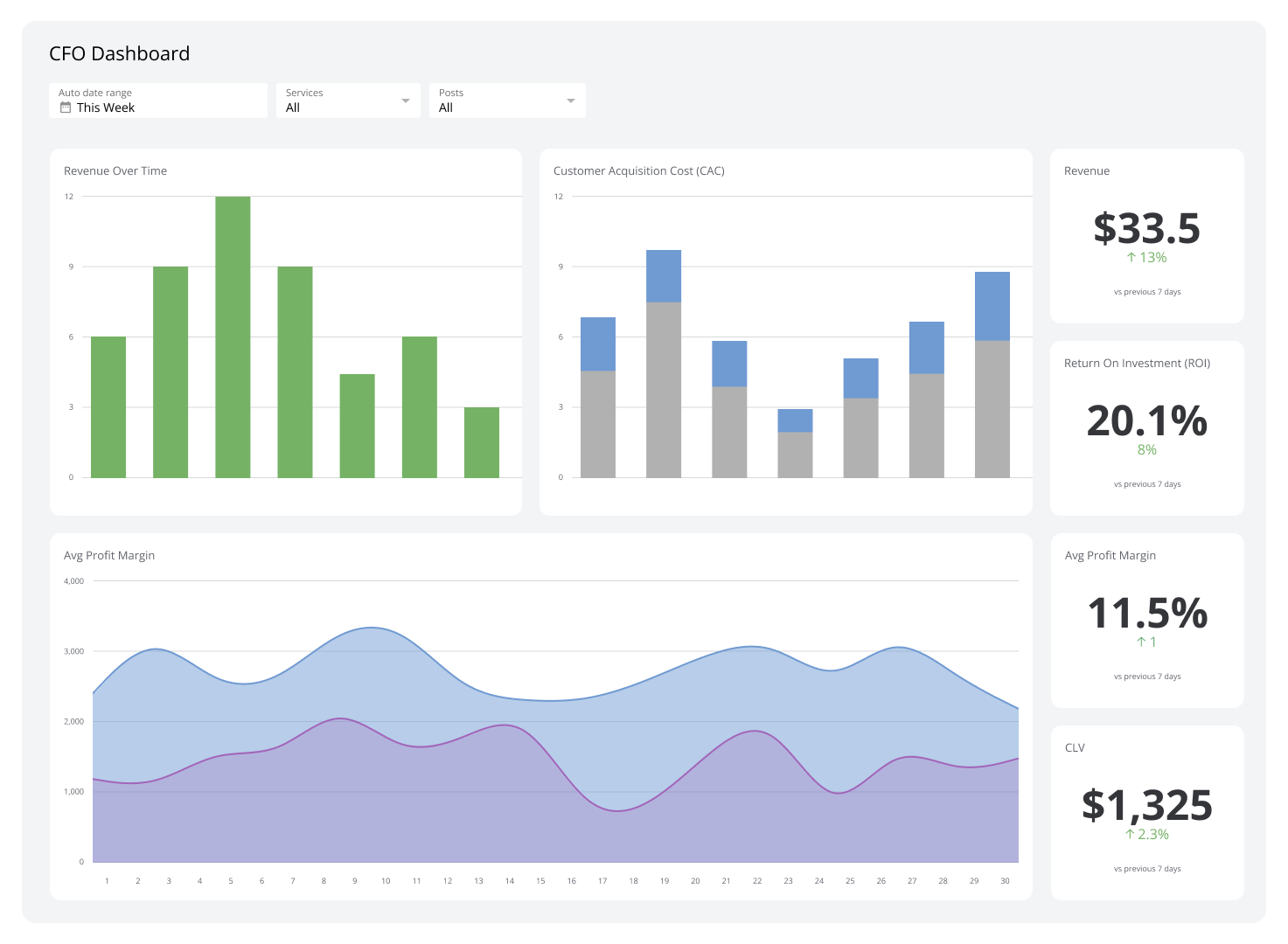
Tracking both together gives you the full picture. Vital financial metrics for a business like Revenue and Profit belong on the same dashboard, reviewed together, not in isolation.
That is exactly where Klipfolio helps. Instead of waiting for someone to pull these numbers or piecing them together from separate reports, you can see Revenue and Profit side by side in real time, updated automatically, and shared with the people who need them. No spreadsheet juggling, no manual exports, no pasting figures into a chat tool and hoping the context lands. Just the numbers, in context, when you need them.