Active User
An active user has registered for your software and engaged with it within a meaningful timeframe. That timeframe matters more than most companies realize.
Active Users
An active user is someone who has registered for your software and engaged with it within a meaningful timeframe. That timeframe matters more than most companies realize.
What is an Active User?
An active user has registered for your software and used it within a timeframe that reflects natural usage patterns for that product. The number tells you how many people are genuinely getting value from what you built.
Most companies default to reporting monthly active users, but that single number can mislead. A tax software user who logs in once a year during filing season is still an active user. Measuring them against a daily-use app creates a false picture of engagement.
The right timeframe depends on what your software does and how people naturally use it.
Common timeframes
Tracking engagement across different windows gives you a more complete view:
- Daily active users (DAU) show you moment-to-moment engagement and help you spot usage patterns, like whether your app gets used primarily on weekdays or weekends.
- Weekly active users (WAU) smooth out daily noise and reveal consistent habits.
- Monthly active users (MAU) give you the broadest view and are most useful for software people return to regularly, but not daily.
Each window answers a different question. The right one depends on your product's natural cadence.
Special cases
Some software follows real-world business cycles. Business tools often see a sharp drop during the Christmas to New Year's week, not because something is wrong, but because business slows down. Trying to push engagement during those periods rarely works and often produces misleading data.
Focus on patterns over extended periods. Short-term dips are normal. Long-term trends are where the signal lives.
Why tracking Active Users matters
Active User data tells you things that revenue numbers alone cannot.
Marketing effectiveness: A spike in active users during a campaign is a clear signal the ads are working. A flat line after heavy spend is a signal to investigate.
Lifetime value signals: If the average user stays active for six months, you have a window to act, such as offering a compelling deal at the five-month mark before they drift away.
Stakeholder confidence: A 20% year-over-year increase in active users is a straightforward, credible growth signal. It lands well with executives and investors because it reflects real behaviour, not just revenue projections.
Product decisions: Knowing when and how people use your software tells you where to invest in features and where to simplify.
This is the kind of number that helps a small team make decisions with confidence, without needing to dig through raw data or wait for someone to pull a report.
Defining an active user for your product
A login alone rarely qualifies someone as active. You need to define what meaningful engagement looks like for your specific software.
A social media platform might count a user as active if they post, react, or view a threshold number of posts. A project management tool might require that a user creates or updates a task. Some products define active users by time spent, regardless of specific actions.
The best definition connects to the core value your software delivers. Ask: what does a user do when they are actually getting something out of this? That behaviour is your benchmark.
Maintaining Active Users honestly
A common trap for SaaS companies is inflating active user counts through short-term behaviour loops, such as push notifications, artificial streaks, or dark patterns that nudge users back without offering real value.
These tactics boost the number temporarily. They rarely improve retention or revenue. Worse, they obscure the real signal: whether people genuinely find your software useful.
The better question is: what value can you offer that makes users want to come back? Build toward that answer and the Active User number will reflect something meaningful.
Segmenting users by activity level
For some products, a single active user metric obscures more than it reveals. Segmenting users by activity level gives you a clearer picture.
Consider a restaurant deals app with three distinct user groups:
- Daily users (20%): Mostly city-based workers finding lunch spots. High frequency, high intent.
- Weekly users (10%): People who eat out regularly but not every day. Consistent patterns, different needs.
- Monthly users (70%): Occasional diners spread across different locations. The majority, but the least frequent.
Counting all three the same way hides meaningful differences. Daily user growth is a different story than monthly user growth. Treating them as one number can make flat daily engagement look like healthy overall growth.
Segment your users by activity level, then track each segment separately. That is where the actionable insight lives.
Create custom dashboards for you and your team.
Get started with KlipsHow to grow your Active User count
There are several reliable ways to increase active users. The most effective approaches focus on genuine value, not just acquisition volume.
Marketing
Consistent marketing brings new users into the funnel, and a percentage of those will stick. Match your channel to your product. A campaign targeting social media influencers makes sense for a consumer app. It rarely makes sense for enterprise software, where decision-makers are found in different places.
Adding features
Software that does more useful things attracts more active users. Expanding what your product can do, especially in ways that address real user needs, gives people more reasons to return.
Feature discovery
Many users never find the features that would make them active. Modals, tooltips, and in-app guidance help users understand what your software can do. A user who invests time learning your product is far more likely to stay active than one who never gets past the basics.
Gamification
Gamification applies game-like mechanics, such as leaderboards, badges, objectives, or levels, to non-game software. When the tone fits the product, these elements motivate users to engage more frequently. The key is matching the mechanic to the context. A playful streak counter works in a fitness app; it may feel out of place in accounting software.
Collecting feedback
In-app feedback surfaces problems you would not find through internal testing alone. Real users interact with your software in ways your team does not anticipate. Acting on that feedback improves the product in ways that matter to the people using it, which leads to higher engagement over time.
Tracking Active Users with a dashboard
Tracking Active Users in a spreadsheet works until it does not. When you are pulling numbers from multiple sources, reconciling data manually, or waiting for someone to compile a report, you are already behind.
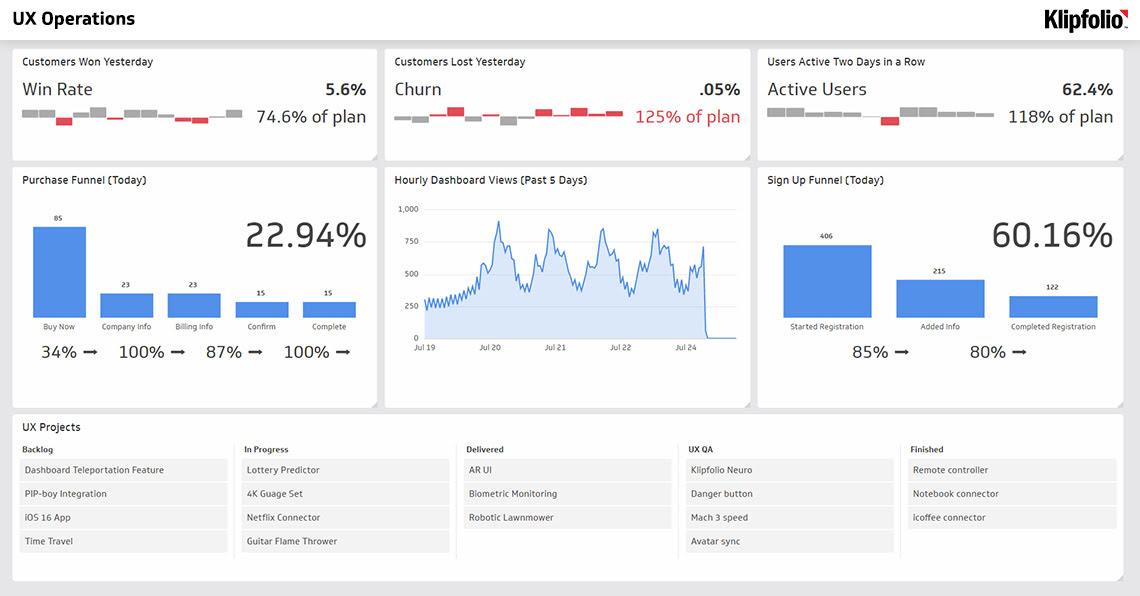
A Klipfolio dashboard connects to your data sources directly and keeps your Active User metrics current, without manual effort. You see your DAU, WAU, and MAU alongside the other numbers that matter, on one screen, updated automatically. No pasting numbers into a spreadsheet. No explaining your business context from scratch every time you need an answer.
Active User data is most useful when it is easy to see and easy to act on. That is what a well-built dashboard gives you.
Wrapping up
Active User is a crucial SaaS metric for any software or app business. It tells you whether people are genuinely engaging with your product, signals the health of your retention, and gives you the foundation for decisions about features, marketing, and pricing.
Define the metric in a way that reflects real value. Segment where it matters. Track it consistently. And make sure the number you are watching actually tells you something true about how your product is performing.