Annual Recurring Revenue (ARR)
Annual Recurring Revenue (ARR) is the total recurring revenue a subscription business expects to collect over a 12-month period, normalized to a yearly figure. Learn how to calculate it, grow it, and track it in real time.
Annual Recurring Revenue
Annual Recurring Revenue (ARR) is the total recurring revenue a subscription business expects to collect over a 12-month period, normalized to a yearly figure.
ARR strips away the noise of one-time charges and mid-year contracts, leaving you with a clean, consistent number that reflects the true run rate of your business. If you run a SaaS company or any subscription-based model, ARR is the metric your investors, board, and leadership team will reach for first.
Explore this vital SaaS metric alongside others that matter for subscription businesses.
What is Annual Recurring Revenue?
Annual Recurring Revenue (ARR) is the recurring revenue a business generates from active subscriptions over 12 months, excluding one-time fees and contracts shorter than one year.
ARR is not simply Monthly Recurring Revenue multiplied by 12, though that shortcut works when your subscription base is stable. The full calculation accounts for expansion revenue from upgrades and add-ons, and subtracts revenue lost to downgrades and cancellations.
How to calculate Annual Recurring Revenue
The ARR formula adds expansion revenue to your base subscription revenue, then subtracts losses from downgrades and cancellations:
ARR = (Annual subscription revenue + Revenue from upgrades and add-ons)
      - Revenue lost from downgrades and cancellations
A worked example
Start with a company charging $100 per month with 500 active subscribers.
Monthly revenue:
$100 × 500 = $50,000
Annualized base ARR:
$50,000 × 12 = $600,000
Now apply the full formula. Assume $200,000 in upgrade and add-on revenue for the year, and $80,000 lost to cancellations and downgrades:
($600,000 + $200,000) - $80,000 = $720,000
ARR for the year: $720,000.
That number tells you what to expect in recurring revenue if nothing changes, and it gives you a baseline to measure growth against.
What to exclude from ARR
Keep the number clean by leaving out:
- One-time setup or onboarding fees: These do not recur and will distort the figure.
- Professional services and consulting: Project-based revenue is not subscription revenue.
- Contracts shorter than one year: These belong in Monthly Recurring Revenue, not ARR.
Why ARR matters
ARR is more than a revenue figure. It is a signal that tells you whether your business is growing, stable, or quietly eroding, without requiring you to dig through raw transaction data.
Revenue forecasting you can trust
A reliable ARR gives you a foundation for financial planning that does not depend on guesswork. When you know your recurring revenue baseline, you can make confident decisions about hiring, spending, and investment without waiting for someone to pull a report. The number is already there.
A metric investors recognize immediately
Investors evaluating subscription businesses look at ARR before almost anything else. It demonstrates revenue predictability, which reduces perceived risk. A growing ARR signals that customers are staying and spending more, which is the story every investor wants to see.
A clear read on customer health
ARR movement tells you something important about customer satisfaction without a survey. When expansion revenue grows, customers are finding more value. When churn and downgrades pull ARR down, something in the experience is not working. You do not need to wait for a quarterly review to know which direction things are heading.
Better budgeting for the year ahead
When your ARR is accurate and up to date, you can allocate resources with confidence. Sales targets, marketing spend, headcount decisions, and product investment all become easier to justify when the revenue baseline is clear and consistent.
How to grow your ARR
Growing ARR comes down to four levers: bring in new subscribers, expand what existing subscribers spend, reduce churn, and keep acquisition costs in check.
Create custom dashboards for you and your team.
Get started with KlipsReduce churn before it compounds
Churn is the fastest way to undermine ARR growth. One percentage point of monthly churn compounds quickly, and recovering lost revenue costs far more than retaining it. When ARR starts declining, the first question to ask is why customers are leaving, not how to replace them.
Look at the patterns: are cancellations concentrated in a particular plan tier, a specific onboarding cohort, or a usage segment? Knowing where churn originates tells you where to act.
Expand revenue from existing customers
Upgrades and add-ons flow directly into your ARR calculation. A customer who moves from a base plan to a higher tier increases your ARR without any new acquisition cost. That makes expansion revenue one of the highest-return activities a subscription business can focus on.
Evaluate your current tier structure. If customers are consistently bumping into the limits of a lower plan, that is a signal to make the upgrade path more visible and more compelling.
Move customers to annual plans
Monthly subscribers introduce more churn risk than annual subscribers. Annual commitments lock in ARR, improve cash flow, and reduce the administrative overhead of monthly renewals. When customers are already happy with your product, the conversation about switching to an annual plan is usually straightforward, especially when there is a meaningful incentive to do so.
Keep Customer Acquisition Cost in proportion
ARR growth means little if the cost of acquiring each subscriber is unsustainable. Track your Customer Acquisition Cost alongside ARR and watch the ratio. If acquisition costs are rising faster than ARR, the underlying unit economics are weakening even when the top-line number looks healthy.
Use a freemium tier to build the top of the funnel
A freemium offering lets potential customers experience your product before committing. When the free experience is genuinely useful, conversion to paid plans follows naturally. The network effect compounds this: users who find value tend to bring others in, turning your customer base into a source of qualified leads.
Invest in the channels that convert
Not all growth channels deliver equal returns. Identify the one or two that consistently bring in subscribers who stay and expand, then concentrate resources there. Common options include:
- SEO and content: Organic traffic from search compounds over time and brings in subscribers with lower acquisition costs.
- Paid search: Useful for capturing high-intent buyers, but requires disciplined tracking of conversion rates and payback periods.
- Cold outreach: Effective when targeting is precise and the message is specific to the recipient's situation.
- Social platforms: Best used to build awareness and trust with an audience that is not yet ready to buy.
Tracking ARR with a dashboard
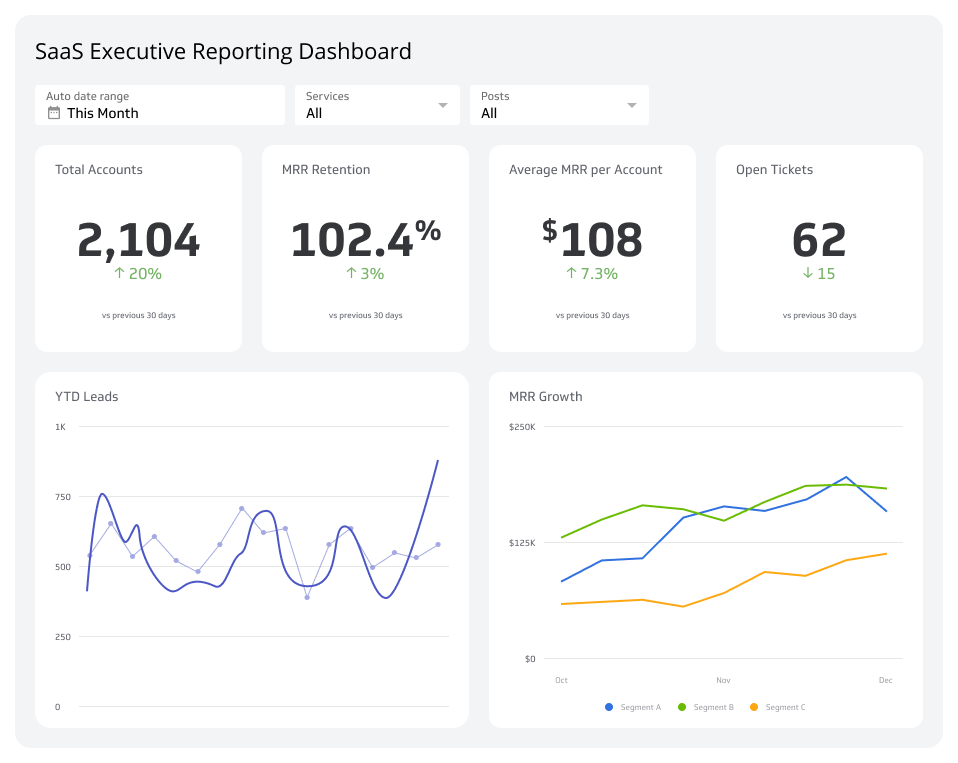
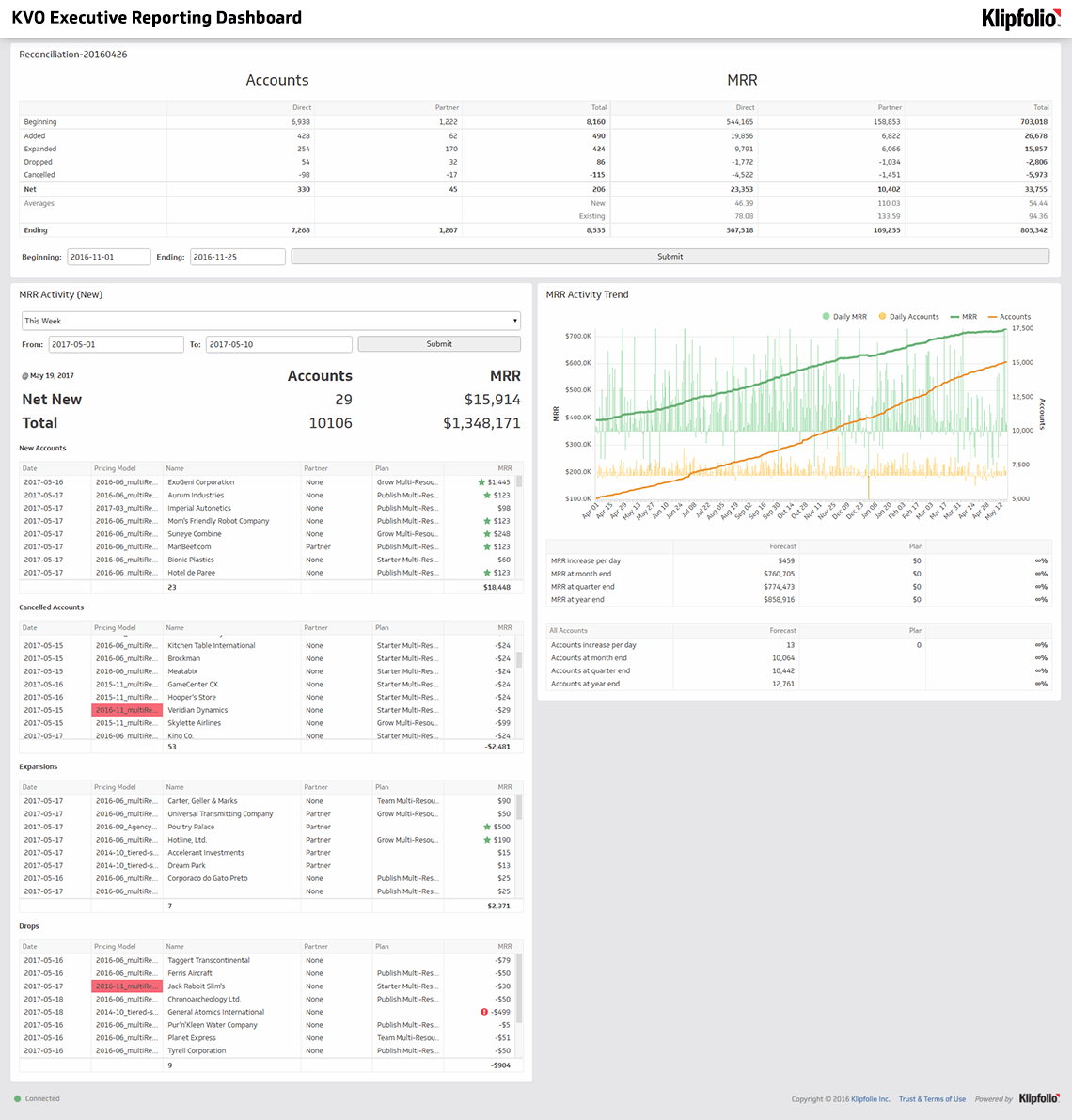
Knowing your ARR is one thing. Knowing it in real time, broken down by plan tier, cohort, or region, is what lets you act on it. A dashboard that pulls subscription data automatically means you are never working from a number that is a week out of date, and you are not waiting for someone to run a calculation before a meeting.
Klips connects to the tools your subscription data already lives in and surfaces ARR alongside the metrics that explain it: churn, expansion revenue, Customer Acquisition Cost, and Monthly Recurring Revenue. The numbers stay current, stay consistent, and stay visible to everyone who needs them.
ARR vs. MRR: which one to use
ARR and Monthly Recurring Revenue (MRR) measure the same underlying business, just at different time scales.
| ARR | MRR | |
|---|---|---|
| Time horizon | 12 months | 1 month |
| Best for | Annual planning, investor reporting, long-term trend | Month-to-month operations, early-stage tracking |
| Typical users | Executives, boards, investors | Finance, revenue operations, growth teams |
| Sensitivity | Smooths short-term fluctuations | Captures changes immediately |
Use ARR when you are communicating the scale and trajectory of the business. Use MRR when you need to catch problems early and move quickly.
Frequently asked questions
What is a good ARR for a SaaS company?
There is no universal benchmark. What matters is the growth rate and the quality of the revenue. Investors typically look for consistent year-over-year ARR growth, low churn, and a healthy ratio of Customer Lifetime Value to Customer Acquisition Cost.
Can ARR be used for non-SaaS businesses?
Yes. Any business with predictable, recurring annual contracts can use ARR, including professional services firms, media companies, and managed service providers.
How often should ARR be reviewed?
Most leadership teams review ARR monthly and report it quarterly. If your business is growing quickly or experiencing churn, more frequent monitoring helps you catch changes before they compound.
What is Net New ARR?
Net New ARR is the change in ARR over a period, accounting for new subscriptions, expansion revenue, and losses from churn and downgrades. It shows whether your ARR is actually growing, not just holding steady.