
How to use metrics to measure sales performance: 20+ sales metrics
Metrics & KPIs for modern sales teams.
Activated New Business Value
Adjusted Trial Rate
Adjusted Trial Rate
32%
vs. 40% unadjusted estimate
Why track sales metrics?
Most leaders already sense when something is off. Revenue feels soft, a deal keeps slipping, a rep seems stuck. Sales metrics turn that instinct into something you can act on. Here is what consistent tracking gives you:
- A clear performance picture. You see exactly where your team stands against targets, without waiting for someone to pull a report or explain the numbers.
- Faster problem-solving. When a metric flags a gap, you know where to look. Poor win rate, long sales cycles, high churn: each one points to a specific fix.
- Better decisions. Whether you are setting next quarter's targets, shifting budget, or deciding which product to push, reliable data makes the call easier to defend.
- Trend awareness. Revenue dips in certain months. Deals close faster in others. Patterns only appear when you track consistently over time.
- Team alignment. When your team can see how their work connects to results, they stay focused and motivated without needing constant check-ins.
20+ sales metrics your team should track
Every stage of the sales process, from first contact to closed deal, generates data worth watching. These are the metrics that matter most.
Total Sales Revenue
Total Sales Revenue is the total income your business generates from all products and services over a set period.
This is the broadest measure of sales health. Multiply the quantity of everything sold by its price to get the number. Without it, you cannot set meaningful targets or know whether your efforts are actually moving the business forward.
Revenue by product or service
This metric shows how much revenue each product or service generates individually.
It tells you what is carrying the business and what is not. Use it to decide where to invest more, where to pull back, and which offerings might need better positioning or a harder look at whether they belong in the portfolio at all.
Monthly Recurring Revenue Growth
Monthly Recurring Revenue (MRR) Growth measures how your predictable monthly income changes from one month to the next.
Formula: (End of month MRR - Start of month MRR) / Start of month MRR × 100
Example: If MRR starts June at $10,000 and ends at $12,000:
MRR Growth = ($12,000 - $10,000) / $10,000 × 100 = 20%
A rising MRR tells you two things: new customers are coming in and existing ones are staying. A flat or falling MRR is a signal worth investigating before it compounds.
Year-Over-Year Growth
Year-Over-Year (YOY) Growth compares total revenue across equivalent periods in consecutive years.
Subtract the prior year's revenue from the current year's, divide by the prior year's, and multiply by 100. This cuts through seasonal noise and gives you a reliable read on whether the business is genuinely growing. Use it to set future targets with more confidence.
Average Revenue per account or customer
This metric shows the average revenue generated by a single customer, account, or product.
It tells you where the business is actually weighted. If most of your revenue comes from a handful of accounts, that concentration is a risk worth knowing about. It also shows you which relationships or products deserve more attention and investment.
Annual Contract Value
Annual Contract Value (ACV) is the average yearly revenue from a multi-year contract.
Formula: Total contract value / Number of years in the contract
Example: A $60,000 contract over three years = $20,000 ACV per year
ACV helps you compare accounts on equal footing and gives you useful context when renegotiating or renewing contracts.
Average Customer Lifetime Value
Average Customer Lifetime Value estimates the total revenue a single customer is likely to generate over the course of their relationship with your business.
A rising Customer Lifetime Value means customers are staying longer and spending more. To calculate it, look at average purchase frequency and average spend per transaction. This metric is one of the clearest signals of whether your product and customer relationships are actually working.
Sales Expense Ratio
Sales Expense Ratio shows how much you spend to generate revenue, expressed as a percentage.
Formula: Operating expenses / Net sales × 100
This keeps your spending honest. You need to spend to grow, but if the ratio is climbing without a matching lift in revenue, something in the acquisition process needs attention.
Market Penetration
Market Penetration measures the share of your target market you have reached.
Formula: Total customers / Target market size × 100
A low percentage is not always a problem; it can mean significant room to grow. But paired with flat revenue, it signals that your go-to-market approach may need rethinking.
Sales Metrics & KPIs
Activated New Business Value
Measure the total revenue value of all new business contracts signed and activated within a specified period.
Adjusted Trial Rate
Adjusted Trial Rate is the percentage of consumers who will try a product after accounting for brand awareness and distribution reach, giving you a realistic picture of trial performance.
Average Profit Margin
Average Profit Margin measures the percentage of revenue that remains as profit after all expenses are deducted, showing how efficiently your business converts sales into profit.
Average Purchase Value
Measure the average dollar amount of each sales transaction using this core sales KPI.
Baseline Sales
Measure the expected volume of sales your business generates without any marketing activity, and use it to separate product strength from marketing lift.
Sales Bookings
Measure the total value of won, signed, or committed sales over a given time period.
Cannibalization Rate
Measure the rate at which new products and offerings impact sales for existing products.
Channel Margin
Measure the profit margin your business earns through each sales channel, expressed as a dollar amount or percentage of channel revenue.
Conversation to Appointment Rate
Measure the percentage of initial sales conversations that result in a scheduled appointment, call, or consult.
Customer Acquisition
Measure how effective your team is at gaining new customers during a specified time period.
First Appointment-to-Sales Ratio
Monitor the percentage of first sales appointments that advance to the proposal stage, and use the trend to coach your team and improve pipeline quality.
Gross Margin Return on Investment
Measure how much gross profit your business earns for every dollar invested in inventory, and whether your inventory is paying for itself.
Leads Generated by Agents
Measure the number of qualified prospects each sales agent brings into your pipeline.
Missed Sales Opportunities
Track and reduce the percentage of qualified leads that go uncontacted, directly protecting your revenue.
Sales Opportunities
Organize prospects by deal value and closing probability to focus effort and forecast revenue with confidence.
Order Frequency
Measure the average number of orders received during a specific time period, such as a day, week, or month.
Orders Cancelled by Reason
Measure the count of orders cancelled within a period, grouped by the specific reason each cancellation occurred.
Percent Closing Ratio
Measure how many sales proposals convert to completed sales.
% Markdown Goods
Measure the share of total sales that come from products with permanently reduced prices, and understand how markdowns affect your revenue mix.
Potential New Clients Contacted
Measure the number of new leads your sales team contacted in a given period, and use outreach volume as a leading indicator of pipeline health.
Potential Revenue in the Sales Pipeline
Measure the total value of all active deals in your pipeline and understand whether your sales effort is sized to hit your revenue targets.
Product-Line Profitability
Measure the total profit a specific product line generates after subtracting all costs to produce and sell it.
Product Performance
Rank products based on revenue performance.
Promotions Conducted
Measure the total number of promotional campaigns run within a defined period to connect promotional activity to revenue outcomes.
Purchase Frequency
Measure how often customers make a purchase within a set time period, and what that tells you about retention and repeat revenue.
Repeat Purchase Volume
Measure the total number of transactions made by returning customers within a defined period to understand loyalty and retention health.
Repurchases of Services Following Project Completion
Measure the percentage of clients who hire you again after a project ends, and what that tells you about service quality, loyalty, and growth.
Percent of Revenue from New Products
Measure the share of total revenue generated by recently launched products and assess whether your innovation investments are paying off.
Revenue Gained from Top Customers
Measure the total revenue contributed by your highest-value customers over a defined period, and use that number to understand concentration risk and prioritize retention.
Sales Revenue per Hour
Sales Revenue per Hour measures the average revenue your business generates for every hour of selling activity, helping you gauge team efficiency and set realistic targets.
Revenue to Average Market Sales Revenue Ratio
Measure how your company's revenue compares to the average revenue of competitors in your market, and use that gap to set smarter targets.
Sales by Contact Method
Monitor which contact methods are most effective at generating sales.
Sales by Department
Measure the total sales revenue generated by each department over a set period.
Sales by Region
Measure the total volume or value of sales generated across geographic areas to identify high-performing markets and allocate resources more precisely.
Sales Closing Ratio
Measure the percentage of formal quotes sent that result in closed deals.
Sales Conversion Rate
Measure of the effectiveness of your sales team at converting leads into new customers.
Sales Cycle Duration
Measure the total time from first contact to closed deal, and use that number to find where your sales process slows down and where it can move faster.
Sales Force Effectiveness
Measure how well your sales team converts effort into revenue, across individual agents, teams, and the overall sales operation.
Sales Growth metric and KPIs
Sales Growth measures your sales team's ability to increase revenue over a fixed period, making it a core indicator for business strategy and forecasting.
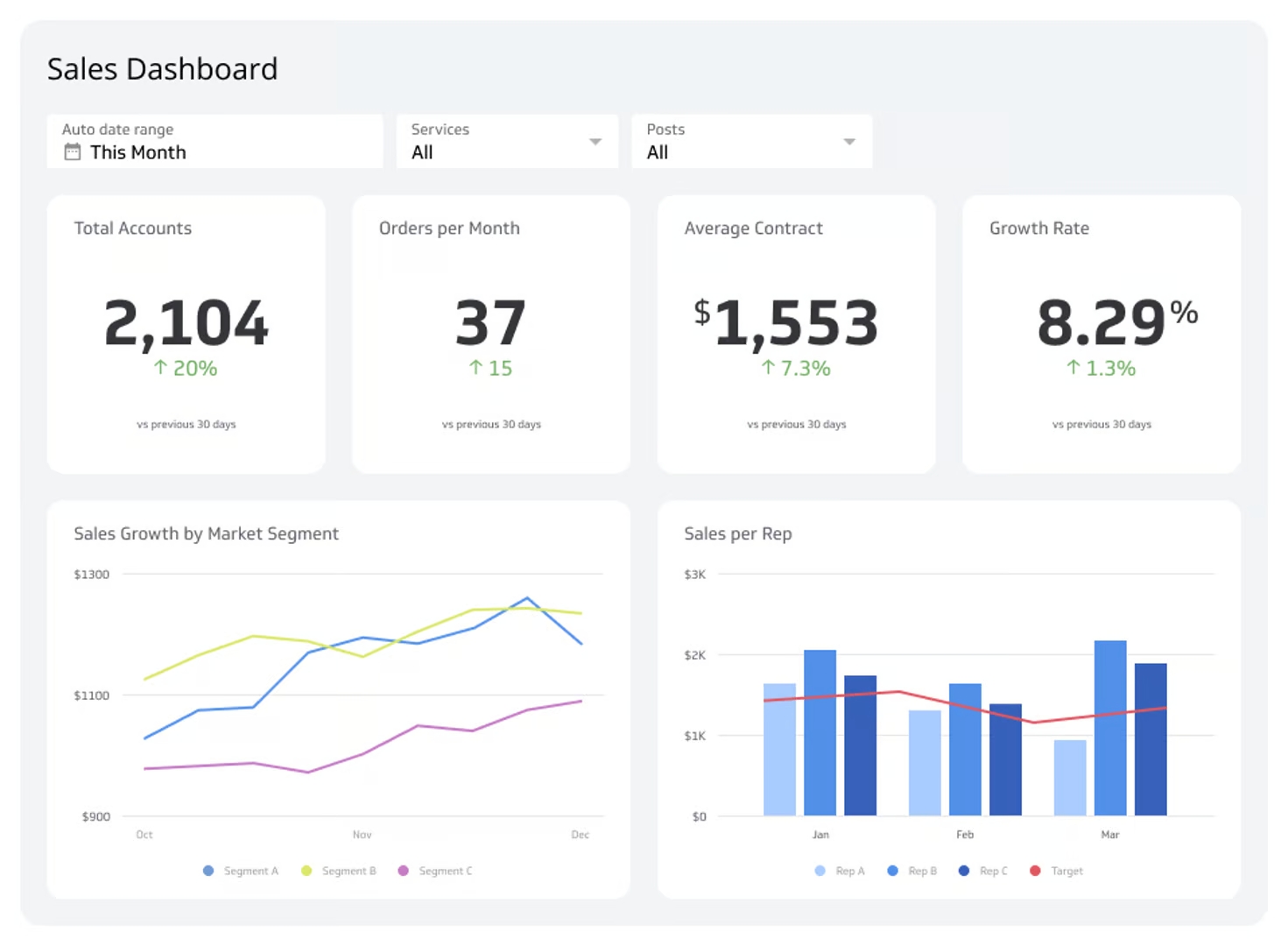
Sales Growth by Market Segment
Measure the percentage change in revenue generated by a specific customer or market segment over a defined period.
Sales Orders Filled per FTE
Measure the average number of sales orders completed per full-time employee over a set period.
Sales Orders Filled per Unit Time
Measure how many sales orders your team completes within a specific timeframe.
Sales per Rep
Measure how much revenue each sales rep or team generates, and use that data to coach, compare, and improve performance over time.
Sales Quota Attainment
Measure the percentage of a sales target achieved by a salesperson or team within a defined time period.
Sales Target
Measure and compare current sales to a target or past performance.
Unit Sales to Average Market Unit Sales
Measure the total share of the market that your company currently holds with their product.
Sales-to-Date
Measure the cumulative value of sales recorded from the start of a defined period up to the current date.
Sales Turnover
Measure the total value of products or services sold within a given period to gauge commercial momentum and revenue performance.
Sales Value Productivity
Measure the average revenue generated by each sales agent on your team.
Sell-Through Rate
Measure the percentage of available inventory sold in a given period to assess supply chain efficiency and product demand.
Selling Costs to Sales Ratio
Measure the percentage of revenue consumed by selling costs and track how efficiently your business converts selling effort into revenue.
Selling Opportunity
Measure the number of unique users that access your store or site.
Store Conversion Rate
Track the percentage of store visits that result in a purchase, and understand how efficiently each location turns traffic into sales.
Tender Win Rate
Measure the percentage of bids or proposals your business wins out of the total number submitted.
Time to Break Even
Measure the amount of time between the launch of a new product, project, or full entity to when it will start making actual profit.
Trial Accounts
Measure the number of open trial accounts.
Customer Effort Score (CES)
Customer Effort Score (CES) measures how much effort a customer puts into interacting with your business. Learn how to calculate it, when to use it, and how to act on the results.
Customer Health Score
Customer Health Score is a composite metric that measures how satisfied, engaged, and likely to stay a customer is, based on behaviour, feedback, and account activity. Tracking it gives you early signals so you can act before problems escalate.
Lead vs. Prospect vs. Sales Opportunity
Leads, prospects, and sales opportunities are three distinct stages in the buying journey, each requiring a different approach from your marketing and sales teams.
Sales Cycle Length
Sales Cycle Length is the average number of days it takes your team to close a deal, from first contact with a prospect to a signed agreement. Track it to forecast revenue, spot bottlenecks, and improve your sales process.
Sales Qualified Lead (SQL)
A Sales Qualified Lead (SQL) is a prospect who has moved through the sales pipeline and shown enough intent that your sales team can focus on converting them into a customer.
Win Rate
Win Rate is the percentage of sales opportunities your team converts into closed deals, calculated over a defined reporting period.
Sales Dashboard Examples
- Sales
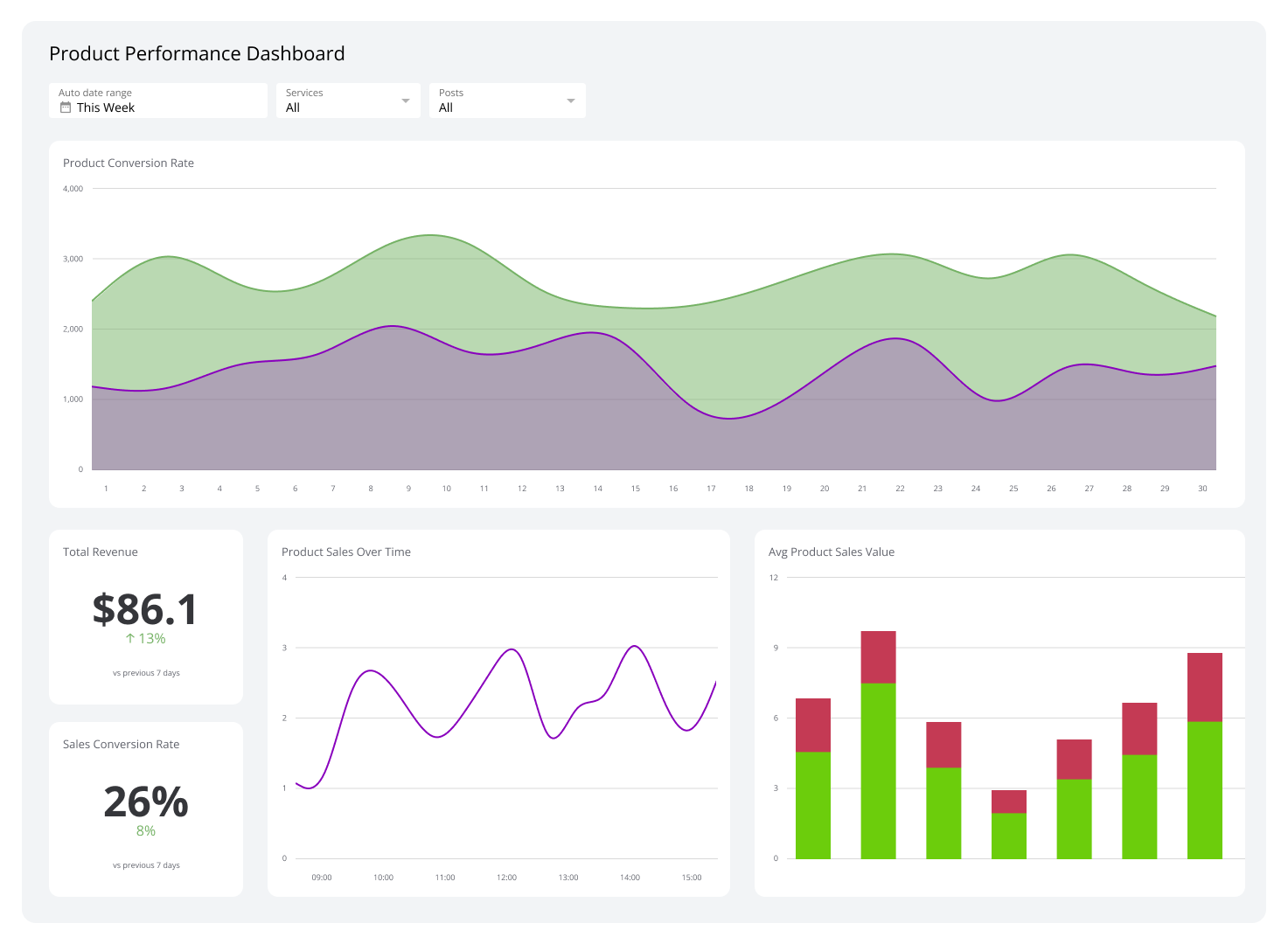
Product Performance Dashboard
See product KPIs in one view so you can make faster, smarter calls.
- Sales
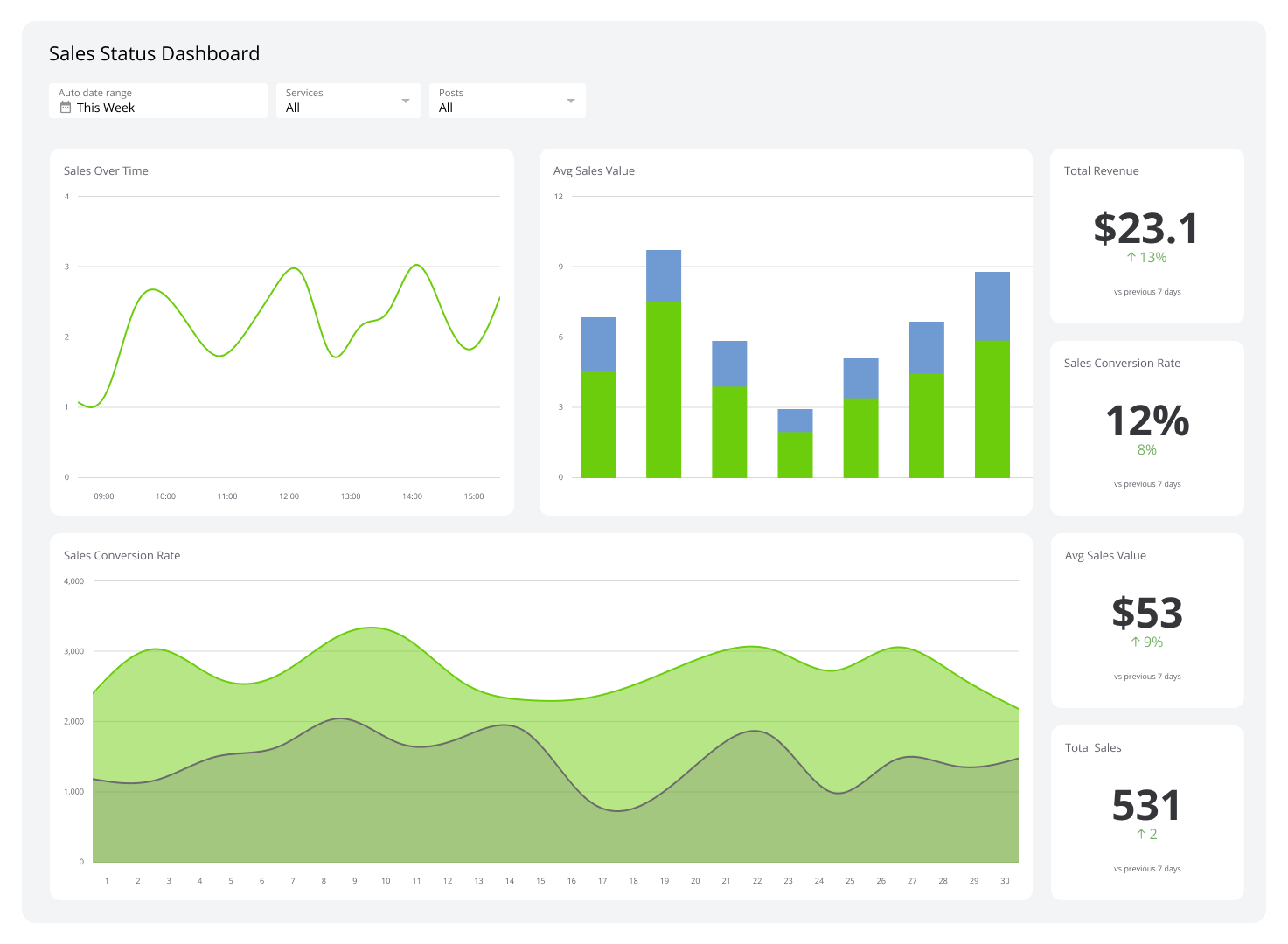
Sales Status Dashboard
Your sales team's performance, visualized in real-time.
- Sales
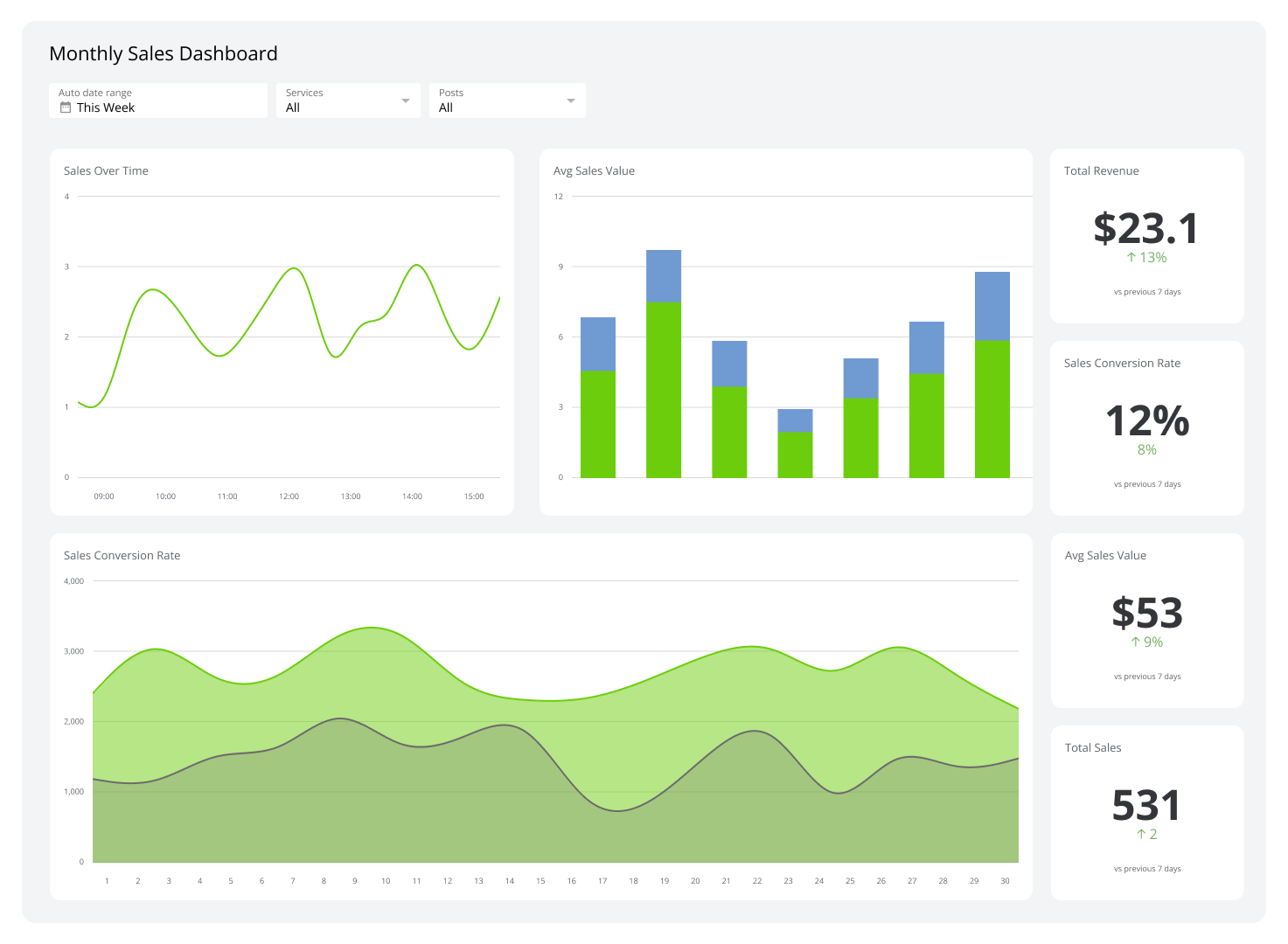
Monthly Sales Dashboard
Track MRR, new accounts, and daily sales in real-time.
- Sales
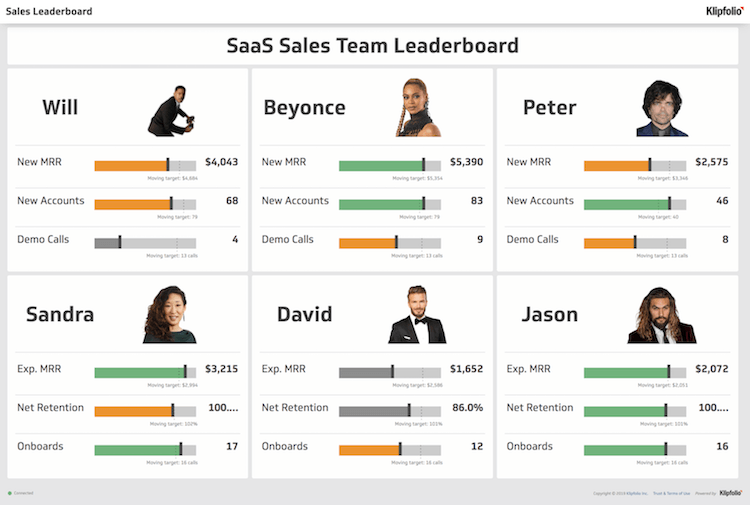
Sales Leaderboard
Track performance, motivate your team, and crush your targets.
- Sales
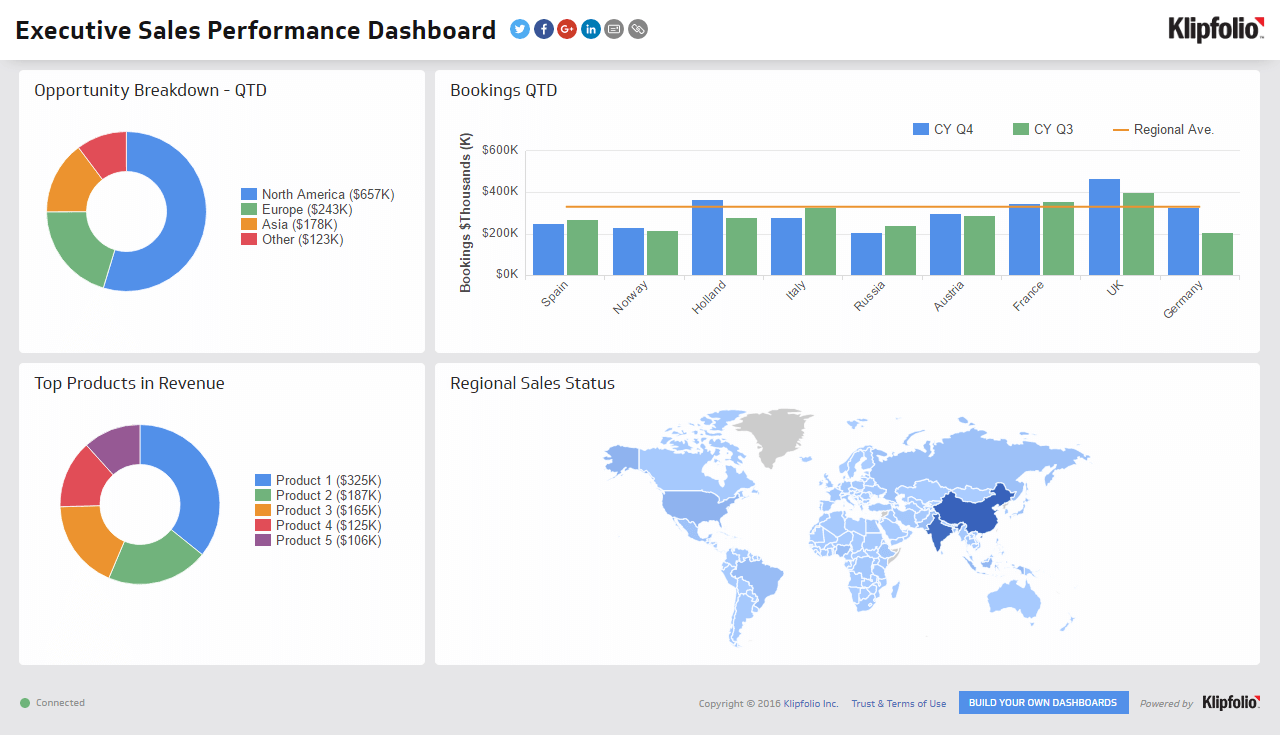
Sales Performance Dashboard
A comprehensive guide to tracking the right metrics and driving revenue with powerful sales dashboards.
- Sales
Sales Pipeline Dashboard
Visualize your sales process, from lead to close.
- Sales
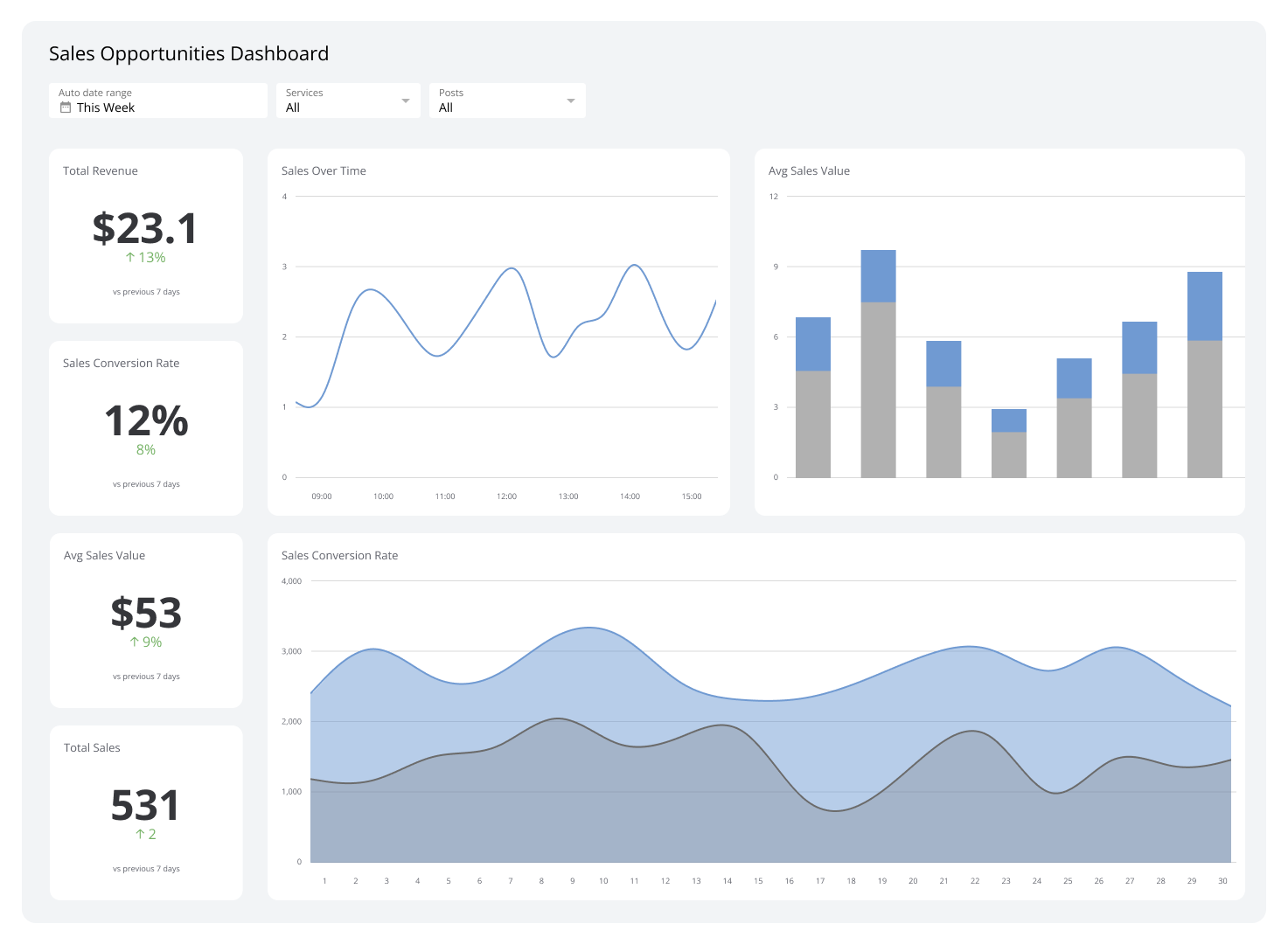
Sales Opportunities Dashboard
Your sales pipeline, visualized in real-time.
- Sales
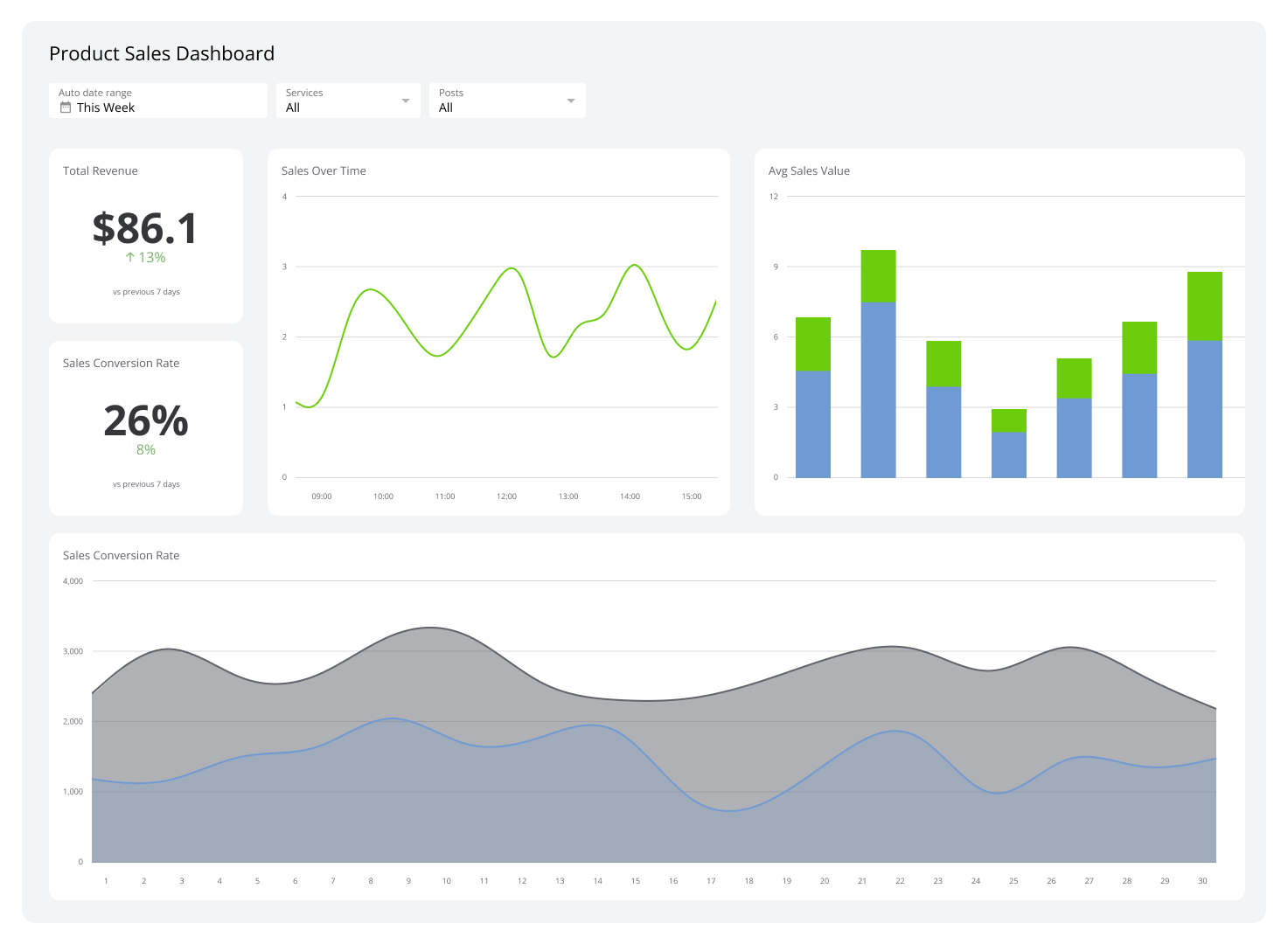
Product Sales Dashboard
See which products are driving your business forward.
- Sales
Sales Activity Dashboard
Track daily sales tasks, improve productivity, and move more deals through the pipeline.
Percentage of revenue from new customers
This metric shows what share of total revenue comes from first-time buyers.
Formula: Sales from new customers / Total revenue × 100
It tells you whether your acquisition efforts are actually contributing to the bottom line, not just adding names to a list.
Percentage of revenue from existing customers
Retaining a customer costs far less than acquiring a new one. This metric shows how much of your revenue comes from repeat sales, cross-sells, and upsells.
Formula: Sales from existing customers / Total revenue × 100
A high number here is a strong signal that your product delivers ongoing value and that your customer relationships are healthy.
Percentage of revenue from new vs. existing customers
Compare your new-customer and existing-customer revenue percentages side by side.
The balance tells you where your growth is actually coming from. Heavy reliance on new customers can mask retention problems. Heavy reliance on existing customers can mask a stalled acquisition engine. Knowing the split helps you decide where to focus.
Net Promoter Score
Net Promoter Score measures customer loyalty by asking how likely customers are to recommend your business to others.
It is a leading indicator of organic growth. Customers who refer others reduce your acquisition costs and tend to have higher lifetime value themselves. A declining Net Promoter Score is often the first warning sign that something in the customer experience has slipped.
Churn rate
Churn rate measures the percentage of customers who cancel or do not renew within a given period.
Formula: Churned customers / Total customers × 100
For any business with recurring revenue, churn is the metric that quietly erodes everything else. Tracking it consistently lets you catch problems before they become expensive.
Create custom dashboards for you and your team.
Get started with KlipsSales Quota Attainment
Sales Quota Attainment measures what percentage of their assigned quota each sales rep has achieved.
It shows you who is performing, who needs support, and whether your quotas are realistic in the first place. If attainment is consistently low across the team, the issue may be the target, not the people.
Average length of a sales cycle
This metric tracks the average time from first contact to closed deal.
The typical stages: prospect, connect, research, present, close. Knowing your average cycle length helps you forecast more accurately and spot where deals tend to stall. A shortening cycle usually means your process is getting sharper. A lengthening one is worth investigating.
Win rate
Win Rate is the percentage of deal opportunities that result in a closed sale.
Formula: Closed deals / Total opportunities × 100
Track this at both the team and individual rep level. A low win rate points to gaps in qualification, pitching, or follow-up. A high win rate with low volume suggests you are not generating enough pipeline.
Deal slippage
Deal slippage measures how many deals fail to close within their forecasted period.
A deal committed for Q1 that pushes to Q2 is a slipped deal. Consistent slippage skews your forecasts and can mask pipeline health problems. Tracking it keeps your projections honest and helps you identify where in the process deals get stuck.
Weighted value of pipeline
This metric assigns a probability-adjusted value to each deal in your pipeline.
Formula: Deal value × Probability of closing
Example: A $10,000 deal at 60% probability = $6,000 weighted value
Summing weighted values across your pipeline gives you a more realistic revenue forecast than counting total deal value at face value. It also shows you which deals deserve the most attention right now.
Tools for tracking sales metrics
The metrics above only create value when you can see them clearly and trust what they are telling you. These are the main categories of tools that make that possible.
Dashboard and data visualization
When your numbers are scattered across spreadsheets, CRM exports, and in-app reports, you spend more time gathering data than acting on it. A dashboard brings everything into one place, updates automatically, and presents the numbers in a format that is easy to read at a glance.
Klips connects to 130+ data sources and lets you build dashboards that surface the metrics that matter most to your team, without needing someone to pull a report every time you have a question. The numbers are always current, always consistent, and visible to everyone who needs them.
Sales automation platforms
Tools like Pipedrive and Salesloft handle the repetitive parts of the sales process: follow-up emails, call scheduling, lead scoring. That frees your reps to spend more time on conversations and deals, and less time on administrative tasks that do not move the needle.
Cloud-based collaboration tools
Tools like Google Workspace, Microsoft Teams, and Slack keep distributed sales teams aligned. Shared documents, real-time updates, and quick communication mean everyone is working from the same information, not different versions of a spreadsheet.
AI-assisted sales tools
Tools like Salesforce Einstein can analyse past interactions and flag which customers are most likely to buy again or which products they might want next. That kind of signal helps reps prioritize their time and make more targeted pitches.
One thing worth noting: pasting numbers into a general-purpose AI tool and asking it to interpret them is not a reliable workflow. The AI has no context about your business, your targets, or what changed last quarter. A dashboard built around your actual data gives you answers you can trust, not a summary that needs to be verified.
How to build sales metrics into your strategy
Having the metrics is only useful if they are connected to how you actually run the business. Here is how to make that connection:
Set clear objectives first. Know what you are trying to achieve before you decide which metrics to watch. Increasing revenue by 20% and improving retention by 10% call for different dashboards.
Choose metrics that match your goals. Not every metric on this list is relevant to every business at every stage. Focus on the ones that directly reflect your current priorities.
Review regularly, not just at quarter-end. Metrics only help if you check them often enough to act. A live dashboard means you do not have to wait for a meeting to know where things stand.
Act on what you see. A metric that flags a problem is only useful if someone does something about it. Build a habit of connecting what the data shows to a specific next step.
Train your team on what matters and why. When reps understand which metrics reflect their work and how those connect to company goals, they stay more focused and engaged.
Stay flexible. If a strategy is not working, the metrics will show it. Be willing to adjust rather than wait out a bad trend.
Ask your team what they are seeing. The people closest to customers often spot problems and opportunities that do not show up in the numbers yet. Combine their feedback with your data.
Review and reset your targets regularly. Goals that made sense six months ago may not reflect where the business is now. Revisit them and adjust.
FAQs
How do you monitor sales performance?
Track metrics like Total Sales Revenue, win rate, and average sales cycle length on a consistent schedule. A dashboard that pulls live data from your CRM and other sources means you always have a current view without waiting for someone to compile a report.
How do I keep track of sales reps?
Monitor Sales Quota Attainment, deal closure rate, and pipeline activity for each rep. Regular one-on-ones grounded in these numbers give you a clear basis for feedback, coaching, and recognizing strong performance.
Why is sales per hour important?
Sales per hour measures how efficiently your team converts time into revenue. It highlights where processes can be tightened and helps you understand whether low output is a capacity problem or a process problem.
How should sales reps spend their time?
On activities that directly move deals forward: prospecting, nurturing qualified leads, presenting proposals, and following up. Sales automation tools handle the repetitive tasks so reps can stay focused on conversations that close.
What is the ideal sales process?
A structured sequence that takes a prospect from first contact to closed deal, typically: prospecting, qualification, needs assessment, solution presentation, objection handling, closing, and follow-up. The best sales processes are customer-focused, adaptable, and reviewed regularly against performance data.