
What are key performance indicators (KPIs)?
A Key Performance Indicator (KPI) is a measurable value that demonstrates how effectively a company is achieving key business objectives. Read our KPI guide to learn the meaning of the term.

Every business defines success differently. KPIs make those definitions visible, measurable, and actionable — so your entire organization can move in the same direction.
What is a key performance indicator?
A key performance indicator (KPI) is a quantifiable measurement that tracks progress toward a specific business objective over a set period of time.
KPIs help businesses set goals (targets), monitor achievement (milestones), and identify areas for improvement. To benchmark progress, you set KPI targets. Organizations typically base their targets on one or more of the following:
Competitor performance: What similar organizations achieve in the same period
Past performance: Your own historical results as a baseline
Pre-determined benchmarks: Industry standards or internally agreed thresholds
KPIs provide targets to aim for, milestones to gauge progress, and insights to guide data-driven decision-making. By monitoring KPIs, organizations can identify areas of strength and weakness and take action to improve performance.
What is the difference between a KPI and a business metric?
Business metrics are the units of measurement used in KPIs. All KPIs use business metrics, but not all business metrics become KPIs. You can designate a metric as a KPI if it is relevant to the organization's goals — or the goals of its functions, processes, locations, and segments.
A sales KPI example: percentage of new inbound leads. You might use lower-level business metrics to measure activities that contribute to gaining those leads, such as unique visitors, page views, or dwell time.
Types of KPIs
You can categorize a KPI within one or more of five types. A KPI's type provides a general idea of its organizational purpose, time frame, and level within the business.
Strategic
Strategic KPIs are monitored at the executive level to measure the organization's overall health. They track progress along organizational goals. Examples include total company revenue, market share, and profit margin.
Operational
Operational KPIs measure the performance of specific organizational processes, locations, and segments. A key characteristic is a focus on shorter timeframes, such as monthly or daily targets.
Operational KPIs typically serve larger-scale strategic KPIs. For example, if a company wanted to increase revenue growth, lower-level managers might analyze sales by region to determine which areas to improve.
Functional
Functional KPIs track progress across specific organizational functions, like finance, sales, marketing, or human resources. Finance teams would likely monitor KPIs like Return on Investment and Profit Margin, while HR would focus on Employee Satisfaction and Retention.
You can classify functional KPIs as either strategic or operational. Revenue Growth, for example, is a popular strategic KPI tied to financial functions. Monthly Sales Growth and Product Performance, on the other hand, make effective operational KPIs.
Lagging and leading KPIs
Another way to classify KPIs is by whether they measure the past or forecast the future.
Lagging KPIs reflect past performance. You use this data to set realistic organizational objectives. An example is monthly recurring revenue — you can use past performance or industry benchmarks to set future targets.
Leading KPIs aim to predict future performance. Progress along a leading KPI correlates to success in achieving a lagging KPI. For example, if you want to increase monthly lead conversions, you would track daily page visits, unique visitors, and session duration as leading indicators.
Benefits of KPIs
KPIs play a crucial role in business success. They align the team on a shared idea of progress, promote action, and create accountability.
Clarifies organizational progress
Without KPI targets, you would struggle to determine whether your organization is moving forward. KPI targets define a standard and measurement for organizational performance.
For example, an end-of-year revenue of $1,000,000 is meaningless without context. Set a target, and that number tells a story. Compared to $800,000 last year, it shows growth. Compared to a $1,500,000 target, it signals a gap in projections or sales execution.
Guides strategic business decision-making
Adding visibility to the organization's successes and failures within a defined objective makes it easier to identify what actions to take next. For example, if you track revenue growth across two sales teams using different strategies, results will show which approach was more effective — and where to apply it next.
Aligns the organization on a shared idea of success
KPI targets ensure the entire team understands the organization's definition of success. They push every member to move in the same direction rather than following varied, self-defined progress indicators. Without sales targets, for instance, your sales team might produce results far below what the business requires.
Creates team accountability
KPIs give teams a benchmark for tracking their own performance. A sales team, for example, can use the company's revenue growth target to create individual sales targets for each member — making expectations clear at every level.
Characteristics of an effective KPI
Not every KPI drives results. Effectiveness hinges on the following characteristics:
Business-aligned
A KPI and its target should align with your business objectives. Increases in specific metrics don't always contribute to business growth. Aiming for more leads, for example, won't benefit a company that lacks the resources to support new customers.
Relevant
Each KPI should be relevant to the function or team that owns it. KPIs like search engine rankings and Customer Acquisition Cost belong with the marketing team — they have the context to act on that data.
Simple
Your KPIs serve as a shared progress marker for the entire organization. They must be easy to measure and understand. "Increase revenue by 20% this year" has a clear goal and target. Team members can determine how to create tasks and projects that impact it.
Measurable
Avoid vague KPIs. "Improve customer relations" lacks an assigned metric. "Increase customer satisfaction" can be measured with surveys, net promoter scores, or customer effort scores.
While most KPIs are quantitative, some — like customer satisfaction and employee engagement — can be qualitative. Measured through surveys or feedback tools, qualitative KPIs can drive more accurate business strategies by surfacing clear, actionable sentiments.
Achievable
Setting unrealistic goals increases the risk of failure and burnout. Use past data to analyze your team's capacity with available resources. To increase monthly sales, check past targets and increase them by a reasonable margin. If you can provide additional support, you can aim higher.
Timely
Effective KPIs are bound within appropriate timeframes. Tracking too infrequently makes it difficult to identify trends. Tracking too frequently wastes time and resources when there are few meaningful changes between reports.
Visible
Ensuring everyone in the organization has access to KPI results increases accountability across teams. It also shows each member whether their efforts are bearing fruit, allowing better strategy and execution.
Visibility helps both strategic and operational KPIs. Operational KPIs add clarity to specific business endeavors. Strategic KPIs help teams see whether collective efforts are working — profit-related KPIs, for instance, can reveal whether the organization is consuming too many resources or whether revenue-generating activities are effective.
How to define a KPI
Defining a KPI requires incorporating the above characteristics while ensuring systems are in place to track progress. The table below outlines the process.
| Question | Answer |
|---|---|
| What is your desired outcome? | Increase revenue by 20% this year. |
| Why does this outcome matter? | The business will become more profitable. |
| How are you going to measure progress? | Monthly revenue, measured in dollars. |
| How can you influence the outcome? | Encourage expansion MRR, move MQLs to SQLs, move opportunities to close, and align marketing and sales. |
| Who is responsible for the business outcome? | Director of Sales. |
| How often will you review progress? | Monthly. |
Identify the desired outcome
Define the strategic objective your KPI will measure. Start by identifying what your business currently needs, then set a timeframe so the team has a reference for mapping out their strategy.
Leading metrics are tracked more frequently because changes within small timeframes help map out trends. Lagging metrics are tracked less regularly because significant changes take longer to appear. If you want to expand your business, Revenue Growth is a natural KPI — it shows whether your product or service is attracting and retaining customers.
Establish the outcome's relevance to the business
Identify how meeting your KPI goals contributes to the well-being and growth of your business. Growing revenue, for example, increases profitability. Excess revenue can fund additional revenue-generating activities or investments that streamline operations.
Set a unit of measurement
If the KPI is quantifiable, identify the unit of measurement that aligns with your goal. A Revenue Growth KPI is simply measured in dollars.
If your KPI is qualitative, identify an effective method of data collection. For employee engagement, ask questions about common motivators — management, work-life balance, pay, and benefits.
Determine how to influence the outcome
Identify the actions that can bring your KPI to its target. Operational KPIs are typically attached to specific day-to-day operations. Strategic KPIs require you to identify which organizational functions can add impact. Increasing Revenue Growth, for example, might involve raising sales targets, running lead conversion campaigns, or tightening the handoff between marketing and sales.
Assign a KPI owner
Assign a KPI owner who can build business strategies from regular progress monitoring. Operational KPIs typically fall under managers heading specific business endeavors; strategic KPIs belong to executives. The best owner for a Revenue Growth KPI is the Sales Lead — that individual has the most valuable insights for generating revenue.
Determine KPI review frequency
Whether your KPI is leading or lagging, regular review is essential. Leading KPIs require frequent review to map patterns and trends. Tracking lagging KPIs semi-regularly helps check progress within the designated timeframe.
If you aim to increase revenue by year-end, tracking monthly gives your strategy room to adapt. You can test different approaches each month and compare performance to determine what works.
KPI examples
Different departments track different KPIs to gauge progress. Below are some of the most common KPI examples per business function.
Marketing KPI examples
Return on Marketing Investment (ROMI)
ROMI compares marketing campaign costs against subsequently generated revenue to calculate the effectiveness of your marketing campaigns. Analyzing ROMI shows which marketing activities work, allowing for efficient resource allocation.
| Who it's for | Marketing managers |
|---|---|
| How often it's needed | Weekly, monthly, quarterly |
Click-Through Rate
The click-through rate compares total ad or page viewers against the total number of clicks for a designated link. It helps measure the effectiveness of ad or content campaigns in capturing attention.
| Who it's for | Marketing managers, web designers |
|---|---|
| How often it's needed | Daily, weekly |
Lead Conversion Rate
The lead conversion rate measures the number of leads that become paying customers. This could be website visits against the number of visitors who completed a desired action, such as a purchase or newsletter sign-up.
| Who it's for | Marketing managers, web designers |
|---|---|
| How often it's needed | Daily, weekly |
Average Time on Page
This KPI tracks the average time a visitor spends on your website. Measuring average time on page helps you determine your website's effectiveness and the likelihood of converting visitors to customers.
| Who it's for | Marketing managers, web designers |
|---|---|
| How often it's needed | Daily, weekly |
Social media reach
Social media reach tracks the number of viewers per post. Higher reach increases opportunities for engagement and conversion.
| Who it's for | Marketing managers, social media teams |
|---|---|
| How often it's needed | Daily, weekly, monthly |
Net Promoter Score (NPS)
The net promoter score asks customers to rate their likelihood of recommending the organization's product or service. It helps gauge the potential for gaining new leads.
| Who it's for | Marketing managers |
|---|---|
| How often it's needed | Weekly, monthly |
Website traffic by source
Website traffic by source tracks where your visitors come from. It helps you determine which channels to engage to attract more leads.
| Who it's for | Marketing managers, social media teams |
|---|---|
| How often it's needed | Weekly, monthly |
Create custom dashboards for you and your team.
Get started with KlipsSales and retail KPI examples
Revenue
Revenue is one of the most common KPIs for sales. It refers to the income gained from selling goods and services.
| Who it's for | Sales directors, sales managers |
|---|---|
| How often it's needed | Daily, weekly, monthly, quarterly |
Sales growth rate
The Sales Growth Rate tracks how much your sales increase over a specific timeframe. Understanding sales growth rates helps you set realistic revenue or sales targets.
| Who it's for | Sales directors, sales managers, sales strategists |
|---|---|
| How often it's needed | Monthly, quarterly, yearly |
Average sales cycle length
The average sales cycle length tracks how long leads transition from initial contact to final sale. Tracking this KPI helps forecast cash flow and identify potential areas for improvement in sales processes.
| Who it's for | Sales directors, sales managers, sales strategists |
|---|---|
| How often it's needed | Weekly, monthly, quarterly |
Sales pipeline value
Sales Pipeline Value estimates the total value the organization can earn from leads and opportunities currently in the pipeline. Because this KPI helps predict future earnings, you can use it for more accurate resource allocation.
| Who it's for | Sales directors, sales managers, sales strategists |
|---|---|
| How often it's needed | Daily, weekly |
Customer retention rate
The customer retention rate tracks the number of existing customers who continue purchasing your products and services. It can help predict revenue or sales growth.
| Who it's for | Sales directors, sales managers, sales strategists |
|---|---|
| How often it's needed | Monthly, quarterly, yearly |
Customer Satisfaction Score (CSAT)
The CSAT uses surveys and other feedback tools to determine how satisfied a customer is with a product, service, or company. It helps predict future customer retention.
| Who it's for | Sales directors, sales managers, sales strategists |
|---|---|
| How often it's needed | Weekly, monthly, quarterly |
Operations KPI examples
Return on Investment (ROI)
ROI measures profit against the cost of a particular investment. It helps you determine the success of an investment.
| Who it's for | Company executives, finance executives, operations managers |
|---|---|
| How often it's needed | Quarterly, yearly |
Overall Equipment Effectiveness (OEE)
OEE uses your machinery's availability, performance, and quality metrics to measure effectiveness and efficiency. It can help you determine where to allocate resources for upgrades or fixes.
| Who it's for | Operations managers |
|---|---|
| How often it's needed | Monthly, quarterly, yearly |
Capacity utilization
Capacity Utilization measures the extent to which you maximize your full production potential. Tracking it shows how much you can increase production without incurring additional costs.
| Who it's for | Operations managers |
|---|---|
| How often it's needed | Daily, weekly, monthly |
Labour productivity
The Labour Productivity KPI tracks the output produced per hour of labour. It helps you determine whether labour processes need refinement to improve efficiency.
| Who it's for | Operations managers |
|---|---|
| How often it's needed | Daily, weekly, monthly |
Cost of Goods Sold (COGS)
COGS refers to the sum of all direct costs involved in producing a sold product. Analyzing what adds to COGS helps you reduce production costs and increase profitability.
| Who it's for | Product managers, product developers |
|---|---|
| How often it's needed | Monthly, quarterly, yearly |
Days in inventory
Days in Inventory tracks the average number of days an organization holds inventory before it is sold. It helps you track when cash will flow into the business.
| Who it's for | Operations teams |
|---|---|
| How often it's needed | Daily, weekly, monthly |
Inventory turnover
Inventory Turnover measures the rate at which you sell, use, or replace stock. It helps gauge sales performance and inventory management effectiveness.
| Who it's for | Operations teams |
|---|---|
| How often it's needed | Daily, weekly, monthly |
Human resources KPI examples
Employee engagement index
Keeping employees engaged ensures they are motivated to work and stay with the organization. You can measure employee engagement through surveys or other feedback tools.
| Who it's for | HR teams |
|---|---|
| How often it's needed | Monthly, quarterly, yearly |
Employee satisfaction index
Employee satisfaction increases the likelihood of employees staying with the organization or recommending it to potential hires. Like employee engagement, it is tracked through surveys and feedback, allowing employees to rate their satisfaction across areas like work-life balance, benefits, and management.
| Who it's for | HR teams |
|---|---|
| How often it's needed | Monthly, quarterly, yearly |
Employee turnover rate
Employee turnover rate measures how many employees exit the company within a given timeframe. It is used to track patterns in turnover causes.
| Who it's for | Company executives, HR teams |
|---|---|
| How often it's needed | Monthly, quarterly |
Project completion rate
The Project Completion Rate tracks the rate at which tasks and projects are completed. It helps identify bottlenecks or inefficient processes.
| Who it's for | HR teams, project managers |
|---|---|
| How often it's needed | Weekly, monthly, quarterly |
Time to hire
Time to Hire measures the length of a hiring process from application to offer acceptance. It is used to identify inefficiencies in the hiring process for reduced downtime and increased candidate satisfaction.
| Who it's for | HR teams |
|---|---|
| How often it's needed | During application periods |
Percentage of cost of the workforce
This KPI measures the cost of the workforce — including compensation packages, training, and support — against the total costs the company incurs. It helps HR teams contextualize the cost of adding benefits or automating gaps in the organization.
| Who it's for | HR teams |
|---|---|
| How often it's needed | Monthly, quarterly, yearly |
Quality of hire
Quality of Hire counts the number of new hires who received strong ratings in performance reviews. It reveals HR's effectiveness at finding quality candidates.
| Who it's for | HR teams |
|---|---|
| How often it's needed | Monthly, quarterly, yearly |
Project management KPI examples
Number of scope change requests
Number of Scope Change Requests monitors uncontrolled growth in a project's scope. These changes typically exceed available resources and time frames. This KPI helps identify problematic changes and keep projects on track. A related KPI is Percentage of Project Budget Allocated to Scope Changes.
| Who it's for | Project managers |
|---|---|
| How often it's needed | Weekly, monthly |
Change requests
This KPI tracks the number of requested changes in a project. Staying on top of change requests helps you add necessary resources, set realistic deadlines, and inform stakeholders — avoiding scope creep.
| Who it's for | Project managers |
|---|---|
| How often it's needed | Daily, weekly, monthly |
Risk exposure
This KPI tracks the cost or impact of potential project risks. It helps project managers craft mitigation strategies.
| Who it's for | Project managers |
|---|---|
| How often it's needed | Daily, weekly, monthly |
On-time completion rate
This KPI measures total tasks against tasks completed within schedule. Tracking On-Time Completion Rate helps you identify inefficiencies or set timeline goals more realistically.
| Who it's for | Project managers |
|---|---|
| How often it's needed | Daily, weekly, monthly |
Team productivity
Team Productivity measures output per team member within a set development period. Tracking this data helps project managers build realistic timelines for future endeavors and identify improvements for effective team management.
| Who it's for | Project managers |
|---|---|
| How often it's needed | Daily, weekly, monthly |
Stakeholder satisfaction
The Stakeholder Satisfaction KPI uses surveys to ask clients, investors, team members, and other stakeholders to rate their satisfaction with the project's output. This measures project success and allows project managers to identify which strategies to carry forward.
| Who it's for | Project managers |
|---|---|
| How often it's needed | Weekly, monthly, per-project |
Project health
The Project Health metric tracks schedule, budget, scope, and quality to evaluate a project's performance against its defined timeline and goals. It helps project managers identify inefficiencies and communicate progress to stakeholders.
| Who it's for | Project managers |
|---|---|
| How often it's needed | Weekly, monthly |
The limitations of KPIs
KPIs are a tool for gauging progress. Unwise use of this tool can hinder your business as much as help it. Below are a few common limitations to keep in mind.
Lack of agility
KPIs represent goals — but goals can change under evolving circumstances. Sticking to KPIs instead of adapting to new realities can set your business back.
For example, you may be focused on acquiring new customers. But if equipment failures force you to scale back operations, your reduced capacity will make it difficult to accommodate the new customers your KPI is designed to attract.
Demotivation
Demotivation most often occurs when organizations set unattainable KPI targets. Employees work without seeing progress, leading to burnout. Reduced motivation then diminishes productivity and work quality.
Misses smaller wins
KPIs can fail to account for smaller wins. Progress that isn't officially measured is still progress — but employees don't receive recognition because it falls outside a KPI. Having systems in place to reward impactful work that doesn't directly move a KPI helps maintain morale and momentum.
Information overload
Stick to the KPIs that align with your organization's needs. Tracking numbers that don't matter wastes resources and labour. Many KPIs also require deeper analysis to become effective. Tracking employee turnover, for example, only tells you how many people leave — the real work is understanding why.
Track your KPIs with Klipfolio
Monitoring KPIs is only valuable when you can see them clearly and share them easily. Klipfolio Klips is customizable KPI dashboard software that connects to 130+ data sources, visualizes progress in real time, and distributes results to your entire team — however they need to see them.
Visit the Klipfolio Business Dashboard page to see what's possible.
Updated 2026-09-08
Continue learning

What are business metrics? Definition and examples

Startup dashboard guide: how Klipfolio tracks every KPI

The CEO's guide to metrics that actually matter
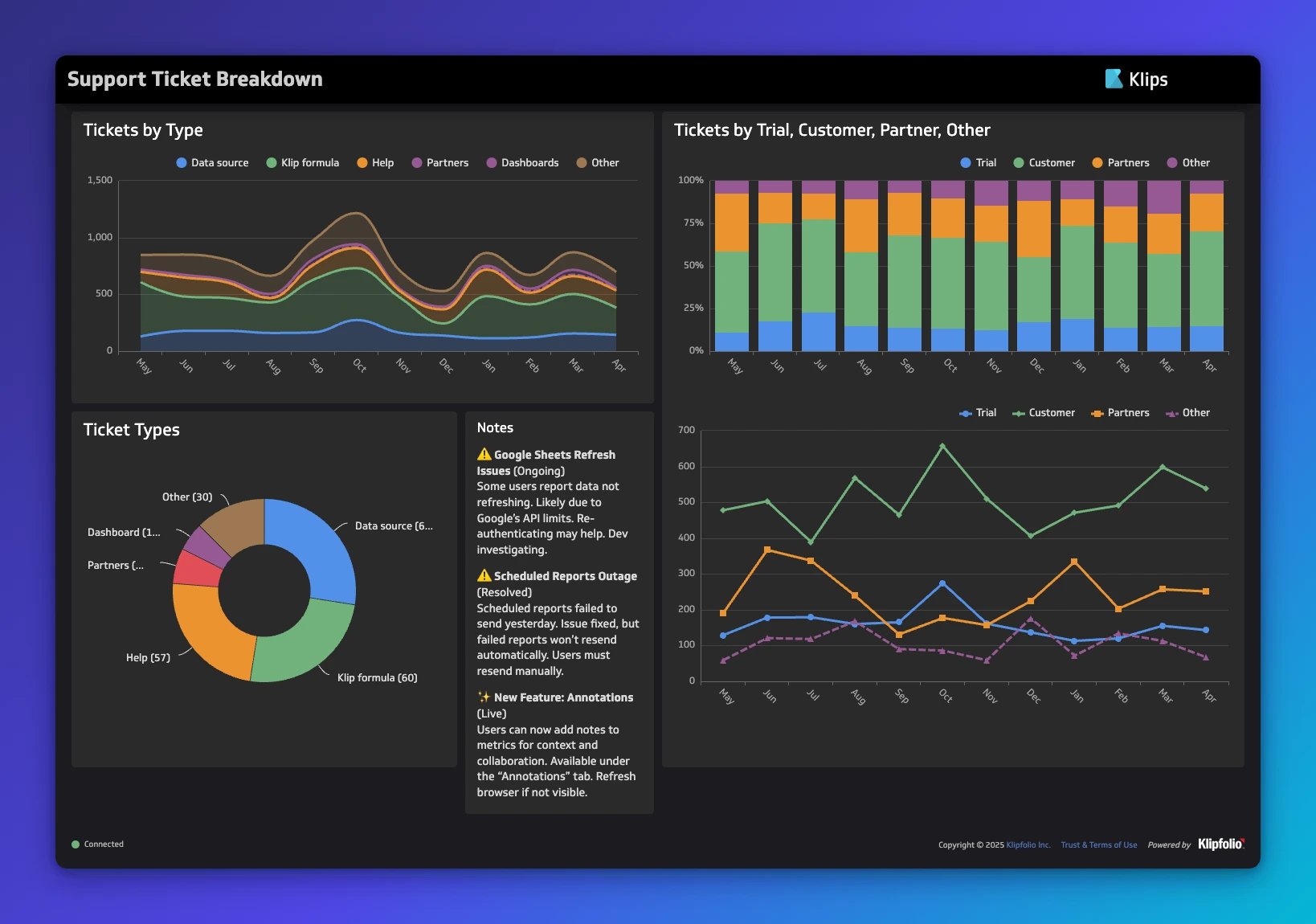
Dashboard design: principles, visualizations, and best practices
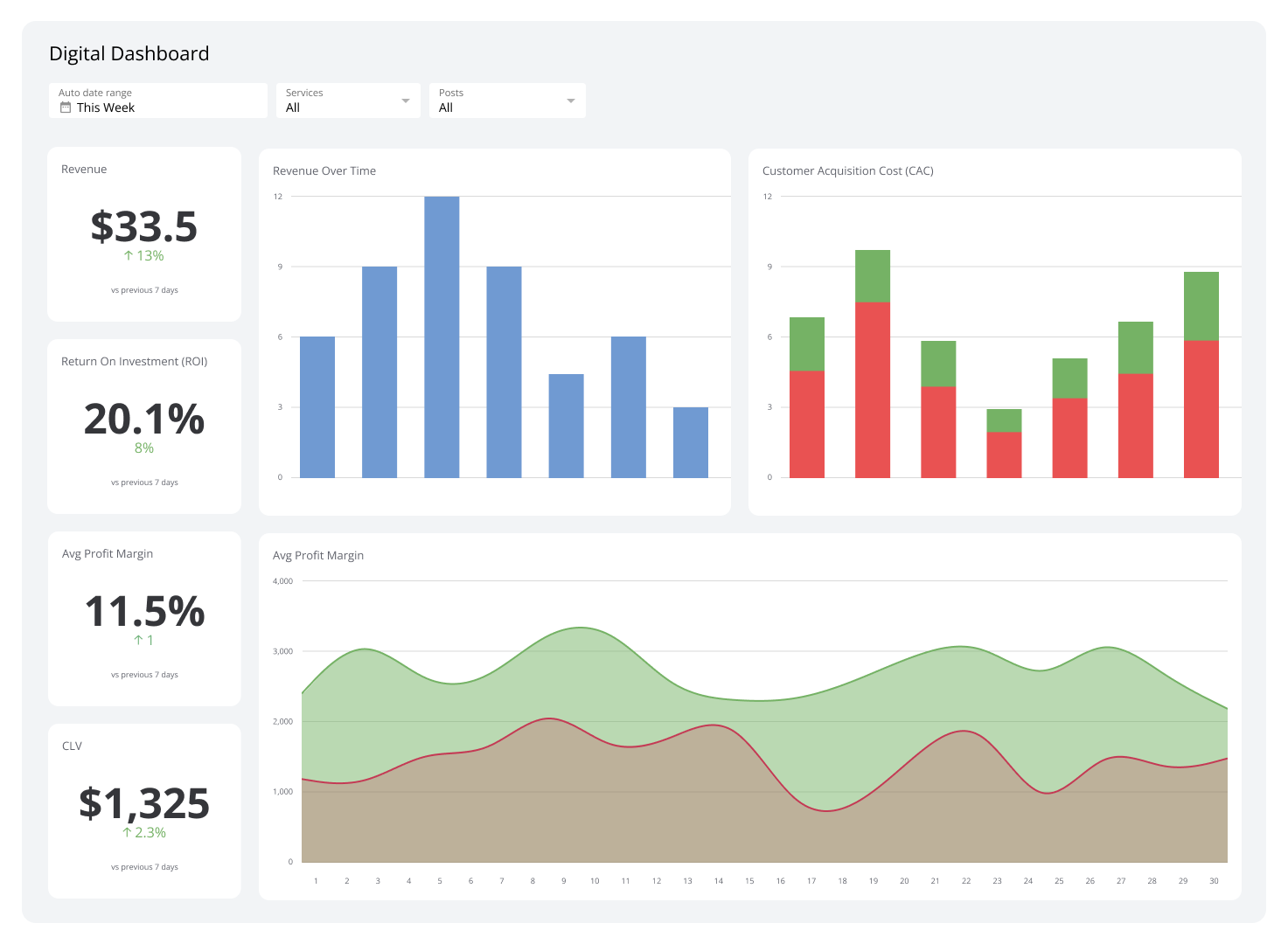
What Is a Dashboard? Types, benefits, and how to build one

The complete guide to NDR and CAC Payback Period
Most recent
- SEP 2310 ways to automate Klips with the Klips API
- SEP 14Automate Klips: from repetitive tasks to managing reporting at scale
- AUG 20The consolidating stack: 3 years of SMB data connection trends
- MAY 28Dashboard Data Security and Privacy: A Five-Layer Framework
- MAR 30The CEO's guide to metrics that actually matter
- NOV 10Project Management Dashboard: Guide to KPIs and Examples